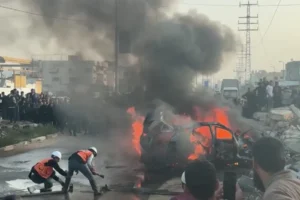
TEHRAN – A fire broke out on two commercial vessels following a US-Israeli strike targeting a dock in the southern Iranian city of Bandar Lengeh in Hormozgan province, Iranian semi-official Mehr news agency reported Saturday. One person was injured in the resulting fires, which rescue teams and maritime authorities are continuing to bring under control.
The attack on the dock in Bandar Lengeh marks the latest escalation in the six-week-old US-Israeli war on Iran, which has seen strikes expand from military and nuclear infrastructure to commercial and civilian targets. The vessels struck were owned by locals, according to the Mehr report.
Rescue teams and maritime authorities are continuing efforts to bring the fires under control, the report added, without providing further details on the extent of the damage or the type of vessels involved.
Expanding Target Scope
The strike on commercial vessels in Bandar Lengeh represents a significant expansion of the US-Israeli targeting criteria. While previous strikes have focused on military installations, nuclear facilities, energy infrastructure, and industrial sites, the attack on a dock and commercial shipping suggests that no sector of Iran’s economy or infrastructure is off-limits.
Bandar Lengeh is a port city on the Persian Gulf coast, located approximately 200 kilometers west of the Strait of Hormuz. The strike adds to the growing list of attacks on Iranian ports and maritime infrastructure, following earlier strikes on Shahid Haghani Port in Bandar Abbas.
Regional Maritime Disruption
The attack comes as the Strait of Hormuz remains effectively closed, with Iran asserting control over the vital waterway through which approximately 20 percent of global oil passes. Iran has attacked multiple vessels attempting to transit the strait, while US and Israeli forces have struck Iranian ports and naval assets.
The targeting of commercial vessels in a port adds a new dimension to the maritime conflict. While previous Iranian attacks have targeted vessels in transit, the US-Israeli strike hit vessels at dock, raising questions about the safety of commercial shipping in Iranian ports.
Six Weeks of Conflict
The US and Israel launched their air offensive against Iran on February 28, a conflict that has now entered its sixth week. More than 1,340 people have been killed in Iran, according to Iranian figures, including former Supreme Leader Ayatollah Ali Khamenei. Iranian strikes have targeted Israel and Gulf states hosting US military assets, causing casualties and infrastructure damage.
The conflict has spread across the region, with Iran-aligned Houthis in Yemen entering the war, and Israeli strikes in Lebanon displacing more than one million people. The closure of the Strait of Hormuz has driven global oil prices above $100 a barrel, with economic ripple effects felt worldwide.
Humanitarian and Environmental Concerns
The fires on the commercial vessels raise potential environmental concerns. Depending on the type of vessels and their cargo, the fires could release pollutants into the Persian Gulf, affecting marine life and coastal communities. Rescue teams are working to contain the fires and prevent further damage.
No Sector Is Safe
The US-Israeli strike on a dock in Bandar Lengeh, targeting commercial vessels owned by locals, signals that no sector of Iran’s infrastructure is safe from attack. What began as a campaign against military and nuclear targets has expanded to include energy infrastructure, industrial sites, and now commercial shipping.
For Iran, the strike is both a military setback and a propaganda opportunity. The targeting of commercial vessels and civilian infrastructure allows Tehran to frame the conflict as an attack on ordinary Iranians, potentially strengthening domestic support for the regime.
For the United States and Israel, the strike continues the pattern of expanding target sets in an effort to pressure Tehran into a negotiated settlement. But with each new category of targets—bridges, power plants, commercial docks—the risk of civilian casualties and unintended consequences grows.
As the conflict enters its sixth week, with no end in sight, the targeting of commercial vessels in a port represents another dangerous escalation. The question now is not whether the war will expand further, but what new red lines will be crossed next.