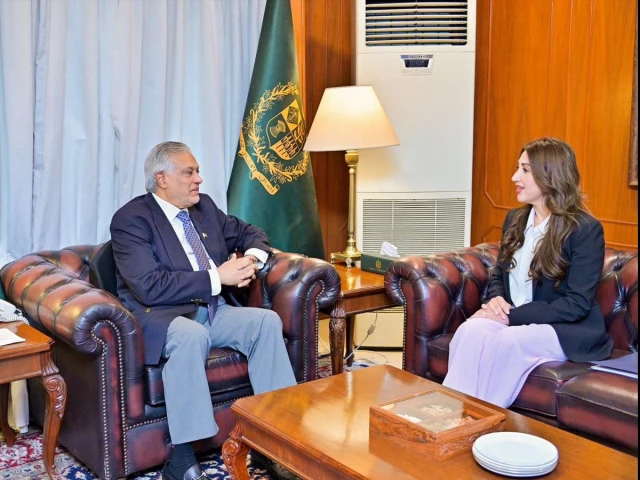
ISLAMABAD: Ishaq Dar has appreciated the United States’ assistance in facilitating the repatriation of Pakistani and Iranian seafarers during a meeting with US Chargé d’Affaires Natalie Baker in Islamabad, according to a statement issued by the Foreign Office.
The meeting focused on the evolving regional situation, Pakistan-US relations, and ongoing diplomatic coordination aimed at addressing humanitarian and maritime issues linked to recent tensions in the Middle East.
According to the Foreign Office (FO), both sides exchanged views on regional developments and discussed Pakistan’s continued diplomatic engagement to support peace efforts between the United States and Iran.
FM Dar highlighted Pakistan’s role in facilitating communication between Washington and Tehran, stressing that Islamabad remains committed to encouraging dialogue and stability in the region.
“FM Dar highlighted Pakistan’s role in facilitating communication between the US and Iran, while expressing hope that the ongoing diplomatic efforts would contribute to peace and stability in the region and beyond,” the FO statement said.
The minister also expressed gratitude for US cooperation in the repatriation process of seafarers who were stranded following recent maritime enforcement actions near Southeast Asian waters.
Last week, Pakistan had formally requested assistance from Singapore to help ensure the safe return of 11 Pakistani and 20 Iranian seafarers aboard vessels reportedly seized by US authorities and located near Singapore’s maritime zone.
Dar had also confirmed coordination with Iranian Foreign Minister Abbas Araghchi, stating that Pakistan was working closely with Iran to ensure the safe return of affected nationals.
He further indicated that Islamabad was prepared to facilitate the return of Iranian citizens through Pakistan if required, underscoring the humanitarian nature of the effort.
Earlier, Pakistan also helped facilitate the transfer of 22 Iranian crew members from the container vessel MV Touska, which had been seized in a separate incident involving US authorities.
Diplomatic sources say Pakistan’s role in the repatriation efforts has been part of its broader attempt to act as a mediator in regional tensions, particularly between Washington and Tehran amid ongoing geopolitical friction in the Gulf region.
During the meeting, FM Dar reiterated Pakistan’s commitment to supporting humanitarian solutions and ensuring the safety of civilians affected by maritime and security disputes.
The Foreign Office noted that discussions also covered the wider Pakistan-US relationship, with both sides acknowledging the importance of continued engagement on regional peace and security.
In a separate development, FM Dar also held discussions with Faisal bin Farhan Al Saud, during which both leaders reviewed the regional situation and ongoing diplomatic efforts related to the US-Iran dialogue process.
The Saudi foreign minister reportedly appreciated Pakistan’s constructive diplomatic role and reiterated support for Islamabad’s efforts to promote regional peace and stability.
Both sides also stressed the importance of ensuring maritime security, particularly in sensitive shipping routes such as the Strait of Hormuz, which has become a key focus amid ongoing regional tensions.
Additionally, FM Dar met with Jean Arnault, where he discussed the latest developments in the Middle East conflict and Pakistan’s diplomatic engagement with relevant stakeholders.
According to the Foreign Office, Arnault conveyed the United Nations’ appreciation for Pakistan’s continued diplomatic efforts aimed at promoting peace and regional stability.
He also reaffirmed the UN’s support for Pakistan’s constructive role in facilitating dialogue and reducing tensions in the region.
FM Dar, in response, expressed gratitude for the UN Secretary-General’s consistent engagement and support for Pakistan’s peace-oriented initiatives.
Pakistan has in recent months positioned itself as an active diplomatic facilitator, engaging with multiple countries including the United States, Iran, Saudi Arabia, and international organisations in an effort to reduce regional tensions and support humanitarian coordination.