NEW YORK — Yasmen Almashan lost five of her six brothers during the early years of the Syrian civil war. Four of them died in 2012 alone.
Zouhair was killed during protests against the Assad regime. Oqba was detained by security forces and disappeared. Obaida, working as a medic trying to rescue wounded civilians from rubble, was killed by a sniper. Another sniper took Tishreen. In mid-2014, the youngest brother, Bashar, was kidnapped by the Islamic State group. She never heard from him again.
“I’m the only girl among six brothers, and suddenly I lost five of them,” Almashan explained, standing outside the United Nations headquarters. “All the time before I lost them, they surrounded me with all the love you can imagine. I feel that my duty now is to fight for justice for them.”
When a military defector code-named Caesar smuggled thousands of photographs out of Syria documenting regime atrocities, Almashan recognized her brother Oqba among the images of tortured corpses.
She co-founded the Caesar Families Association and worked with other groups of survivors and families to seek justice for those who disappeared in Syria. From the start of the civil war in 2011 to the fall of the Assad regime, more than 180,000 people went missing, according to the Syrian Network for Human Rights.
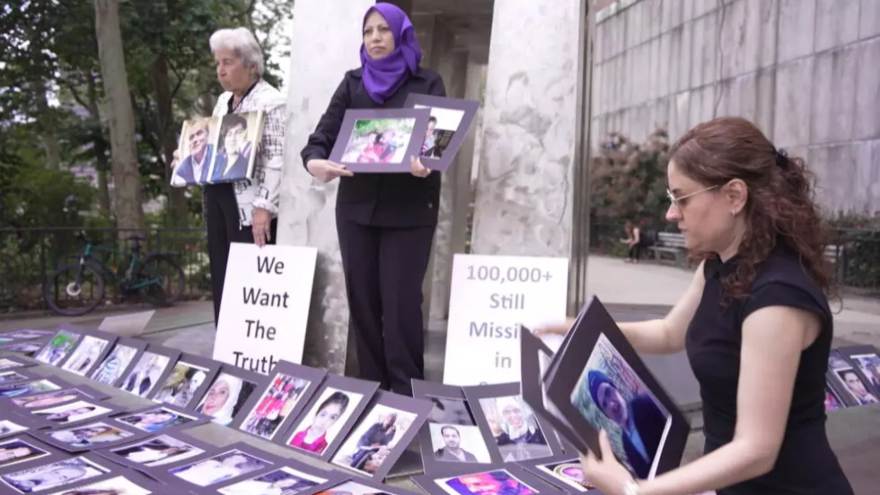
FRANCE 24 first met Almashan in 2023, when she came to lobby for the creation of an international foundation for the disappeared. Quiet and resolute, she stood outside the United Nations in protest, holding photos of civilians who went missing under the regime.
A New Role
Fifteen months after the fall of the Assad regime, Almashan is back at the United Nations—only this time in an official role as a commissioner for Syria’s National Commission for Transitional Justice.
At a side event called “Advances in Transitional Justice and Access to Justice in Syria” at German House in New York on Thursday, she spoke alongside two other Syrian human rights activists who also serve on the governmental body tasked with addressing past human rights violations, ensuring accountability, and supporting national reconciliation.
“Ten years ago I was just a woman in a tent in a refugee camp in Turkey,” she told the gathering. “We fought to reach a point where we are decision-makers in our beloved Syria.”
From Activist to Ambassador
Syria’s Ambassador to the United Nations, Ibrahim Olabi, followed a similar trajectory. A former human rights defender, he founded the Syrian Legal Development Programme, which offered legal expertise to Syrian NGOs on issues related to forced displacement, torture, and humanitarian aid delivery. Now he represents his country at the UN.
“I feel that it’s part of all of our healing to be in the positions we’re in now—we’re able, we’re in the driving seat,” Olabi said.
A New Syria
Forces loyal to Syria’s transitional president Ahmed al-Sharaa overthrew the Assad regime in December 2024. Once the head of an armed Islamist group, Hayat Tahrir al-Sham—which was only removed from the US list of terrorist groups in July 2025—Sharaa has worked to project a more moderate image since taking power.
Although the war has ended, sporadic sectarian violence continues. Hundreds have died in clashes between Druze and Sunni Bedouin communities and government forces, with targeted violence against the Alawite community also reported.
The Kurdish community has accused Sharaa of complicity in the genocide of Yazidi Kurds in 2014, filing a complaint with Germany’s federal public prosecutor’s office in October 2025. He denies the accusations.
“The president himself has made it clear that he was not involved and that this commission is independent and will investigate any crimes relevant to the Assad era,” Ambassador Olabi told FRANCE 24. “It is the [Sharaa] government that enabled this national commission and appointed people like Yasmen to work on accountability and human rights.”
Learning from History
Germany’s deputy ambassador to the UN, Dr. Thomas Zahneisen, hosted the side event, which included experts on the rule of law and sexual violence. He spoke of Germany’s own long journey of national reconciliation and reunification.
“It is a difficult path by experience. Yes, there are successes, but also a lot of setbacks,” Zahneisen explained. “It takes a long time.”
Zahneisen noted that Syria’s National Commission for Transitional Justice had recently visited the archives of the Stasi, the feared security forces of former East Germany that repressed and intimidated the population during the Cold War. He added that UN mechanisms were playing an important role in supporting this process.
Colombia’s deputy ambassador, Raul Sanchez, also shared his country’s experience in addressing past crimes to establish accountability and social cohesion.
The Road Ahead
“It’s a remarkable time for transitional justice in Syria, because everything is possible and everything is at risk,” explained Crisis Action’s UN Director, Gareth Sweeney. “The commissions are blessed to have people like Yasmen, who have phenomenal integrity. They speak a truth that Syrians can see and feel. But the challenges they face are obvious to us all, in terms of resourcing and having to operate and build justice and accountability in a country that is having, itself, to rebuild.”
After the meeting at German House, Almashan headed to Syria’s UN mission, a block from the main UN building, to meet the delegation ahead of iftar, the fast-breaking evening meal during Ramadan. The building bears no obvious marking other than a sign reading “Diplomat Centre,” but for her, it symbolizes the regime under which her brothers died.
She gets the shivers as she enters. But she remains hopeful that eventually, reconciliation is possible.