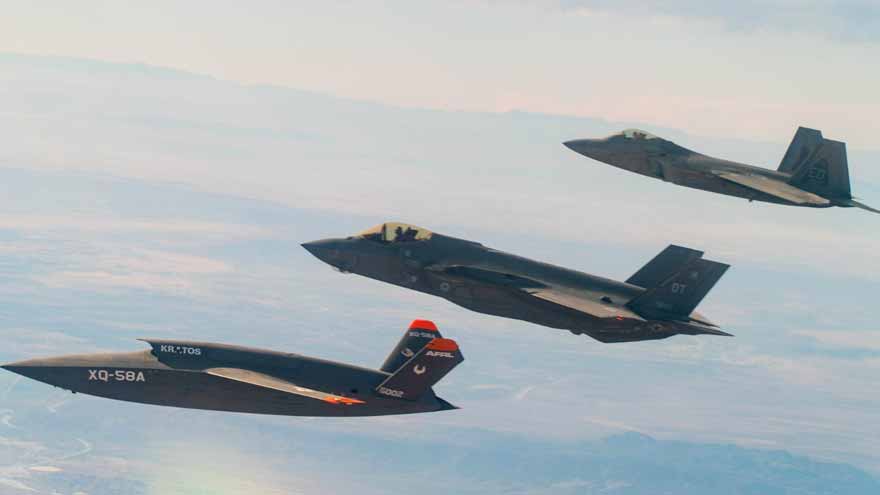
WASHINGTON — The balance of power in modern air warfare is undergoing a fundamental shift as low-cost drones challenge the dominance of advanced, expensive military aircraft, forcing the United States to rethink its strategy in ongoing operations linked to Iran.
For decades, air superiority belonged to nations with the financial and technological capacity to deploy sophisticated fighter jets such as the F-35 Lightning II and F-22 Raptor. However, the emergence of inexpensive unmanned aerial systems is beginning to erode that advantage, enabling smaller or less wealthy actors to inflict significant damage at a fraction of the cost.
Operation Epic Fury
As part of what US officials describe as “Operation Epic Fury,” Washington has deployed a wide array of military assets in its conflict with Iran, including fighter jets, bombers, and surveillance aircraft. High-end platforms such as the B-2 Spirit and F-15 Eagle are being used alongside unmanned systems like the MQ-9 Reaper.
While these aircraft provide unmatched precision and capability, they also come with immense operational and financial costs. An F-35 costs approximately $80 million per unit, with operational expenses adding millions more annually. Pilot training requires years and millions of dollars per individual.
Iran’s Drone Strategy
In contrast, Iran has increasingly relied on mass-produced drones such as the Shahed-136, designed as one-way attack systems that detonate upon impact. These drones are remarkably cheap, with estimated production costs ranging between $20,000 and $50,000 per unit.
Their effectiveness lies not in precision but in volume—launched in large numbers to overwhelm air defense systems. Since late February, Iran has reportedly launched hundreds of missiles and over 1,000 drones targeting Israel and US-aligned Gulf states.
Analysts say Tehran has the capacity to produce up to 10,000 drones per month, highlighting a strategic shift toward scalable, cost-effective warfare that prioritizes quantity over individual platform sophistication.
The Math of Defense
The economic imbalance between attack and defense has become a growing concern for military planners. A single interceptor from systems like the Patriot missile battery can cost around $4 million—enough to produce over 100 low-cost Shahed drones. This disparity means that defending against drone swarms can quickly become financially unsustainable.
The challenge is not merely monetary. Advanced aircraft require years of pilot training and extensive maintenance. If such an aircraft is lost, it represents not only a significant financial blow but also the potential loss of highly trained personnel. Drones, operated remotely, reduce risk to human life and allow for rapid replacement.
Adapting the Strategy
The United States is now attempting to adapt. New systems like the FLM-136 LUCAS have been fast-tracked to counter the growing drone threat. Notably, the LUCAS drone closely resembles the Shahed-136 in both design and function, signaling a shift toward embracing similar low-cost technologies rather than relying exclusively on high-end platforms.
Military planners are also developing countermeasures including electronic jamming systems, interceptor drones, and high-energy laser weapons. While promising, many of these technologies remain in early stages and face limitations in range, power, and scalability.
Lessons from Ukraine
This transformation in warfare has already been observed in other conflicts, particularly in Ukraine, where drones are believed to account for a significant proportion of battlefield casualties. The trend underscores how unmanned systems are reshaping combat by enabling remote strikes and reducing reliance on traditional military hardware.
Both state and non-state actors have observed these developments, recognizing that drone swarms can potentially neutralize advantages that took decades and billions of dollars to build.
The New Calculus
As drone technology continues to evolve, military experts warn that the cost dynamics of warfare are being fundamentally altered. The ability to produce large numbers of inexpensive attack drones is not only lowering the barrier to entry for air power but also exposing vulnerabilities in even the most advanced defense systems.
For the United States, the Iran conflict represents a proving ground for new tactics and technologies that will likely define air warfare for decades to come. The era of unquestioned air superiority based on a few expensive platforms may be giving way to a future where quantity has a quality all its own.