
TEHRAN/WASHINGTON: Iran’s Revolutionary Guard Corps (IRGC) launched missile and drone attacks on multiple US military installations across the Gulf region on Wednesday in retaliation for American strikes on Iranian military targets near the Strait of Hormuz, significantly escalating tensions between Washington and Tehran.
The latest confrontation marks one of the most serious military exchanges since the United States and Iran agreed to a fragile ceasefire earlier this year, raising fresh concerns about regional stability and prospects for a broader peace agreement.
US Strikes Follow Helicopter Incident
The escalation began after US President Donald Trump confirmed that an American Apache attack helicopter had been brought down near the Strait of Hormuz.
In response, the US military launched what it described as a “proportional and defensive response” targeting Iranian air defence systems, surveillance installations, radar sites, and ground control facilities.
According to the US Central Command (CENTCOM), nearly 20 Iranian military targets were struck during a four-hour operation.
The Pentagon said the mission was aimed at preventing future threats to American personnel and international maritime security.
“I believe the response should be very strong, very powerful, and that’s what this one is,” Trump said while commenting on the operation.
Iran Announces Retaliatory Operations
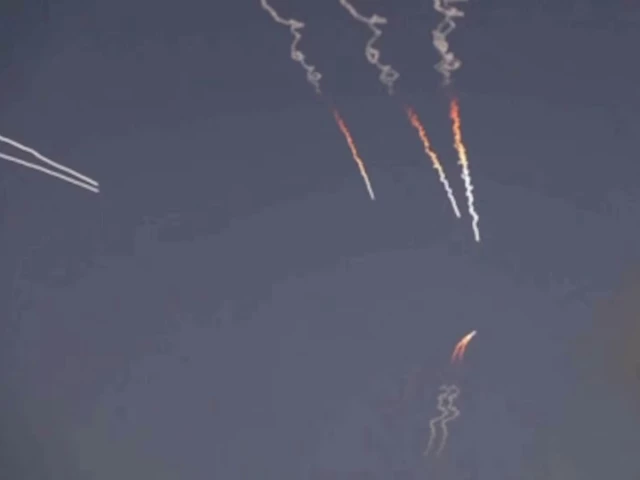
Soon after the US strikes, Iran’s Islamic Revolutionary Guard Corps announced retaliatory missile and drone attacks against American military facilities in Bahrain, Kuwait, and Jordan.
The IRGC claimed that several strategic sites, including facilities at the US Al-Azraq Air Base in Jordan, were targeted.
Iranian military officials said long-range missiles were fired at aircraft shelters, command centers, and military infrastructure.
The IRGC warned that any further military action against Iran would receive what it called a “crushing and decisive” response.
Regional Air Defences Activated
Authorities across the Gulf region activated air defence systems following the attacks.
Jordan’s military announced that it intercepted and destroyed five missiles launched toward the Al-Azraq military facility.
Kuwait’s Defence Ministry reported intercepting multiple hostile aerial targets, while Bahrain confirmed that its air defence systems successfully repelled incoming missile and drone threats.
Initial assessments from US officials indicated that most Iranian missiles and drones were intercepted before reaching their intended targets.
No immediate casualties or significant damage to US military facilities were reported.
Strait of Hormuz Tensions Intensify
The military exchanges have once again focused global attention on the Strait of Hormuz, one of the world’s most strategically important maritime routes.
The waterway handles a substantial portion of global oil and liquefied natural gas shipments, making any disruption a major concern for international markets.
Reports from Iran indicated that military activity was observed near Qeshm Island, Sirik, Bandar Abbas, and Jask—key locations surrounding the Strait.
The renewed conflict has heightened fears of further disruptions to international shipping and energy supplies.
Trump Downplays Helicopter Loss
Despite authorizing military strikes, President Trump sought to downplay the loss of the Apache helicopter.
According to US officials, the aircraft was allegedly brought down by an Iranian one-way attack drone while conducting a patrol mission near Oman’s coast.
The two crew members were successfully rescued by US naval forces and reportedly suffered no serious injuries.
Speaking to reporters, Trump described the incident as “not a big deal,” emphasizing that the pilots were safe.
Diplomacy Faces New Challenges
The latest hostilities have further complicated ongoing diplomatic efforts aimed at ending the broader conflict that began with joint US-Israeli military operations against Iran earlier this year.
Iranian Foreign Ministry spokesperson Esmaeil Baghaei said Tehran would reassess its diplomatic engagement with Washington following what he described as repeated violations of ceasefire commitments.
“Any diplomatic process requires a minimum stable environment,” Baghaei stated.
Several rounds of indirect negotiations, facilitated by regional partners including Pakistan and Qatar, have thus far failed to produce a comprehensive settlement.
Peace Agreement Appears Distant
While both sides have publicly expressed support for diplomacy, major disagreements remain unresolved.
The United States continues to insist that any agreement must prevent Iran from acquiring nuclear weapons.
Iran, meanwhile, seeks the lifting of sanctions, the release of frozen assets, the easing of restrictions on maritime trade, and broader recognition of its regional security interests.
The ongoing conflict involving Iran-backed Hezbollah in Lebanon has also become a key factor influencing negotiations.
Markets React to Escalation
Global financial markets reacted cautiously to the latest developments.
Oil prices rose on concerns that renewed military activity around the Strait of Hormuz could affect energy supplies, while Asian stock markets recorded modest declines amid investor uncertainty.
Analysts warn that continued military exchanges could increase economic pressure worldwide and undermine efforts to restore stability in the region.
Uncertain Path Forward
As military and diplomatic tensions continue to rise, international observers fear that the latest exchange could derail months of ceasefire efforts and push the region closer to a wider conflict.
With both Washington and Tehran maintaining firm positions, the path toward a lasting peace agreement remains uncertain.
For now, the Middle East faces another dangerous period of instability as world powers closely monitor developments around one of the globe’s most critical strategic waterways.