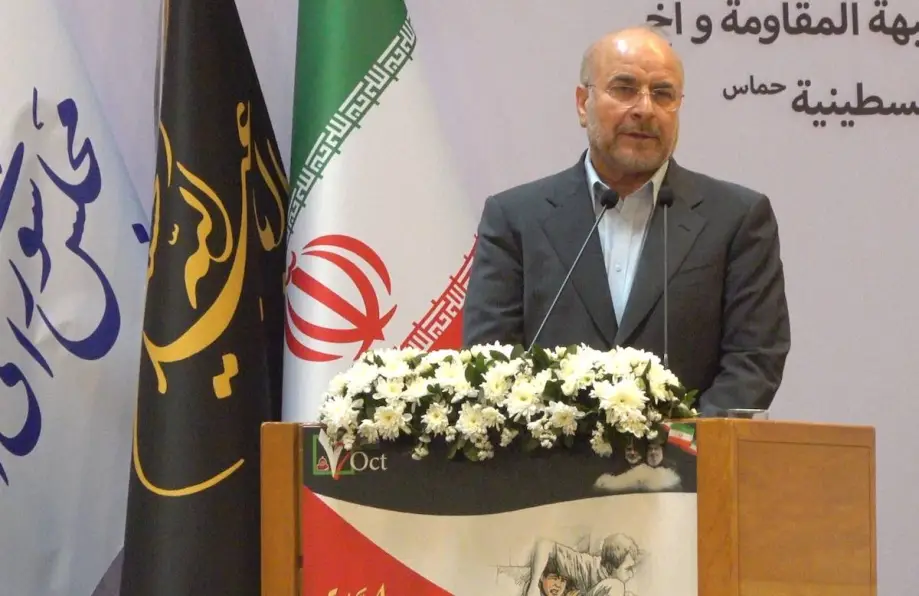
ISLAMABAD – Iranian Parliament Speaker Mohammad Baqher Qalibaf said Saturday that Tehran has “good intentions but no trust” ahead of negotiations with the US, according to the Tasnim News Agency. His remarks came as he arrived in Islamabad for high-stakes peace talks with the American delegation led by Vice President JD Vance.
“Unfortunately, our experience of negotiating with the Americans has always been met with failure and breach of contract,” Qalibaf said when he touched down at Islamabad Airport. “Twice in less than a year, in the middle of negotiations, despite the good intentions of the Iranian side, they attacked us and committed numerous war crimes.”
Iran Ready to Reach Agreement
Qalibaf stressed that Iran is ready to reach an agreement if the US demonstrates sincerity. “In the upcoming negotiations, if the American side is ready to make a real agreement and grant the rights of the Iranian people, they will see our readiness to make an agreement as well,” he said.
He warned that Tehran would respond firmly if talks were used as a cover for insincere actions. “In the current war, we have shown them that if they want to use negotiations to carry out a fruitless show and deception operation, we are ready to realize our rights with faith in God and relying on the power of our people,” said Qalibaf.
Vance’s Remarks
US Vice President JD Vance said before departing for the talks with Iran in Pakistan: “If the Iranians are willing to negotiate in good faith, we are certainly willing to extend the open hand.” “If they’re going to try to play us, they’re going to find that the negotiating team is not that receptive,” he warned.
Ceasefire Background
Pakistan, together with Turkiye, China, Saudi Arabia, and Egypt, managed to secure a two-week ceasefire on Wednesday between Washington and Tehran, 40 days after the US and Israel initiated attacks against Iran on February 28. As part of the deal, the two sides agreed to meet in Islamabad for talks to negotiate a lasting peace.
Analysis: Trust Deficit
Qalibaf’s statement that Iran has “good intentions but no trust” encapsulates the challenge facing the Islamabad talks. The Iranian parliament speaker’s reference to past US attacks during negotiations — specifically mentioning that the US struck Iran twice in less than a year while talks were ongoing — highlights the deep mistrust that pervades the relationship.
The fact that both sides have sent such high-level delegations suggests a genuine desire to reach an agreement. But Qalibaf’s warning that Iran will respond firmly if talks are used as a “deception operation” indicates that Tehran is prepared to walk away if it perceives bad faith.
Vance’s remarks — offering an “open hand” if Iran negotiates in good faith, while warning that the US team will not be “receptive” if Iran tries to “play us” — mirror the Iranian position. Both sides are approaching the talks with optimism tempered by skepticism.
As the negotiations begin, the question is whether the shared interest in ending the war can overcome decades of mistrust. Qalibaf has made Iran’s position clear: good intentions, but no trust. It is now up to the US to demonstrate that it is worthy of that trust.