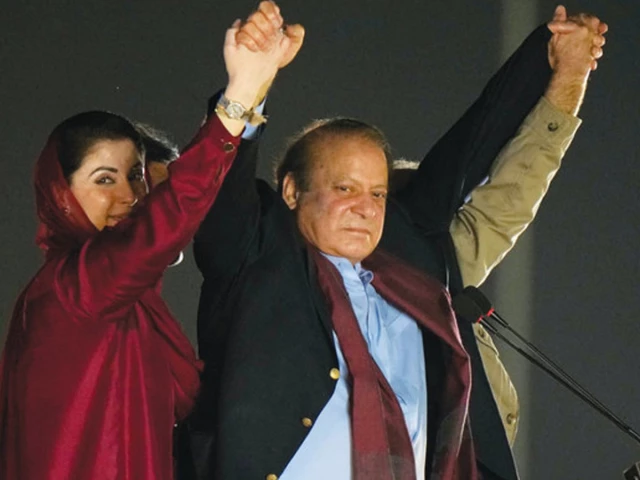
LAHORE — In a significant legal development, an accountability court in Lahore on Monday formally approved the closure of the National Accountability Bureau’s (NAB) long-running inquiry against former prime minister Nawaz Sharif and Punjab Chief Minister Maryam Nawaz in the Chaudhry Sugar Mills case.
Accountability Court Judge Rana Muhammad Arif announced the ruling after hearing an application filed by NAB seeking official sanction to terminate the proceedings. The anti-corruption body informed the court that its investigation into allegations of corruption against the Sharif family leaders had been completed and that no evidence supported the charges.
The court accepted NAB’s plea, granting final approval to close the inquiry in accordance with legal requirements. During the proceedings, counsel for Maryam Nawaz presented arguments supporting the application.
Background of the Case
The Chaudhry Sugar Mills case involved allegations of money laundering and accumulation of assets beyond known sources of income through irregular business transactions. Maryam Nawaz had previously been reported as a major shareholder in the mill.
NAB initially launched the inquiry on November 14, 2018. During the investigation, Maryam Nawaz—who now serves as Punjab chief minister—was arrested on August 8, 2019, and placed on physical remand for 48 days.
She subsequently filed a post-arrest bail petition before the Lahore High Court (LHC). On October 31, 2019, the court granted her bail against two surety bonds of Rs10 million each and directed her to deposit Rs70 million while submitting her passport with the registrar judicial.
NAB challenged the bail grant before the Supreme Court, but the petition was dismissed on August 22, 2023, after being withdrawn.
Investigation Concluded, No Evidence Found
Following amendments to the NAB law, the NAB investigation officer concluded that no case of corruption or corrupt practices was made out against the accused. Based on this finding, the NAB Executive Board decided on April 3, 2024, to withdraw the proceedings under Section 31B(1) of the NAB Ordinance.
After the closure of proceedings, Maryam filed a miscellaneous application before the LHC seeking the return of the Rs70 million deposited as part of her bail conditions.
LHC Directive and NAB Appeal
On February 4, 2026, the LHC ruled that the case could only be formally closed with the accountability court’s approval and directed the Lahore accountability court to decide the matter within one month—a directive that led to Monday’s formal closure.
However, NAB has since appealed to the Federal Constitutional Court (FCC), requesting it to set aside the LHC’s February 4 order. In its appeal, NAB argues that once the NAB chairman approved the inquiry’s withdrawal, the high court had no authority to interpret the law in a way that imposed additional judicial approval requirements.
The bureau contends that when a case is withdrawn at the inquiry stage, the accountability court does not possess judicial authority over the matter. It maintains that if the law does not require judicial approval for withdrawing an inquiry, such a requirement cannot be introduced through a court decision.
NAB further contends that the LHC issued its February 4 ruling without notifying the Attorney General’s Office and that the court exceeded its jurisdiction by taking suo motu notice of the matter. It requests the FCC to declare the February 4 judgment null and void.
Political Implications
The formal closure of the inquiry represents a legal victory for the Sharif family, which has faced a series of accountability cases over the past decade. The development comes as Maryam Nawaz continues to serve as Punjab chief minister following her party’s success in recent provincial elections.
Legal experts note that while the case has been closed at the inquiry level, the ongoing appeal before the FCC means the matter may not yet be fully resolved. The constitutional court’s eventual ruling on NAB’s appeal could have implications for how future inquiry withdrawals are processed.
For now, Monday’s court decision brings formal closure to a case that has lingered in the legal system for nearly eight years, since the initial inquiry was launched in 2018.