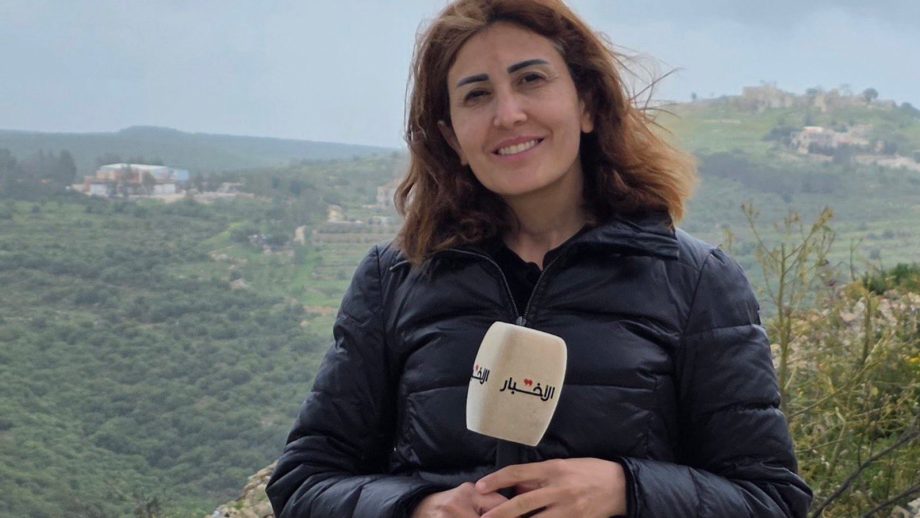
BEIRUT – Lebanese journalist Amal Khalil was killed on Wednesday evening in an Israeli strike while carrying out her work in the town of Tayri, southern Lebanon, according to local reports. Minutes before her martyrdom, Khalil posted on Facebook about an earlier incident involving a wounded fighter, paramedics, and Israeli forces.
Khalil wrote that Lebanese Civil Defence teams in Rmeish had treated a wounded fighter who arrived in Ain Ebel from Bint Jbeil, before contacting the Lebanese Red Cross to transfer him to a liberated area. She said Israeli forces stationed in Debel became aware of the wounded man and demanded, in a phone call with paramedics, that he be handed over, threatening to target the ambulance. The paramedics refused.
A Decision to Surrender
Khalil added that the fighter later decided to walk to Debel to surrender himself in order to protect the lives of the medics and local residents, as surveillance drones flew at low altitude.
The Strike
Lebanon witnessed tense hours earlier on Wednesday after Israeli shelling hit the town of Tayri, targeting journalists Amal Khalil and Zeinab Faraj during field coverage. Rescue teams faced difficulties reaching the area, with Israel reportedly preventing paramedics from accessing Khalil’s location for several hours.
Following extensive contacts and movement, ambulance teams, escorted by the army, were able to enter Tayri. Reuters confirmed that Khalil’s body was found inside the damaged building.
Context
The killing of Amal Khalil adds to the growing toll of journalists who have lost their lives covering the conflict. Since the escalation between Israel and Hezbollah began, multiple journalists have been killed or injured in Israeli strikes, often while clearly identifiable as press.
The targeting of journalists raises serious concerns under international humanitarian law, which protects media personnel as civilians unless they are directly participating in hostilities.
Analysis: A Dangerous Profession
Amal Khalil’s death is a tragedy for her family, her colleagues, and the profession of journalism in Lebanon. Her final Facebook posts — documenting the desperate efforts of paramedics to save a wounded fighter, the Israeli demands to hand him over, and the fighter’s decision to surrender to protect others — are a testament to her commitment to bearing witness.
The fact that rescue teams were prevented from reaching Khalil for several hours suggests a deliberate effort to impede access to the wounded — a potential violation of international law.
As the conflict continues, journalists in Lebanon face increasing dangers. Khalil was killed while doing her job. Her death is a reminder that journalism is not a crime — and that those who die covering the news are not collateral damage but casualties of war.