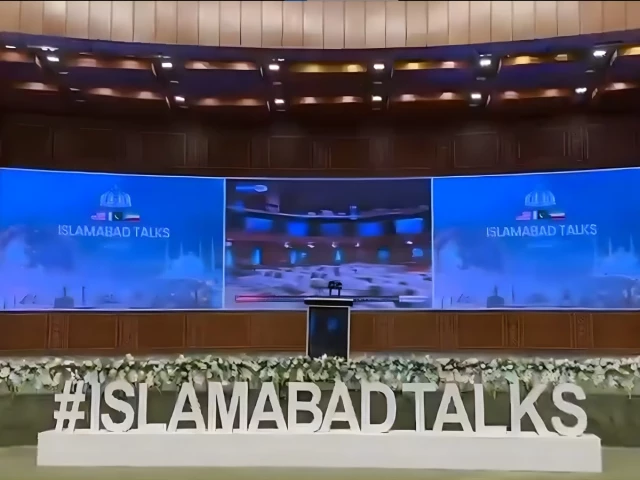
ISLAMABAD – The government has established a Media Facilitation Centre at the Jinnah Convention Centre for foreign journalists arriving to cover the ‘Islamabad Talks’, Information Minister Attaullah Tarar said in a post on X on Saturday. “All arrangements are in place to facilitate foreign and local journalists in the best way possible,” he stated.
The centre has been established by the Ministry of Information and Broadcasting, Tarar said, adding, “We will be looking after them well.” The facility is designed to provide journalists with workspace, internet connectivity, and other resources needed to cover the high-stakes negotiations between the United States and Iran.
Visa on Arrival for Delegates and Journalists
A day earlier, Deputy Prime Minister and Foreign Minister Ishaq Dar said that delegates and journalists from participating nations coming for peace talks will be issued a visa on arrival in Islamabad. He said that “Pakistan welcomes all delegates, including journalists from participating nations, travelling in relation to Islamabad Talks 2026. To this end, all airlines are requested to permit boarding to all such individuals without a visa. Immigration authorities in Pakistan will issue them a visa on arrival.”
Foreign Office spokesperson Tahir Andrabi then clarified that the visa on arrival facility applies only to delegates and journalists from participating nations, namely Iran and the United States. “This facility, extended for the duration of the talks, does not cover third-country nationals,” he added.
Historic Talks Underway
The government has introduced these facilities as senior figures from the United States and Iran are set to hold historic talks in Islamabad today, with Prime Minister Shehbaz Sharif describing the high-stakes negotiations as a “make or break moment” for peace.
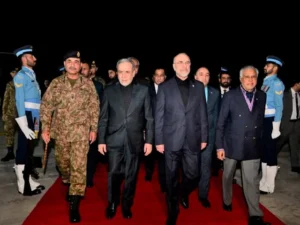
Iranian Foreign Minister Abbas Araghchi and Parliament Speaker Mohammad-Bagher Ghalibaf landed in Pakistan late on Friday night, the Foreign Office said. The delegation was received by Dar along with National Assembly Speaker Sardar Ayaz Sadiq, Chief of Defence Forces and Chief of Army Staff Field Marshal Syed Asim Munir, and Minister for Interior Syed Mohsin Raza Naqvi.
US Delegation Arrives
US Vice President JD Vance also departed for Islamabad yesterday, telling media that America was looking forward to the negotiation with Iran and expressing hope that the talks would be positive. The delegation from the US will be led by Vance, who will be accompanied by President Donald Trump’s key Middle East envoys, Steve Witkoff and Jared Kushner.
Ceasefire Background
On April 8, Trump agreed to a two-week ceasefire with Iran, less than two hours before his 8:00pm deadline to destroy a “whole civilisation,” while responding to diplomatic efforts from Pakistan to defuse tensions in the Middle East. Prime Minister Shehbaz Sharif also announced the ceasefire in a post on X, inviting the delegations of both Iran and the US to Islamabad on Friday, April 10, “to further negotiate for a conclusive agreement to settle all disputes.”
The prime minister expressed hope “that the ‘Islamabad Talks’ succeed in achieving sustainable peace.”
Analysis: Facilitating Global Coverage
The establishment of a Media Facilitation Centre and the visa-on-arrival facility for journalists demonstrate Pakistan’s commitment to facilitating comprehensive coverage of the historic talks. With the world’s attention focused on Islamabad, ensuring that journalists can work efficiently is essential for the accurate and timely reporting of the negotiations.
The fact that the facility is limited to journalists from the US and Iran reflects the targeted nature of the talks. However, given the global significance of the negotiations, media from around the world will also be covering the event, relying on the resources provided by the centre.
For Pakistan, hosting these talks is an opportunity to showcase its capabilities as a facilitator of international diplomacy. The arrangements for journalists are a small but meaningful part of that effort.