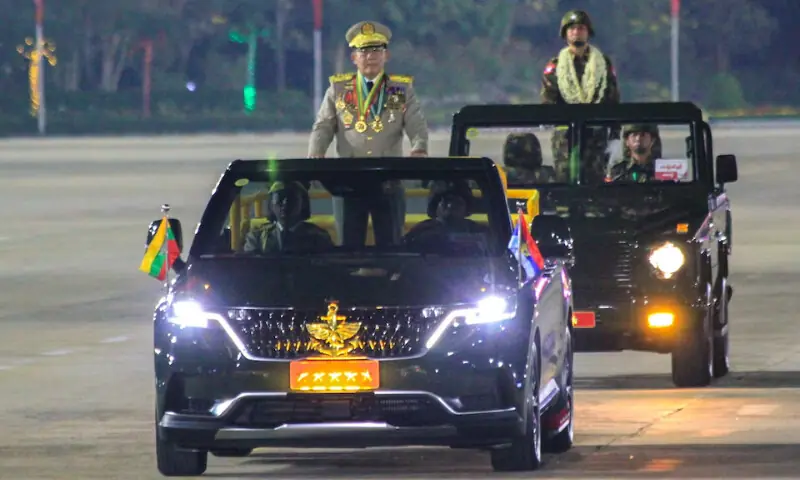
JAKARTA – A criminal case against Myanmar’s newly-elected President Min Aung Hlaing was filed in Indonesia on Monday by a group of civil society organisations, accusing the leader of acts of genocide against the Rohingya ethnic group. The complaint, filed to Indonesia’s Attorney General’s office, marks the first time a case has been officially received under Indonesia’s new penal code, which allows for “universal jurisdiction” for certain serious crimes.
The complaint was filed by Yasmin Ullah, a Rohingya who fled Myanmar, and several Indonesian figures, including a former attorney general and the chairman of Muhammadiyah, one of Indonesia’s largest Muslim groups, they said in a statement on Monday. They said they would present evidence of forced displacement of the Rohingya—the world’s largest stateless population—as well as killings by the junta.
Universal Jurisdiction Claim
The claimants said Indonesia’s penal code allows for “universal jurisdiction” when certain crimes are considered so serious they can be processed regardless of victim nationalities or where the crime was committed. This legal principle allows national courts to prosecute individuals for serious international crimes even if the crimes were not committed on the country’s territory and regardless of the nationality of the perpetrators or victims.
“It is the first time under Indonesia’s new penal code that a case has been officially received and I warmly welcome this historic development as a milestone for all Rohingya people on their long march to justice and accountability,” Ullah said.
The Rohingya Crisis
Myanmar’s armed forces, under then-junta chief Min Aung Hlaing, launched an offensive in 2017 that forced at least 730,000 Rohingya from their homes and into neighbouring Bangladesh, where they recounted killings, mass rape and arson. The Rohingya, a Muslim minority group in predominantly Buddhist Myanmar, have faced decades of persecution and are considered stateless under Myanmar law.
The 2017 crackdown was described by UN investigators as having “genocidal intent.” Myanmar has consistently denied these allegations, maintaining that its military operations were a legitimate response to attacks by Rohingya militants.
Myanmar’s Political Situation
Myanmar is a member of the Association of South East Asian Nations (ASEAN), but relations have come under strain since a 2021 coup led by Min Aung Hlaing, which led to civil war and a humanitarian crisis, with large numbers of Rohingya Muslims displaced and forced into refugee settlements.
Min Aung Hlaing was elected president through a parliamentary vote last week after an army-backed party won the December and January election in what Western governments described as a sham, formalising his grip on political power. The 2021 coup led to widespread protests and nationwide resistance ever since.
Indonesia’s Role
Indonesia, which hosts ASEAN’s headquarters, is the biggest Muslim-majority country in the world, and is among the destinations for Rohingya people fleeing Myanmar or the refugee camps by boat. In recent years, hundreds of Rohingya have arrived in Indonesia’s Aceh province, where local communities have sometimes turned them away but have also provided assistance.
Indonesia’s Attorney General’s Office did not immediately respond to a request for comment on the complaint.
Gambia’s Case at ICJ
Another predominantly Muslim country, Gambia, told judges in January at the United Nations’ top court that Myanmar targeted minority Muslim Rohingya for destruction and made their lives a nightmare in a landmark case accusing Myanmar of genocide at the International Court of Justice (ICJ). The ICJ case, filed in 2019, is ongoing.
Myanmar has always denied genocide. The junta did not immediately respond to a request for comment on Monday.
Analysis: A Historic Legal Move
The filing of a genocide complaint against Myanmar’s president in Indonesia represents a significant legal development. Under the principle of universal jurisdiction, Indonesian courts could potentially assert jurisdiction over crimes committed in Myanmar, even though neither the victims nor the perpetrators are Indonesian.
The acceptance of the case by Indonesian prosecutors is a first step. Whether the case proceeds to trial, and whether Indonesia can secure the cooperation of Myanmar—or extradite Min Aung Hlaing—is highly uncertain. Myanmar has consistently rejected the authority of foreign courts over its leaders and has refused to cooperate with international investigations into the Rohingya crisis.
Nevertheless, the symbolic value of the complaint is significant. For Rohingya activists who have sought justice for the 2017 crackdown for nearly a decade, the case represents a new avenue for accountability. For Indonesia, it is a test of its commitment to international justice and its role as a leader in the Muslim world.
For Min Aung Hlaing, who has consolidated power through a sham election and now faces a genocide complaint in a neighboring country, the international pressure continues to mount. Whether that pressure translates into accountability remains to be seen.