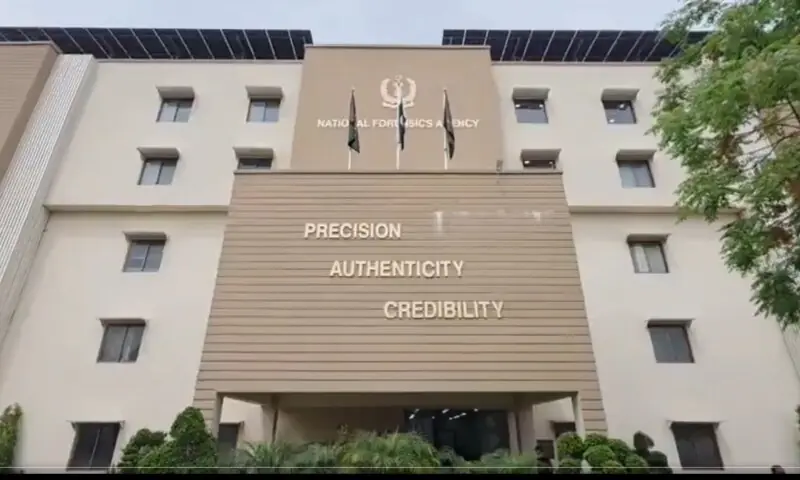
ISLAMABAD – The country’s first National Forensic Agency formally began operation on Friday, the Ministry of Interior announced, marking a significant milestone in Pakistan’s efforts to modernize its criminal justice system and enhance the capacity of law enforcement agencies across the country.
The agency was established under “The National Forensic Agency Bill, 2024,” which was passed into law in 2024. In a statement on X, the ministry said that Interior Minister Mohsin Naqvi visited the headquarters on Friday, expressing hope that “the institution will assist in national security matters and curtailing crime.”
A Modern Forensic Hub
During his visit, Interior Minister Naqvi said that the agency will provide support to law enforcement agencies across Pakistan, directing the NFA to establish offices in Khyber Pakhtunkhwa, Balochistan, Kashmir, and Gilgit-Baltistan. He also directed that the services provided by the agency should be “widely publicised.”
Director General NFA Hasnaat Rasool briefed the interior minister on the agency’s progress, informing that the “first phase” had been completed. He informed Naqvi that the agency was providing services “in the field of digital forensics, including deepfake forensics, computer and mobile forensics, audio-video, network, and drone forensics.”
“1,500 digital forensic cases have been reported in one year,” he was quoted as saying, adding that under the second phase, “25 specialised labs will be established.”
State-of-the-Art Facilities
Naqvi visited the “Research and Innovation Lab, Digital Forensics Lab, Narcotics Lab, FinTech Lab, and Questionable Documents Lab at NFA,” the statement said. He also “inspected DNA, firearms, serology, and explosives rooms,” the statement read, adding that the minister lauded the team for “making the agency fully operational in a short time.”
The minister also inquired about the training course of the assistant superintendents of police at the agency, indicating that capacity-building for law enforcement personnel is a key component of the NFA’s mandate.
A Game-Changer for Criminal Justice
The establishment of a national forensic agency has been a long-standing need for Pakistan’s criminal justice system. Previously, forensic services were fragmented across provincial governments and law enforcement agencies, leading to inconsistencies in quality, delays in case processing, and challenges in maintaining evidentiary standards.
The NFA is expected to serve as a centralized hub for forensic analysis, providing services to police, anti-corruption bodies, and other law enforcement agencies across the country. Its capabilities in digital forensics—including deepfake detection and drone forensics—reflect the evolving nature of crime in the digital age.
Phased Implementation
The completion of the first phase, including the handling of 1,500 digital forensic cases, demonstrates that the agency is already operational. The second phase, which will establish 25 specialized labs, will significantly expand the NFA’s capacity to handle a wider range of forensic services.
The establishment of regional offices in Khyber Pakhtunkhwa, Balochistan, Kashmir, and Gilgit-Baltistan will ensure that forensic services are accessible to law enforcement agencies across the country, not just in the federal capital.
Leadership and Vision
Interior Minister Mohsin Naqvi has been a driving force behind the establishment of the NFA, prioritizing it as a key component of the government’s criminal justice reform agenda. His visit to the headquarters and direct engagement with the agency’s leadership signal the importance the government places on this institution.
DG Hasnaat Rasool, who briefed the minister on the agency’s progress, has overseen the rapid establishment of the NFA’s capabilities. The handling of 1,500 digital forensic cases within the first year suggests that the agency is already making a significant contribution to criminal investigations.
Analysis: A Milestone for Pakistan’s Justice System
The formal operationalization of the National Forensic Agency represents a major step forward for Pakistan’s criminal justice system. For decades, the country has lagged behind international standards in forensic science, with police and prosecutors often relying on outdated methods or lacking access to specialized analysis.
The NFA’s capabilities in digital forensics are particularly timely. As crime becomes increasingly digital—from cyber fraud to online harassment to the use of drones in criminal activities—law enforcement agencies need access to sophisticated forensic tools. The NFA’s ability to handle deepfake forensics, computer and mobile forensics, and drone forensics positions it at the cutting edge of forensic science.
The establishment of regional offices will be critical to ensuring that the NFA’s services reach law enforcement agencies across the country. Without local access, the benefits of a centralized forensic agency would be limited to the federal capital and major cities.
For police investigators, prosecutors, and judges, the NFA offers the promise of more reliable evidence, faster case processing, and higher conviction rates. For the public, it offers the promise of a justice system that is more effective and more trustworthy.
As the NFA moves into its second phase, with plans for 25 specialized labs, the focus will be on building capacity, recruiting and training forensic scientists, and ensuring quality control across all areas of analysis. The agency’s success will ultimately depend on its ability to deliver reliable, timely, and impartial forensic analysis to support criminal investigations and prosecutions.
With the NFA now fully operational, Pakistan has taken a significant step toward modernizing its criminal justice system. The challenge now is to ensure that the agency lives up to its promise.