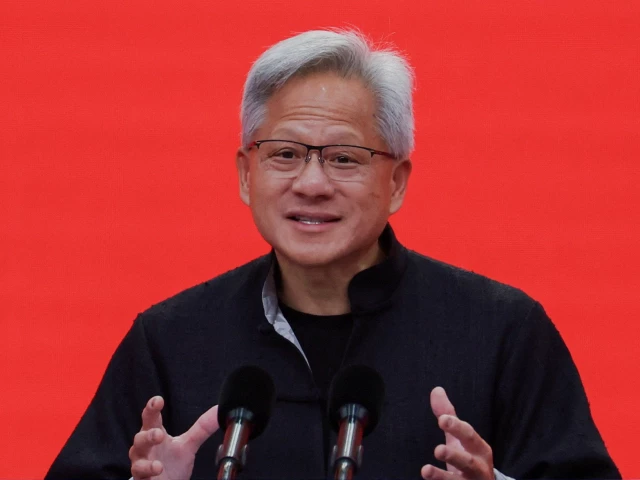
Nvidia CEO Jensen Huang says he believes China will eventually reopen broader access to high-end American artificial intelligence chips despite ongoing geopolitical tensions and export restrictions between Washington and Beijing.
Speaking in an interview with Bloomberg Television, Huang expressed optimism about the long-term future of Nvidia’s business in China while acknowledging that political and national security considerations continue to shape the market.
The comments come as the United States and China remain locked in an escalating technological rivalry centered on artificial intelligence, semiconductor manufacturing, and advanced computing infrastructure.
Nvidia Sees Long-Term Opportunity in China
Huang stated that China’s market for advanced AI hardware is likely to become more accessible over time, even though major restrictions remain in place on several of Nvidia’s most powerful products.
“My sense is that over time the market will open,” Huang said during the interview.
He specifically addressed the status of Nvidia’s H200 AI chip — one of the company’s high-performance processors designed for training and running advanced artificial intelligence systems.
According to Huang, the H200 chip is technically licensed for sale to China, but Beijing itself may still choose to limit foreign chip penetration in order to protect domestic technology development.
“The Chinese government has to decide how much of their local market they want to protect,” he explained.
AI Competition Between US and China Intensifies
The remarks highlight the growing global importance of AI chips as both the United States and China compete for dominance in next-generation technologies.
Advanced semiconductors have become central to:
- Artificial intelligence systems
- Military technologies
- Cloud computing infrastructure
- Data centers
- Autonomous systems
Washington has increasingly restricted exports of cutting-edge AI hardware to China, arguing that such technology could strengthen Chinese military and surveillance capabilities.
The H200 chip was previously restricted under US export controls before President Donald Trump announced an agreement with Chinese President Xi Jinping aimed at easing certain restrictions.
Concerns in Washington Continue
Despite partial easing measures, some American lawmakers remain strongly opposed to allowing high-performance AI chips into the Chinese market.
Critics argue that advanced processors could support:
- Military AI development
- Cybersecurity operations
- Surveillance systems
- Strategic defense technologies
Security analysts in Washington continue to view semiconductor exports as one of the most sensitive areas in US-China relations.
At the same time, technology companies warn that fully cutting China off from American chip markets could damage US competitiveness and accelerate China’s domestic chip ambitions.
China Accelerates Domestic Semiconductor Development
Huang’s comments also come as China intensifies efforts to reduce dependence on Western technology.
Beijing has invested heavily in domestic semiconductor production and AI research to challenge American dominance in the global tech industry.
Chinese firms are rapidly developing local alternatives to Nvidia’s products, particularly after years of export controls and sanctions targeting advanced chip access.
Industry experts say the restrictions have unintentionally accelerated China’s push for semiconductor self-sufficiency.
Blackwell and Rubin Chips Still Restricted
While the H200 may now be eligible for limited sales, Nvidia’s newest and most advanced chip families remain restricted.
The company’s:
- Blackwell series
- Upcoming Rubin architecture
are still barred from sale in China under current export regulations.
These next-generation systems are expected to power some of the world’s most advanced AI models and supercomputing applications.
Analysts say restrictions on these products demonstrate how deeply semiconductor technology has become intertwined with national security strategy.
Trump-Xi Talks Highlight Economic Stakes
Huang traveled to China last week alongside President Trump during high-level discussions with Xi Jinping.
The visit underscored the economic significance of semiconductor trade even as geopolitical tensions remain high.
Chinese state media later quoted Xi as saying China would continue opening its economy to foreign companies and that American businesses would enjoy “brighter prospects” in the country.
However, Huang clarified that he did not directly discuss H200 chip sales with Xi or Chinese Premier Li Qiang.
Instead, he noted that President Trump had held broader discussions with Chinese leadership during the trip.
Nvidia Remains Central to Global AI Boom
Nvidia continues to dominate the global AI hardware market due to surging demand for chips capable of powering large-scale artificial intelligence systems.
The company recently became the world’s most valuable corporation as AI investment exploded across industries including:
- Technology
- Healthcare
- Defense
- Finance
- Media
Its processors are widely used for training advanced generative AI models, making Nvidia one of the most strategically important companies in the global tech economy.
AI Chips Now at the Heart of Global Power Politics
Jensen Huang’s comments reflect how semiconductor technology has evolved beyond business into a core geopolitical battleground.
The struggle over AI chips is no longer simply about market share — it now involves national security, economic influence, and technological leadership.
For the United States, restricting advanced AI hardware exports is viewed as a way to slow China’s military and technological rise.
For China, achieving semiconductor independence has become a national strategic priority.
Nvidia sits directly between those competing ambitions, attempting to maintain access to one of the world’s largest technology markets while navigating increasingly complex political pressures.
As the AI race accelerates globally, the future of chip access between Washington and Beijing could significantly shape the balance of technological power for years to come.