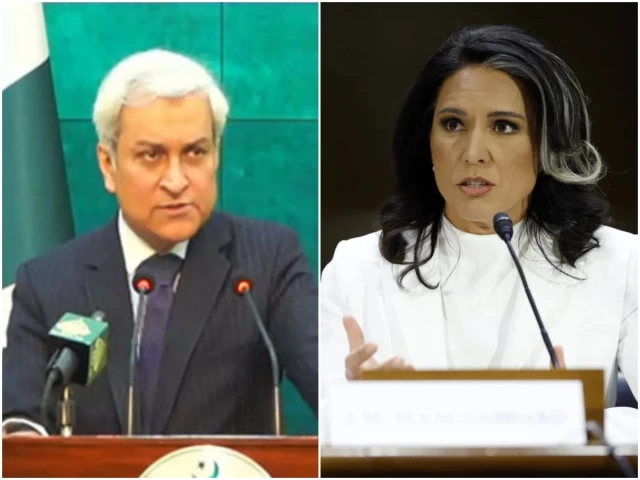
ISLAMABAD — The Foreign Office (FO) on Thursday categorically rejected allegations by United States Director of National Intelligence Tulsi Gabbard that Pakistan’s missile programme posed a threat, emphasizing that the country’s strategic capabilities are “exclusively defensive” in nature .
In a statement responding to media queries, FO Spokesperson Tahir Andrabi said: “Pakistan categorically rejects the recent assertion by a US official alleging a potential threat from Pakistan’s missile capabilities. It is emphasised that Pakistan’s strategic capabilities are exclusively defensive in nature, aimed at safeguarding national sovereignty and maintaining peace and stability in South Asia” .
Gabbard’s Allegations
Gabbard had testified before the US Senate Intelligence Committee on Wednesday, presenting the 2026 Annual Threat Assessment. She listed Pakistan alongside Russia, China, North Korea, and Iran as nations developing missile delivery systems that could potentially put the US homeland within range .
“Russia, China, North Korea, Iran and Pakistan have been researching and developing an array of novel, advanced, or traditional missile delivery systems with nuclear and conventional payloads that put our homeland within range,” Gabbard told lawmakers . She further warned that Pakistan’s long-range ballistic missile development “potentially could include ICBMs” capable of striking the United States .
Pakistan’s Response
Andrabi clarified that Pakistan’s missile programme “remains well below intercontinental range” and is “firmly rooted in the doctrine of credible minimum deterrence vis-à-vis India” . He contrasted this with India’s missile development, noting that “India’s development of missile capabilities exceeding 12,000 kilometres reflects a trajectory that extends beyond regional security considerations and is certainly a cause of concern for the neighbourhood and beyond” .
The spokesperson reaffirmed Pakistan’s commitment to “constructive engagement with the United States, anchored in mutual respect, non-discrimination, and factual accuracy” . He urged “a more measured and considered approach that aligns with South Asia’s strategic imperatives and advances peace, security, and stability across the region” .
Former Diplomat Weighs In
Former Pakistani diplomat and caretaker foreign minister Jalil Abbas Jilani also dismissed Gabbard’s assertion on X, stating that the claim the “US Homeland is within range of Pakistan’s nuclear/con missiles is not grounded in strategic reality” .
“Pakistan’s nuclear doctrine is India-specific, aimed at maintaining credible deterrence in South Asia, not projecting power globally,” Jilani said .
Context of Previous Allegations
This is not the first instance of the US levelling allegations against Pakistan’s missile programme. In December 2024, then-US deputy national security adviser Jon Finer claimed that Pakistan was developing long-range ballistic missile capabilities that could eventually allow it to strike targets well beyond South Asia, making it an “emerging threat” to the US .
The same month, the US announced additional sanctions targeting four entities connected to Pakistan’s ballistic missile programme, citing concerns over the proliferation of weapons of mass destruction . Previous sanctions had also targeted Chinese and Belarusian companies allegedly involved in supplying equipment for Pakistan’s missile programme .
Regional Implications
Analysts note that Pakistan’s inclusion among principal nuclear threats reflects a continuation of previous US policy trends . However, Islamabad maintains that its strategic posture is responsible and restrained, aimed at maintaining a balance of power in South Asia rather than global power projection .
India has also weighed in on the debate, with Ministry of External Affairs spokesperson Randhir Jaiswal highlighting Pakistan’s “history of clandestine nuclear nonproliferation” and suggesting that Gabbard’s remarks make clear “what kind of threat they pose to the world” .
The exchange underscores ongoing tensions surrounding South Asia’s strategic environment, with both nuclear-armed neighbours continuing to develop their respective missile capabilities amid regional instability