ISLAMABAD – Pakistan, Turkiye, Egypt and Saudi Arabia are quietly but steadily moving towards formalising a new quadrilateral framework, as rapid developments in the Middle East push key regional players to coordinate more closely on diplomacy and security. While officials stopped short of calling it an alliance, the pace and frequency of engagements suggest that the four-country forum is evolving into a structured grouping aimed at shaping outcomes in a volatile region.
The latest step came on Tuesday, when senior officials from the four countries met in Islamabad following up on earlier consultations between their foreign ministers.
Senior Officials Meeting
Pakistan’s delegation at the senior officials meeting was led by Ambassador Tahir Andrabi, Additional Foreign Secretary and Spokesperson. The Turkish side was headed by Ambassador Musa Kulaklikaya, Deputy Foreign Minister. Egypt was represented by Ambassador Nazih El Naggari, Assistant Foreign Minister, while the Saudi delegation was led by Prince Dr Abdullah bin Khalid bin Saud Al-Kabeer AlSaud, Director General at the Ministry of Foreign Affairs.
The meeting, hosted by Pakistan’s Ministry of Foreign Affairs, brought together top diplomats to firm up proposals that will now be presented at the upcoming foreign ministers’ meeting in Antalya on April 17, on the sidelines of the Antalya Diplomacy Forum.
Urgency of the Initiative
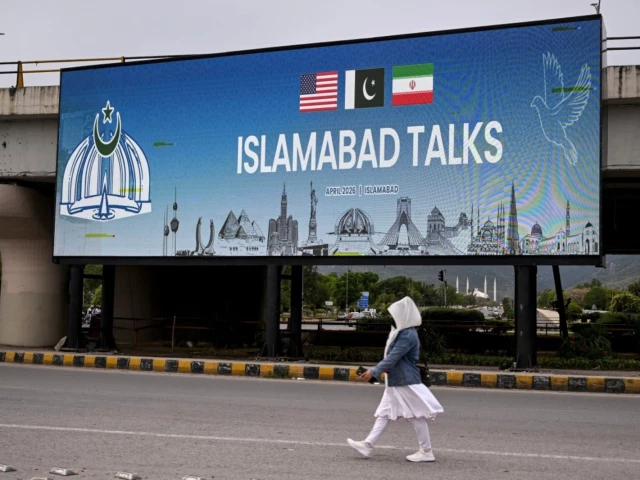
The consultations come against the backdrop of heightened regional instability, particularly the recent Iran-US military escalation, which has upended diplomatic calculations and triggered urgent backchannel efforts to prevent further spillover. The four countries had first convened at the foreign ministers’ level in Riyadh on March 19, at the height of tensions between Tehran and Washington. Just ten days later, they reconvened in Islamabad, underlining both the urgency and seriousness of the initiative.
Now, with another meeting lined up in Antalya within days, officials say the momentum reflects a shared recognition that traditional diplomatic formats are no longer sufficient to respond to fast-moving crises in the Middle East.
Focus of Discussions
Diplomatic sources told The Express Tribune that discussions are focused on devising a cooperative framework centred on conflict de-escalation, economic coordination, and political alignment on key regional issues. “There is a clear convergence of views among the four capitals on the need for a coordinated approach,” said a source, adding that while the structure of the grouping is still being worked out, “it is moving beyond ad hoc consultations.”
Dar’s Remarks
During their stay, the visiting delegations also called on Deputy Prime Minister and Foreign Minister Ishaq Dar, who underscored the importance of institutionalising cooperation among what he described as “brotherly countries.” Dar emphasised that closer coordination could help advance shared objectives of peace, stability and economic development, particularly at a time when geopolitical uncertainty is deepening across the Middle East.
Analyst Perspective
Analysts say the emerging quadrilateral reflects a pragmatic alignment rather than a formal bloc, driven by overlapping interests in regional stability, energy security, and diplomatic leverage. However, they caution that the success of any such framework will depend on how effectively the four countries can reconcile their individual foreign policy priorities while maintaining a unified stance on contentious issues.
Analysis: A New Regional Alignment
The move toward a quadrilateral framework among Pakistan, Turkiye, Egypt, and Saudi Arabia represents a significant development in Middle East diplomacy. Each of the four countries has its own distinct foreign policy priorities, but they share a common interest in regional stability, energy security, and preventing the spillover of conflict.
Pakistan brings its recent experience as a mediator between the US and Iran, as well as its strategic partnership with both China and the Gulf states. Turkiye offers its NATO membership and its influence in the Eastern Mediterranean and the Levant. Egypt provides its weight as the Arab world’s most populous nation and its control of the Suez Canal. Saudi Arabia contributes its financial resources and its leadership of the Islamic world.
The grouping is not a formal alliance, and it is unlikely to become one. But as a forum for consultation and coordination, it could prove valuable in a region where fast-moving crises require rapid responses.
The next test will come at the Antalya Diplomacy Forum on April 17, where the four foreign ministers are expected to meet. If they can agree on a framework for cooperation, the quadrilateral could become a permanent feature of Middle East diplomacy.