Prime Minister Shehbaz Sharif on Sunday assured Pakistan’s “full and unwavering solidarity and support” for Saudi Arabia during a meeting with Saudi Foreign Minister Prince Faisal bin Farhan Al Saud, reaffirming the deep strategic ties between the two nations as the Middle East conflict enters its second month. The assurance came as Pakistan intensifies its diplomatic efforts to mediate between the United States and Iran.
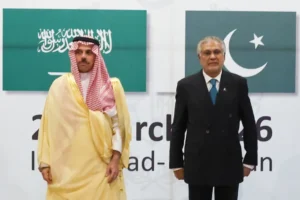
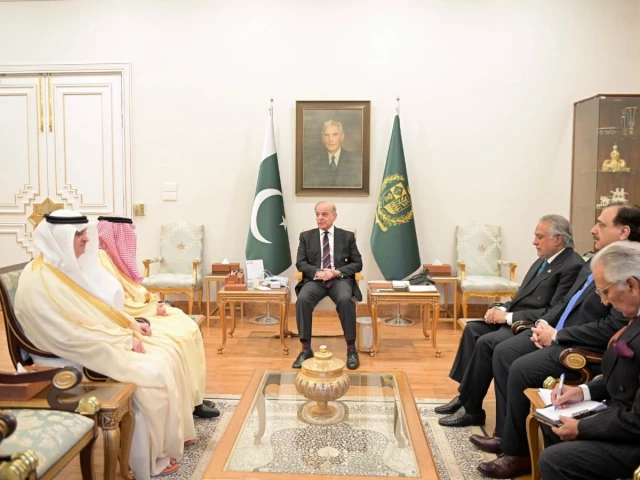
ISLAMABAD – Prime Minister Shehbaz Sharif met with Saudi Foreign Minister Prince Faisal bin Farhan Al Saud at the Prime Minister’s House on Sunday, following a quadrilateral meeting of foreign ministers from Pakistan, Saudi Arabia, Turkey, and Egypt focused on de-escalating the US-Israel war on Iran.
According to a statement from the Prime Minister’s Office (PMO) on X, PM Shehbaz “appreciated the remarkable restraint exercised by Saudi Arabia amid the current crisis and assured the Saudi foreign minister that Pakistan would always stand shoulder to shoulder with Saudi Arabia.”
Unwavering Solidarity
The prime minister’s assurance of unwavering solidarity underscores the historically close relationship between Pakistan and Saudi Arabia. The two countries have maintained deep strategic, economic, and religious ties for decades, with Saudi Arabia consistently supporting Pakistan during times of economic difficulty and Pakistan committing to the defense of the Kingdom’s territorial integrity.
PM Shehbaz recalled his recent conversations with Crown Prince Mohammed bin Salman, including their meeting in Jeddah on March 12, and shared Pakistan’s extensive diplomatic outreach during the current crisis. He briefed the Saudi foreign minister on Pakistan’s mediation efforts aimed at de-escalating tensions and bringing both the United States and Iran to the negotiating table.
Saudi Arabia’s Restraint
The prime minister’s praise for Saudi Arabia’s “remarkable restraint” reflects the difficult position in which the Kingdom finds itself amid the conflict. Saudi Arabia hosts US military assets and has been targeted by Iranian retaliatory strikes, yet it has sought to avoid being drawn directly into the conflict. Riyadh has supported diplomatic efforts to end the war, including Pakistan’s mediation initiative.
The statement from the PMO emphasized the Kingdom’s leadership role in the Muslim Ummah and stressed the need to forge unity among Islamic countries at this critical time—a message that resonates as the conflict threatens to divide the region.
Coordinating Positions
The meeting between PM Shehbaz and Prince Faisal was part of a broader diplomatic push that has brought the foreign ministers of Saudi Arabia, Turkey, and Egypt to Islamabad for consultations. The quadrilateral meetings are aimed at coordinating positions among the four nations and developing a unified approach to de-escalating the conflict.
According to the PMO, “Pakistan and Saudi Arabia also agreed to continue to coordinate their positions closely in order to secure peace and stability in the region.”
Leadership Greetings
PM Shehbaz conveyed his “respectful regards for the Custodian of the Two Holy Mosques, King Salman bin Abdulaziz Al Saud, and greetings for Crown Prince Mohammed bin Salman bin Abdulaziz Al Saud,” the PMO statement said. The gesture reflects the deep personal relationships between the leadership of the two countries.
High-Level Attendance
The meeting was attended by key Pakistani officials, including Deputy Prime Minister and Foreign Minister Ishaq Dar, National Security Adviser and Director General of the Inter-Services Intelligence Lieutenant General Muhammad Asim Malik, and Special Assistant to the Prime Minister on Foreign Affairs Tariq Fatemi.
The presence of the ISI chief at the meeting underscores the security dimension of Pakistan-Saudi relations and the importance Islamabad places on its strategic partnership with the Kingdom.
The Broader Context
The meeting comes amid escalating tensions in the Middle East, where the US-Israeli war on Iran has entered its second month. Since February 28, US and Israeli airstrikes have killed more than 1,300 people in Iran, according to Iranian figures, while Iran has retaliated with drone and missile strikes targeting Israel and Gulf states hosting US military assets.
Pakistan has positioned itself as a key mediator, with Prime Minister Shehbaz offering to host US-Iran talks in Islamabad. The prime minister’s assurance to Saudi Arabia comes as Riyadh weighs its own role in the conflict, balancing its security partnership with the US against its desire to avoid direct involvement in the fighting.
Analysis: A Strategic Partnership Tested
The meeting between PM Shehbaz and the Saudi foreign minister reflects the depth of the Pakistan-Saudi relationship at a time when both countries face significant challenges. For Pakistan, Saudi Arabia remains a critical economic partner, providing financial support and employment for millions of Pakistani workers. For Saudi Arabia, Pakistan is a key security partner, with the Pakistani military historically providing training and support to Saudi forces.
The assurance of “unwavering solidarity” is a reminder that for both countries, the relationship extends beyond transactional diplomacy. The prime minister’s praise for Saudi “restraint” also signals Pakistan’s appreciation for Riyadh’s measured approach to the crisis, which has avoided further escalation even as Iranian missiles have targeted the Kingdom’s territory.
As Pakistan intensifies its mediation efforts, the support of Saudi Arabia—both in terms of political backing and potential diplomatic engagement with Iran—will be crucial. The meeting between PM Shehbaz and Prince Faisal suggests that Riyadh is aligned with Islamabad’s approach and is willing to coordinate positions as the diplomatic push continues.
Whether that coordination can help bridge the gap between Washington and Tehran remains to be seen. But the meeting in Islamabad was a clear signal that two of the region’s most important powers are working together to try to end the conflict.