UNITED NATIONS: Pakistan has called on all parties involved in the ongoing Middle East crisis to exercise restraint and allow diplomacy more time to succeed, warning that recent developments have highlighted the fragile security situation and the risk of a wider regional escalation.
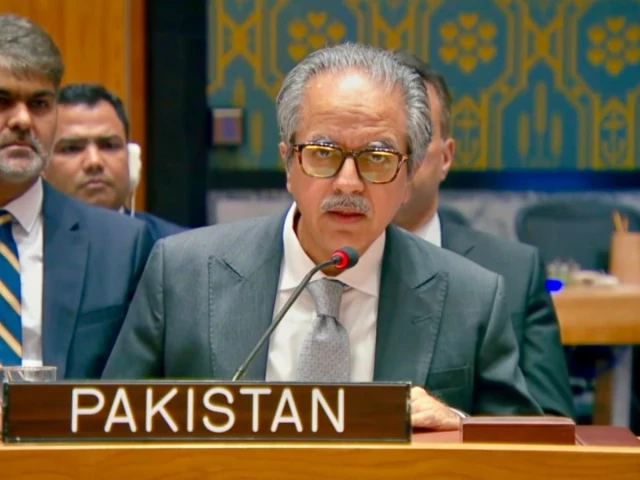
Addressing a United Nations Security Council (UNSC) briefing on non-proliferation, Pakistan’s Permanent Representative to the United Nations, Ambassador Asim Iftikhar Ahmad, expressed deep concern over rising tensions and urged stakeholders to prioritize dialogue over confrontation.
Pakistan Calls for Peaceful Resolution
Speaking before the Security Council, Ambassador Asim Iftikhar stressed that diplomacy remains the most effective path toward resolving complex international disputes.
“Events of the last few days have amply underscored the fragility of the situation, the risk of escalation and the need for diplomatic efforts to come to fruition sooner rather than later,” he said.
The ambassador warned that continued instability could have serious consequences for both regional and international peace and security.
“The cycle of violence and instability must end for the good of regional and international peace, security, and prosperity,” he added.
Concerns Over Iran Nuclear Issue
Pakistan also expressed concern over the impact of recent hostilities on efforts to resolve the Iranian nuclear issue.
According to Ambassador Iftikhar, renewed tensions have complicated negotiations and affected the work of the International Atomic Energy Agency (IAEA), which plays a crucial role in monitoring Iran’s nuclear activities.
“Regrettably, the breakdown of diplomacy and outbreak of hostilities has impacted the consideration of the Iran nuclear issue, pushing the parties further apart on this complex file,” he stated.
He further noted that ongoing conflict has disrupted the IAEA’s verification responsibilities and created additional challenges for diplomatic engagement.
Pakistan Highlights Mediation Efforts
The Pakistani envoy emphasized Islamabad’s active diplomatic role in encouraging dialogue between the concerned parties.
He said Pakistan had remained engaged with both Tehran and Washington while maintaining communication with regional and international partners in an effort to reduce tensions and prevent further escalation.
“Pakistan, along with partners, initiated diplomatic efforts to stop the war and bring the parties to the table,” he said.
The ambassador added that Pakistan’s objective has been to facilitate dialogue, encourage confidence-building measures, and create conditions conducive to meaningful negotiations.
Reference to Islamabad Talks
Ambassador Iftikhar also referred to the recently held “Islamabad Talks,” describing them as a significant diplomatic development.
“We appreciate both parties for reposing their trust in Pakistan and engaging in dialogue to achieve a ceasefire and participating in the Islamabad Talks,” he said.
He characterized the discussions as one of the highest-level direct engagements between the United States and Iran in more than four decades.
According to Pakistan, these efforts reflect the country’s commitment to promoting regional stability and supporting peaceful conflict resolution through diplomacy.
Appeal for Restraint
The ambassador urged all parties to avoid actions that could undermine ongoing diplomatic initiatives and derail progress toward a peaceful settlement.
“As we work earnestly and painstakingly with our friends and partners to find a peaceful diplomatic solution, we sincerely urge all sides to exercise restraint and give peace a little more chance,” he said.
He added that diplomacy offers the best opportunity to achieve lasting peace and stability and remains the path most strongly supported by the international community.
IAEA Raises Concerns
The UNSC discussion comes amid growing international scrutiny of Iran’s nuclear programme.
The International Atomic Energy Agency recently reported that it continues to face challenges in verifying certain aspects of Iran’s nuclear activities due to ongoing regional hostilities.
The agency has repeatedly called on Tehran to cooperate fully with international safeguards and provide clarity regarding stockpiles of enriched uranium that remain unaccounted for following previous military strikes.
The Iranian nuclear issue continues to be a major point of contention in negotiations between Tehran and Washington.
Regional Stability at Stake
The Middle East has remained tense since military confrontations between the United States, Israel, and Iran escalated earlier this year.
Although temporary ceasefires have been reached at various stages, efforts to secure a comprehensive and lasting settlement have faced repeated setbacks.
Pakistan has consistently advocated dialogue, diplomacy, and peaceful negotiations as the preferred means of addressing regional disputes.
Analysts say Islamabad’s growing diplomatic engagement reflects its desire to contribute constructively to regional peace while strengthening its role as a responsible international actor.
As diplomatic efforts continue, the international community remains hopeful that dialogue will prevail over confrontation and help prevent a broader regional conflict.