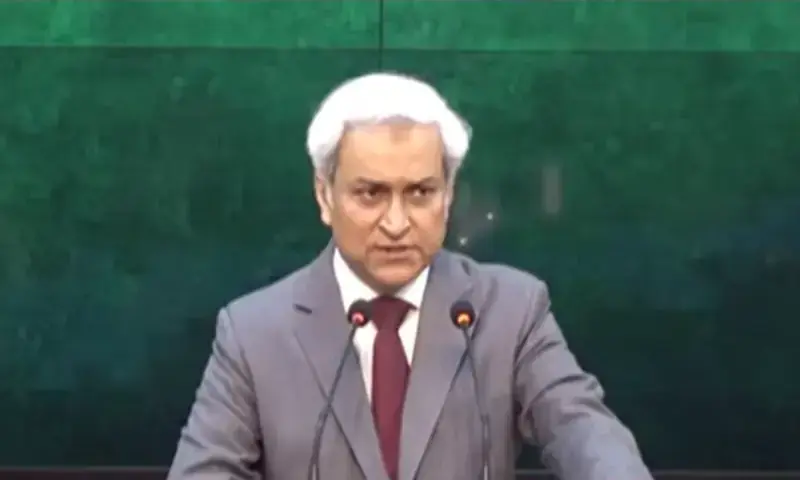
The Foreign Office said on Monday that the peace process is “ongoing” but declined to confirm or deny reports that Pakistan has proposed a framework to end the US-Israel war on Iran, according to state broadcaster Pakistan TV. “There have been several reports of a 45-day ceasefire offer, or 15-point exchange. We do not comment on these individual, specific incidents,” said FO Spokesperson Tahir Andrabi.
The comments by the FO spokesperson follow a Reuters report that claimed Iran and the United States have received a plan to end hostilities, which was put together by Pakistan. The Reuters report, which cited a “source aware of the proposals,” claimed the framework was exchanged with the two sides overnight.
Reports of Ceasefire Proposal
Axios, citing US, Israeli and regional sources, first reported on Sunday that the US, Iran and regional mediators were discussing a potential 45-day ceasefire as part of a two-phase deal that could lead to a permanent end to the war. Under the reported proposal, a ceasefire would take effect immediately, reopening the Strait of Hormuz, with 15–20 days to finalize a broader settlement.
The deal, tentatively dubbed the “Islamabad Accord,” would include a regional framework for the strait, with final in-person talks in Islamabad. Pakistan’s Chief of Defence Forces and Chief of Army Staff Field Marshal Asim Munir has reportedly been in direct contact with US and Iranian officials.
Iran Formulates Response
Separately, Iran said it has formulated its positions and demands in response to recent ceasefire proposals conveyed via intermediaries, a foreign ministry spokesperson said, adding that negotiations were “incompatible with ultimatums and threats to commit war crimes.”
Spokesperson Esmaeil Baghaei said Tehran had a set of requirements based on its national interests that had already been conveyed via intermediary channels, adding that earlier US demands, such as the 15-point plan, were rejected for being “excessive.”
“Iran does not hesitate to clearly express what it considers its legitimate demands and doing so should not be interpreted as a sign of compromise, but rather as a reflection of its confidence in defending its positions,” Baghaei said in a press conference.
Pakistan’s Role as Facilitator
The latest diplomatic push comes amid escalating hostilities that have raised concerns over disruption to shipping through the Strait of Hormuz, a critical artery for global oil supplies. The conflict has heightened volatility in energy markets, with traders closely watching any developments that could affect flows through the strait.
Pakistan has positioned itself as a facilitator in the peace process, leveraging its ties with the US and its working relationship with Iran. On Saturday, Iran’s Foreign Minister Abbas Araghchi clarified that Tehran’s leadership “never refused to go to Islamabad” for possible peace talks that Pakistan has offered to host.
Trump’s Threats and Deadlines
US President Donald Trump has, in recent days, warned Iran of consequences if a ceasefire is not reached within a short timeframe. On Sunday, in an expletives-laden Truth Social post, Trump warned Iran that the US would target its power plants and bridges if Tehran did not “re-open” the Strait of Hormuz, giving another deadline.
Iran said Trump’s statement, which was also denounced within the US, was a “clear evidence of intent to commit war crime” and asked the international community to prevent this atrocious act from happening.
The US president later posted on social media, without mentioning Iran or any other details: “Tuesday, 8:00 P.M. Eastern Time!”
“If they don’t do something by Tuesday evening, they won’t have any power plants and they won’t have any bridges standing,” Trump told the Wall Street Journal.
Trump Claims Progress in Talks
After his Truth Social post, the US president also claimed that talks with Tehran were underway and he believed there was “a good chance” of making a deal with Iran on Monday.
“I think there is a good chance tomorrow, they are negotiating now,” the president told a Fox News journalist. “If they don’t make a deal and fast, I’m considering blowing everything up and taking over the oil,” he added.
Analysis: A Critical Diplomatic Moment
The Foreign Office’s refusal to confirm or deny reports of a Pakistani-proposed ceasefire framework reflects the sensitivity of the diplomatic efforts. By neither confirming nor denying, Pakistan maintains plausible deniability while keeping channels open with both the US and Iran.
The reported “Islamabad Accord” would represent a significant diplomatic achievement for Pakistan, positioning it as a key mediator in one of the most consequential conflicts of the decade. However, Iran’s insistence that negotiations are “incompatible with ultimatums and threats to commit war crimes” suggests that significant obstacles remain.
Trump’s simultaneous pursuit of talks and threats of further military action reflects the dual-track approach the US has maintained throughout the conflict. The president’s claim that there is “a good chance” of a deal on Monday, combined with his threats to “blow everything up,” creates a confusing picture for observers.
For Iran, the challenge is to secure a permanent ceasefire with guarantees against future attacks, while avoiding the appearance of capitulating to US pressure. Tehran’s formulation of its own positions and demands suggests that it will not simply accept the US or Pakistani framework without modifications.
As the Tuesday evening deadline approaches, the world watches to see whether diplomacy will succeed or whether the conflict will escalate further. The “peace process” that the Foreign Office describes as “ongoing” may be the only hope for avoiding a wider war.