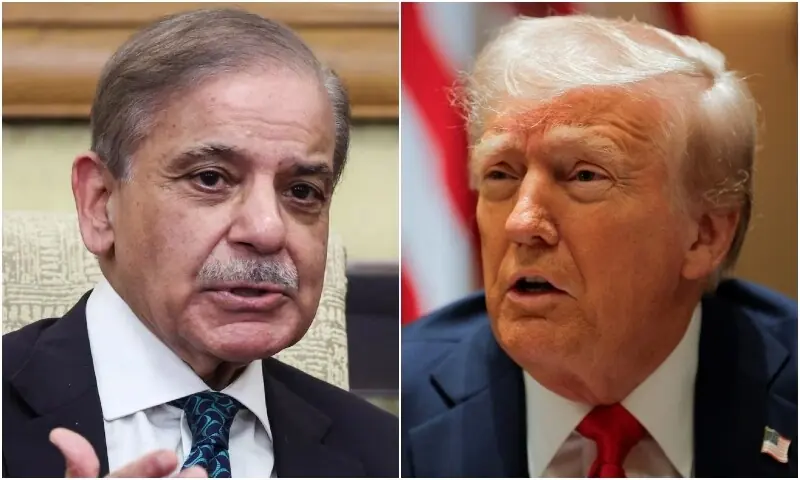
ISLAMABAD – Prime Minister Shehbaz Sharif appealed to US President Donald Trump on Wednesday to extend a deadline for two weeks that he had set for Iran to make a deal with Washington and reopen the Strait of Hormuz. PM Shehbaz’s appeal came hours before Trump’s 8pm ET deadline on April 8 was about to end, with the US president having warned of wider bombing on Iranian infrastructure if Tehran fails to meet the deadline.
Earlier on Tuesday, Trump had renewed his threat to Iran, saying “a whole civilisation will die tonight,” as it showed no sign of accepting his ultimatum to open the Strait of Hormuz.
PM Shehbaz’s Request
Hours later, PM Shehbaz posted on X: “Diplomatic efforts for peaceful settlement of the ongoing war in the Middle East are progressing steadily, strongly and powerfully with the potential to lead to substantive results in the near future. To allow diplomacy to run its course, I earnestly request President Trump to extend the deadline for two weeks.”
He also requested Iran to open the Strait of Hormuz — a key maritime corridor through which 20 per cent of the world’s oil and liquefied natural gas flowed before the Middle East war began — for a corresponding period of two weeks.
“Pakistan, in all sincerity, requests the Iranian brothers to open the Strait of Hormuz for a corresponding period of two weeks as a goodwill gesture. We also urge all warring parties to observe a ceasefire everywhere for two weeks to allow diplomacy to achieve conclusive termination of war, in the interest of long-term peace and stability in the region,” he said.
White House Response
Soon after PM Shehbaz’s post, US media outlet Axios reported that White House Press Secretary Karoline Leavitt had said Trump had been informed about the request. “The President has been made aware of the proposal, and a response will come,” she was quoted as saying.
Separately, Fox News quoted Trump as stating that his administration was in the midst of tough talks. “I can’t tell you, because right now we’re in heated negotiations,” he told Fox News.
Iranian Response
Meanwhile, Reuters quoted a senior Iranian official as saying that Iran was positively reviewing Pakistan’s request. The positive reception from Tehran suggests that Pakistan’s diplomatic outreach may be gaining traction, even as Trump’s deadline looms.
Pakistan’s Mediation Role
Pakistan has positioned itself as a facilitator in the peace process between Tehran and Washington for an end to ongoing hostilities in the Middle East that began with the US and Israel launching strikes on Iran on February 28. In a retaliatory measure, Iran has restricted much of the traffic in Hormuz, which has plunged the world into a fuel crisis.
Dar’s Diplomatic Exchanges
Following PM Shehbaz’s post, Deputy Prime Minister and Foreign Minister Ishaq Dar held four phone calls with the foreign ministers of Morocco, Saudi Arabia, Turkiye and Egypt in a span of around half an hour, according to the Foreign Office (FO). In all these engagements, Dar exchanged views on the latest developments in the Middle East and the wider region and highlighted the current status of Pakistan’s sustained efforts to promote dialogue and diplomatic engagement aimed at fostering peace and stability.
The foreign ministers of Saudi Arabia, Turkiye and Egypt were also in Islamabad last week and participated in a quadrilateral moot focused on de-escalation efforts in the Middle East. Dar had said after the quadrilateral moot that Iran and the US had expressed confidence in Pakistan to facilitate talks and Islamabad would be honoured to host dialogue “in coming days.”
A day after the moot, Dar was in Beijing where Pakistan and China issued a five-point initiative for restoring peace and stability in the Gulf and the Middle East.
Background of Mediation Efforts
Prime Minister Shehbaz Sharif had initially offered on March 24 that Pakistan stood “ready and honoured” to host “meaningful and conclusive talks” between the US and Iran.
On March 25, Iran’s state-owned broadcaster Press TV reported that Tehran had “responded negatively” to an American proposal aimed at ending the US-Israeli war on the country. The report cited a senior political-security official and outlined five conditions under which Tehran would agree to end the ongoing conflict: a complete halt to “aggression and assassinations”; the establishment of concrete mechanisms to ensure the war is not reimposed; guaranteed payment of war damages and reparations; the conclusion of the war across all fronts; and international recognition of Iran’s sovereign right to exercise authority over the Strait of Hormuz.
On Monday, Iranian media reported that Iran had conveyed its response to a US proposal for ending the war to Pakistan, again rejecting a ceasefire and emphasising the necessity of a permanent end to the war. The Iranian response consisted of 10 clauses, including an end to conflicts in the region, a protocol for safe passage through the Strait of Hormuz, lifting of sanctions, and reconstruction.
A Critical Diplomatic Moment
PM Shehbaz’s appeal to Trump to extend the deadline represents a last-ditch diplomatic effort to avert a wider war. With hours remaining before Trump’s deadline, the prime minister’s request is a high-stakes gamble: if Trump agrees, diplomacy has more time; if Trump refuses, the region could be plunged into further chaos.
The prime minister’s simultaneous request to Iran to open the Strait of Hormuz as a “goodwill gesture” is also significant. By linking the two requests — an extension from Trump and the opening of the strait from Iran — PM Shehbaz is attempting to create a parallel set of actions that could build trust between the two adversaries.
The White House’s acknowledgment that Trump has been informed of the request suggests that the proposal is being taken seriously. However, Trump’s description of “heated negotiations” indicates that no agreement has been reached yet.
Iran’s positive review of Pakistan’s request offers a glimmer of hope. If Tehran agrees to open the strait as a goodwill gesture, it could create momentum for a broader ceasefire.
For Pakistan, the stakes could not be higher. Success would cement Islamabad’s status as a key mediator and potentially bring an end to a war that has disrupted global energy markets and threatened regional stability. Failure could mean a wider war, with unpredictable consequences for Pakistan and the world.
As the deadline approaches, the world watches to see whether Trump will grant the extension, whether Iran will open the strait, and whether diplomacy can prevail over military escalation.