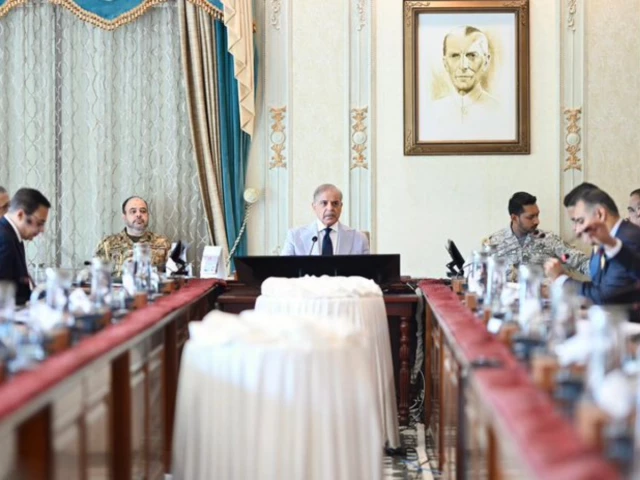
ISLAMABAD, May 14, 2026 — Prime Minister Shehbaz Sharif on Thursday expressed the resolve to make Pakistan an economic power with the same hard work, spirit, and commitment that was demonstrated in making Pakistan a nuclear power, state-run Radio Pakistan reported .
Addressing a federal cabinet meeting in Islamabad, the prime minister paid tribute to all the heroes — including scientists, politicians, and other institutions — who made Pakistan’s defence impregnable and enabled it to become a nuclear power .
The prime minister said all governments had also played a key role in attaining nuclear capability, adding that Pakistan’s nuclear deterrence was “for defence and not for offensive purposes” .
Nuclear Program: Remembering the Journey
PM Shehbaz said the founder of Pakistan’s nuclear programme was Zulfikar Ali Bhutto. However, it was former prime minister Nawaz Sharif who “took it to its logical conclusion and conducted nuclear tests” .
He said history would always remember May 28 — the date in 1998 when Pakistan conducted its nuclear tests in response to India’s tests earlier that month, becoming the seventh declared nuclear weapons state and the first in the Muslim world .
Marka-e-Haq: Remembering the 2025 Conflict with India
Turning to Marka-e-Haq (The Battle for Righteousness), the prime minister said the first anniversary was celebrated in a befitting manner on May 10 .
He said this landmark victory was achieved due to the blessings of Allah Almighty and through national unity and cohesion .
PM Shehbaz said Pakistan’s armed forces “taught the enemy a lesson with great courage and bravery, which they would remember for the rest of their lives” .
The term “Marka-e-Haq” refers to the 2025 conflict with India, which began with the April 22 Pahalgam attack and concluded with a ceasefire on May 10 following Operation Bunyanum Marsoos . The conflict marked the most significant military engagement between the two nuclear-armed neighbors since 2019 .
Counter-Terrorism Efforts
The prime minister also lauded the sacrifices rendered in the fight against terrorism, saying Pakistan was making “unparalleled efforts to eliminate terrorism” .
He further appreciated the teamwork of all cabinet members for economic improvement over the past two years despite several challenges .
On the occasion, the cabinet offered fateha (prayers) for the elevation of the ranks of all those martyred in the war against terrorism .
Housing Reforms: An Urgent Need
Earlier, PM Shehbaz chaired a separate review meeting on housing sector reforms, where he underlined the need for immediate and structured action to address the growing demand for housing .
He said that rising population growth had made reforms in the housing sector an urgent national requirement, stressing that expanding access to affordable housing remains a key government priority .
“Increasing population growth has made reforms in the housing sector an urgent requirement,” he said . The premier added that the government’s focus included:
- Providing housing for low-income groups
- Promoting affordable housing schemes
- Encouraging private sector participation
- Improving public facilities
Urban Planning and Transparency
During the meeting, he reiterated that affordable housing and better urban planning were central to the government’s policy direction as urban pressures continue to rise across major cities .
The prime minister also directed that housing sector processes be digitized and automated to ensure greater transparency and efficiency, while calling for a stronger regulatory framework to attract investment and improve governance in the sector .
Officials briefed the meeting on proposals, including:
- Mandatory registration of developers with the Securities and Exchange Commission of Pakistan (SECP)
- Introduction of a one-window system for stakeholders
- Measures to curb unplanned urban expansion
- Promotion of vertical development
- Preparation of master town planning frameworks for major cities
The prime minister instructed that the proposals be further discussed with provincial governments to ensure coordinated implementation .
Population Pressure: A Looming Challenge
The push for housing reforms comes against the backdrop of alarming population projections. According to the Population Projections report 2023-50 , launched by the Planning Minister, Pakistan’s population may explode to 390 million by 2050 — an increase of 62% .
Key projections from the report:
| Indicator | Current | 2050 Projection | Increase |
|---|---|---|---|
| Total population | — | 390 million | +62% |
| Working-age population (15-64 years) | 135.2 million | 255.4 million | +89% |
| Children (under 18 years) | 118 million | 139.7 million | +18% |
The report noted that 256 million people will be in the market looking for jobs by 2050 — more than Pakistan’s existing total population .
Although the report did not comment on the economic growth rate needed to create jobs for the majority of these 255 million people, Pakistan’s current growth model and trend are not sufficient to absorb the workforce .
The country needs a sustainable economic growth of 6-8% to create jobs for people already in the market, but the economy is growing at an average annual pace of around 3.5%. The government is also implementing fiscal and monetary consolidation policies under the IMF programme that do not allow growth above 5% .
Meeting Attendees
The housing sector review meeting was attended by:
- Minister for Planning Ahsan Iqbal
- Minister for Housing and Works Mian Riaz Hussain Pirzada
- Interior Minister Mohsin Naqvi
- Law Minister Azam Nazeer Tarar
- Adviser to the PM Rana Sanaullah
- Minister of State for Interior Talal Chaudhry
- Minister of State for Finance and Railways Bilal Azhar Kayani
- Chairman NAB Lt Gen (retd) Nazir Ahmad Butt
- Attorney General Mansoor Usman Awan
- Senior government officials
The Economic Challenge Ahead
PM Shehbaz’s vision of transforming Pakistan into an economic power faces significant headwinds:
- IMF program constraints: The government has committed to a Rs2.8 trillion primary budget surplus for the next fiscal year, limiting fiscal space for growth-oriented spending
- Low growth trajectory: The economy grew at just 3.7% in FY26, missing the 4.2% target
- Industrial slowdown: High energy costs, taxation, and borrowing costs have slowed industrial growth to 3.5%
- Unemployment and poverty: Four years of stabilization policies have “taken a heavy toll on national output and contributed to increase in poverty, unemployment and income inequality,” according to the Planning Ministry
The prime minister’s comparison to the nuclear program — which required decades of sustained effort, political will, and national consensus — suggests he envisions a similarly long-term, multi-administration commitment to economic transformation .