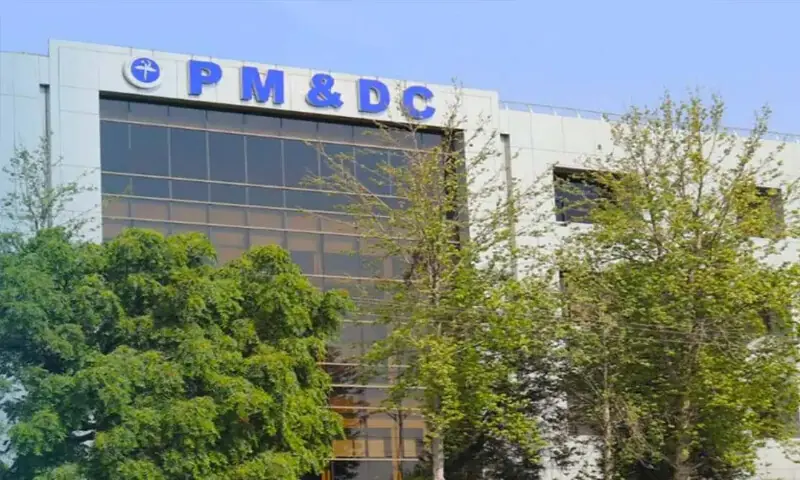
ISLAMABAD – The Pakistan Medical and Dental Council (PMDC) on Tuesday announced that it would hold the National Equivalence Board (NEB) examination on May 16, with the PMDC chairperson terming it the “best opportunity” for students affected by the US-Israeli war on Iran. The exam will provide a pathway for Pakistani students enrolled in foreign medical institutions who wish to return to Pakistan without losing their academic progress.
The PMDC conducts the NEB exam twice a year to assess the knowledge, clinical skills, and professional competence of students who have partially completed medical or dental education abroad and seek transfer to or admission in Pakistan. The exam is computer-based and consists of multiple-choice questions.
Speaking to Dawn, PMDC Chairperson Dr Rizwan Taj said, “Although students from across the world can appear in the exam, it will provide the best opportunity to those who have been stuck [due to the war] and want to return to Pakistan without facing any loss of education and time.”
Eligibility Criteria
Dr Taj explained that Pakistani students who were enrolled in foreign medical or dental institutions, had completed two years of study and reached at least the third year, were eligible to sit the NEB exam. “Passing the exam is required for the transfer and admission to Pakistani institutions for the next academic year,” he added.
The eligibility requirement ensures that students have acquired foundational knowledge before being assessed for equivalence with Pakistani medical education standards.
Exam Date and Registration
According to a statement issued by the PMDC, the NEB exams will be conducted on May 16, 2026, in Rawalpindi. The portal for student registration will be live from April 9 to April 24, 2026.
“All eligible candidates are advised to complete their registration within the prescribed timeline once the portal becomes active,” the statement said.
Special Opportunity for Students in Iran
The PMDC specifically highlighted that the exam presents an opportunity for students currently pursuing medical and dental education in Iran to appear in the examination. “Such candidates are advised to complete the required codal formalities and ensure timely registration with PMDC,” the statement added.
This provision is particularly significant given the ongoing US-Israeli war on Iran, which has disrupted educational institutions and created security concerns for Pakistani students in the country.
Advisory for Future Students
The PMDC also advised students and parents considering admission to foreign medical and dental colleges to consider security concerns and long-term prospects. “The safety and well-being of students remain paramount, and careful consideration should be given to both security concerns and long-term academic prospects,” it said.
The advisory reflects growing concerns about the stability of medical education in conflict-affected regions and encourages families to evaluate risks before sending students abroad.
Exam Details
The statement said details regarding the NEB examination schedule, syllabus, and examination centre were available on the PMDC’s website. “Candidates are encouraged to regularly check official announcements to stay updated on any further instructions or changes,” the statement said.
Context: Students Affected by Regional Conflict
The announcement comes as Pakistani students in Iran have been affected by the ongoing war. The US-Israeli offensive on Iran, which began on February 28, has disrupted normal life, damaged infrastructure, and created security concerns. Several Iranian universities have been targeted in the strikes, and the educational environment has been severely impacted.
Pakistani students enrolled in Iranian medical and dental institutions have faced particular challenges, as their clinical training and academic schedules have been disrupted. The PMDC’s NEB exam offers these students a pathway to continue their education in Pakistan without starting over.
Analysis: A Timely Intervention
The PMDC’s decision to hold the NEB exam on May 16 is a timely intervention for Pakistani students affected by the Middle East conflict. For students who have invested years in medical education abroad, the ability to transfer to Pakistani institutions without losing academic progress is crucial.
The NEB exam serves as an equivalence assessment, ensuring that students who have studied abroad meet the standards required for medical practice in Pakistan. By offering the exam at this time, the PMDC is providing a lifeline to students who might otherwise have to abandon their education.
The special mention of students in Iran is significant. With the war continuing and Iranian universities targeted, Pakistani students in Iran face an uncertain future. The PMDC’s exam offers them a concrete option: return to Pakistan, take the NEB exam, and continue their education in Pakistani institutions.
For the families of these students, the announcement provides some relief. Instead of worrying about their children’s safety and academic future, they now have a clear pathway forward. For the students themselves, the exam represents hope—the hope that their years of study will not be wasted, and that they can complete their medical education in safety.
As the registration portal opens on April 9, eligible students across the world will have the opportunity to secure their academic future. The PMDC has provided a pathway; now it is up to the students to take it.