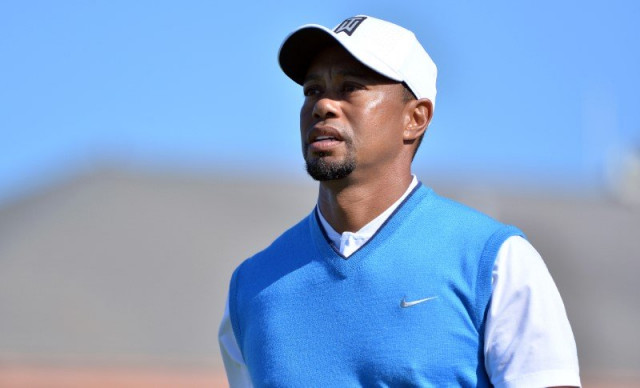
Tiger Woods was arrested and charged with driving under the influence Friday after a rollover crash near his Florida home, authorities said, as the 15-time major champion’s career veered into fresh turmoil. The 50-year-old golfer escaped injury but was detained after his vehicle clipped a truck while attempting to overtake on a residential road on Jupiter Island, flipping onto its side before sliding to a stop.
MIAMI – A decade and a half of physical and personal struggles for one of golf’s greatest champions took another troubling turn Friday when Tiger Woods was arrested following a single-vehicle crash in Jupiter, Florida. The Martin County Sheriff’s Office confirmed that Woods was charged with driving under the influence, property damage, and refusal to submit to a lawful test after the incident.
Martin County Sheriff John Budensiek told reporters that Woods showed signs of “impairment” at the scene, though he passed a breathalyzer test. When officers requested a urinalysis, Woods refused—a decision that led to the additional charge of refusal to submit to testing.
“When it came time for us to ask for a urinalysis test, he refused, and so he’s been charged with DUI, with property damage and refusal to submit to a lawful test in the crash,” Budensiek said.
In accordance with Florida DUI laws, Woods was detained at the county jail for eight hours. A booking photo released by authorities showed a red-eyed, stubbly-chinned Woods upon his arrival at the facility approximately two hours after the crash. He was photographed departing the jail in a vehicle late Friday.
‘Could Have Been Worse’
The incident occurred on a two-lane residential road on Jupiter Island, where Woods lives. According to the sheriff’s account, Woods’s vehicle clipped a truck while attempting to overtake, causing his Land Rover to flip onto its side before sliding to a stop.
Neither Woods nor the driver of the truck was injured, but Budensiek emphasized that the outcome could have been far more severe. “Had somebody been moving in the opposite direction, we would not be having a conversation saying there was no injuries,” he said.
The sheriff noted that drug recognition experts who examined Woods at the scene found the golfer “lethargic” and believed he was impaired by “some kind of medication or drug.” No drugs or medication were found in his vehicle, and because Woods refused the urine test—his right under Florida law—authorities “will never get definitive results as to what he was impaired on at the time of the crash,” Budensiek said.
The sheriff declined to speculate on Woods’s speed in the moments before the crash but noted that the skid marks indicated the vehicle “slid for a decent space before he came to a stop.”
A Pattern of Legal Troubles
Friday’s arrest marks the second time Woods has faced DUI-related charges in Florida. In 2017, he was arrested in Jupiter after police found him asleep at the wheel of his damaged car. In that incident, Woods eventually pleaded guilty to reckless driving and said he had taken a mix of painkillers.
The 2017 arrest came years after the 2009 sex scandal that shattered Woods’s clean-cut image, cost him numerous sponsorships, and led to a prolonged hiatus from professional golf. While he returned to the sport and staged one of the most remarkable comebacks in athletic history—winning the 2019 Masters, his 15th major championship, more than a decade after his previous major victory—his personal struggles have continued.
Woods’s physical health has been a persistent challenge. In 2021, he was involved in a serious car crash in California that left him with severe right leg injuries, requiring pins inserted in his foot and ankle and a rod in his tibia. He underwent follow-up surgery in 2023. He returned to competition at the 2022 Masters, where he struggled to walk all four rounds on the way to a 47th-place finish.
Most recently, Woods has been working to return from an Achilles tendon rupture last March and back surgery last October. He competed earlier this week in the TGL simulator indoor golf league finals and had not ruled out playing in next month’s Masters, where his five victories include his first major title in 1997 and his most recent in 2019.
Trump Expresses Sympathy
President Donald Trump, who has long counted Woods among his golfing partners and friends, expressed sympathy for the golfer in remarks to reporters in Miami following the incident.
“He’s got some difficulty, there was an accident, and that’s all I know,” Trump said. “Very close friend of mine. He’s an amazing person, amazing man, but, uh, some difficulty.”
Trump’s comments came amid a visit to Florida, where he has maintained his Mar-a-Lago residence.
The Road Ahead
Woods’s legal situation will now unfold in the Florida court system. A DUI charge with refusal to submit to testing carries significant penalties, and the golfer’s previous 2017 arrest may factor into sentencing if he is convicted.
For Woods, the arrest represents yet another setback in a career defined by extraordinary highs and devastating lows. His golfing achievements—15 major championships, 82 PGA Tour victories, and a cultural impact that transcended the sport—have cemented his legacy as one of the greatest athletes of his generation. But his personal life has been marked by scandal, injury, and now, repeated legal troubles.
In recent years, Woods has spoken candidly about the toll that injuries have taken on his body and his ability to compete. “This body … it doesn’t recover like it did when it was 24, 25. It doesn’t mean I’m not trying,” he said last year. “I keep trying.”
Whether Woods will be able to compete in next month’s Masters—the tournament he has won five times and where he completed his triumphant 2019 comeback—now appears uncertain. The arrest, combined with his ongoing physical rehabilitation, may make an appearance at Augusta National unlikely.
For the golf world, Friday’s news is a reminder that Woods’s story has never been simple. The man who dominated the sport as no one before or since has also been a figure of persistent personal turmoil. At 50, with his playing career winding down and his legacy secure, the question is not whether Woods will add to his major tally—it is whether he can find the stability that has eluded him for so long.
Analysis: A Troubled Icon
Tiger Woods’s arrest Friday is the latest chapter in a saga that has defined American sports for more than two decades. The narrative arc of his life—from prodigy to dominant champion, from fallen idol to triumphant comeback—has always been marked by extremes. Friday’s incident suggests that the pattern is not yet complete.
The immediate consequences will play out in court. But the broader implications for Woods’s legacy are more complicated. His 2019 Masters victory, which came after years of physical and personal recovery, was widely celebrated as the final chapter of his redemption story. Friday’s arrest suggests that chapter may not have been the end.
For Woods, the challenge now is twofold: legal and personal. The Florida court system will process the charges, and Woods will face the consequences of his actions. But the deeper question is whether he can address the underlying issues that have led to two DUI-related arrests in eight years.
For the golf world, Woods’s arrest is a sobering reminder of the fragility of even the most celebrated careers. The man who once seemed invincible has spent the last decade and a half battling injuries, surgeries, and personal demons. Friday’s incident is another battle—one that, unlike so many on the golf course, cannot be won with a swing of the club.
Woods has shown before that he can return from the brink. Whether he can do so again remains to be seen. But for now, the focus is on the crash, the arrest, and the questions that will follow as the legal process unfolds.