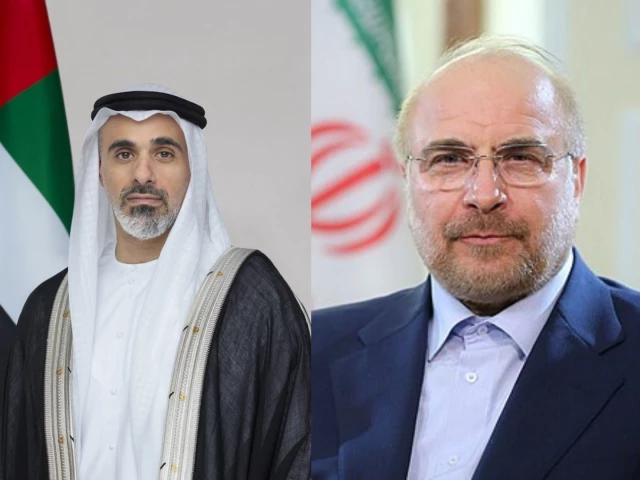
ABU DHABI – The Vice President of the United Arab Emirates (UAE) Sheikh Mansour bin Zayed discussed in a phone call with Iran’s Parliament Speaker Mohammad-Bagher Ghalibaf de-escalation efforts in the Iran war, UAE state news agency WAM reported on Wednesday. The rare phone call between the two countries comes against the backdrop of the UAE having condemned Iran’s attacks on Gulf states, describing them as terrorist acts, while also calling for the unconditional reopening of the Strait of Hormuz.
The phone call represents a significant diplomatic engagement between the UAE and Iran, two countries that have been on opposite sides of the recent conflict. The UAE hosts US military assets and has been targeted by Iranian strikes, yet the call suggests that both sides are exploring avenues for de-escalation.
US Blockade Continues
Meanwhile, the United States said on Wednesday its military had completely halted trade going in and out of Iran by sea, even though President Trump said talks with Tehran on ending the war could resume this week. Trump said negotiations between US and Iranian officials could resume in Pakistan in the next two days, and Vice President JD Vance, who led weekend talks that ended without a breakthrough, said he felt positive about where things stood.
Possible Return to Islamabad
Officials from Pakistan, Iran, and the Gulf also said negotiating teams from the US and Iran could return to Pakistan later this week, although one senior Iranian source said no date had been set. The potential return of delegations to Islamabad suggests that despite the lack of a breakthrough in the first round, all parties remain committed to the diplomatic process.
Pakistani Delegation May Visit Iran
Meanwhile, Iran’s Foreign Ministry spokesperson Esmaeil Baghaei said the Pakistani delegation might arrive in Iran on Wednesday, while President Masoud Pezeshkian insisted that ‘Iran does not seek war or instability.’
“It is highly probable that a Pakistani delegation will arrive in Iran on Wednesday and pass on messages from the US in a continuation of talks between Tehran and Washington,” spokesperson Baghaei said in a weekly press conference carried by state media. Exchanges of messages continued after the Iranian delegation returned home from US-Iranian talks that were hosted by Pakistan on Saturday, he added.
Analysis: Shuttle Diplomacy Intensifies
The UAE VP’s phone call with Iran’s parliament speaker, the potential return of US and Iranian delegations to Islamabad, and the possible visit of a Pakistani delegation to Tehran all point to an intensification of shuttle diplomacy aimed at ending the war.
The UAE’s engagement with Iran is particularly notable. While the UAE has condemned Iranian attacks on Gulf states, it also has significant economic interests in de-escalation. The closure of the Strait of Hormuz has disrupted global energy supplies, and the UAE, as a major trading hub, has been affected.
The potential visit of a Pakistani delegation to Iran suggests that Pakistan is continuing its role as a mediator, shuttling messages between Washington and Tehran. The fact that both sides are willing to continue the dialogue — despite the failure of the first round of talks to produce a breakthrough — is a positive sign.
As the ceasefire enters its second week, the diplomatic clock is ticking. The US blockade of Iranian ports has raised the stakes, but the fact that all parties are still talking suggests that a diplomatic resolution is still possible.