

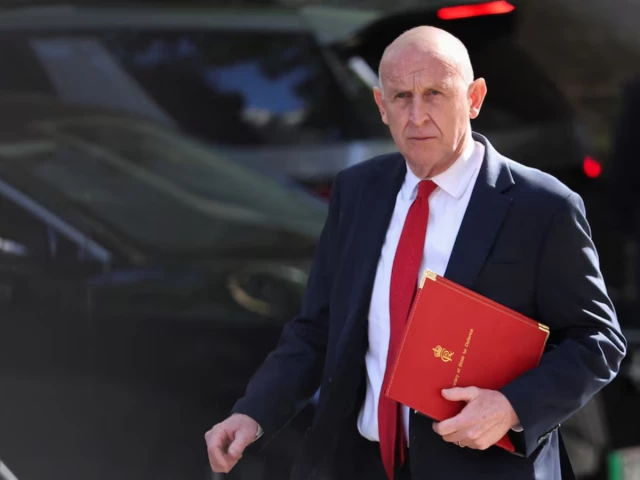
LONDON: Britain’s Defence Secretary John Healey resigned on Thursday after a major dispute over military spending, delivering a sharp rebuke to Prime Minister Keir Starmer and warning that the government’s current defence plans risk leaving the country less secure at a time of growing international threats.
Healey’s resignation marks one of the most significant political setbacks for Starmer’s government and raises fresh questions about Britain’s ability to modernise its armed forces amid mounting geopolitical tensions.
Defence Spending Dispute Sparks Resignation
In a strongly worded resignation letter, Healey accused the government and the Treasury of failing to provide sufficient funding for Britain’s defence requirements.
“You have been unable, and the Treasury has been unwilling, to commit the resources that the nation needs to defend the country at this time of rising threats,” Healey wrote.
The departing defence minister argued that the financial settlement offered for the country’s Defence Investment Plan fell significantly short of military requirements.
According to Healey, the lack of funding could weaken operational readiness and increase risks for British military personnel.
“I am being forced to make decisions that would reduce the readiness of our forces and increase the risk to personnel on operations,” he stated.
Pressure Mounts on Prime Minister Starmer
The resignation comes at a difficult moment for Prime Minister Keir Starmer, who is already facing growing political pressure within his own party.
Healey’s departure follows the earlier resignation of Health Secretary Wes Streeting and comes amid reports that senior Labour figure Andy Burnham is considering a return to frontline politics.
Political analysts say the latest resignation exposes deep divisions within the government over spending priorities and economic policy.
The dispute highlights the challenge facing the Labour administration as it attempts to balance public finances while responding to increasing defence demands from military leaders and NATO allies.
Delayed Defence Investment Plan Causes Concern
For months, Britain’s Ministry of Defence and Treasury have reportedly been engaged in negotiations over funding for a long-awaited Defence Investment Plan.
The strategy was initially expected to be released last year but has faced repeated delays due to disagreements over spending commitments.
Military officials have argued that the plan is essential for preparing Britain’s armed forces to respond to modern security threats.
Defence experts have warned that delays are creating uncertainty across the defence sector and preventing companies from making long-term investments in military production and technology.
Growing Security Challenges
Britain faces a rapidly evolving security environment that has increased pressure on government spending.
Military leaders have pointed to a range of concerns, including:
- Increased Russian naval activity near British waters
- Ongoing instability in the Middle East
- NATO’s heightened readiness requirements
- The need to modernise military equipment and capabilities
- Growing cybersecurity and hybrid warfare threats
Recent developments have also highlighted concerns about Britain’s operational readiness.
Analysts noted that the conflict involving the United States, Israel, and Iran exposed limitations in Britain’s ability to rapidly deploy advanced military assets to the region.
Defence Industry Frustrated
The defence industry has repeatedly expressed frustration over the delayed publication of the Defence Investment Plan.
Industry leaders argue that uncertainty surrounding future budgets makes it difficult to invest in production facilities, workforce expansion, and long-term procurement projects.
Several defence manufacturers have urged the government to provide clarity on future military spending commitments, warning that delays could affect Britain’s industrial capacity and strategic competitiveness.
NATO Summit Approaching
The timing of Healey’s resignation is particularly significant as Britain prepares for an upcoming NATO summit scheduled to begin on July 7.
Prime Minister Starmer recently indicated that the Defence Investment Plan would be published before the summit, where defence spending is expected to dominate discussions among alliance members.
NATO allies have increasingly called for higher military expenditure amid growing concerns over global security challenges.
Britain has traditionally been one of NATO’s leading military contributors, making the current funding dispute especially sensitive.
Economic Pressures Complicate Defence Ambitions
The government faces difficult financial constraints as it seeks to increase defence spending.
Britain continues to grapple with:
- High public debt levels
- Rising borrowing costs
- Sluggish economic growth
- Increased public spending demands
- One of the highest tax burdens in decades
These economic realities have complicated efforts to significantly expand military budgets without introducing further fiscal pressures.
Political Fallout Expected
Healey’s resignation is expected to intensify scrutiny of the government’s defence and national security policies.
Opposition parties and defence analysts are likely to question whether the current administration is adequately prepared to address emerging threats.
The departure also raises uncertainty over the future direction of Britain’s defence strategy and whether the government will revise spending plans in response to growing criticism.
As pressure builds ahead of the NATO summit, Prime Minister Starmer now faces the challenge of restoring confidence within both the military establishment and his own party while addressing concerns about Britain’s long-term security posture.
The coming weeks are expected to be critical in determining whether the government can resolve the dispute and deliver a defence strategy capable of meeting the country’s evolving security challenges.