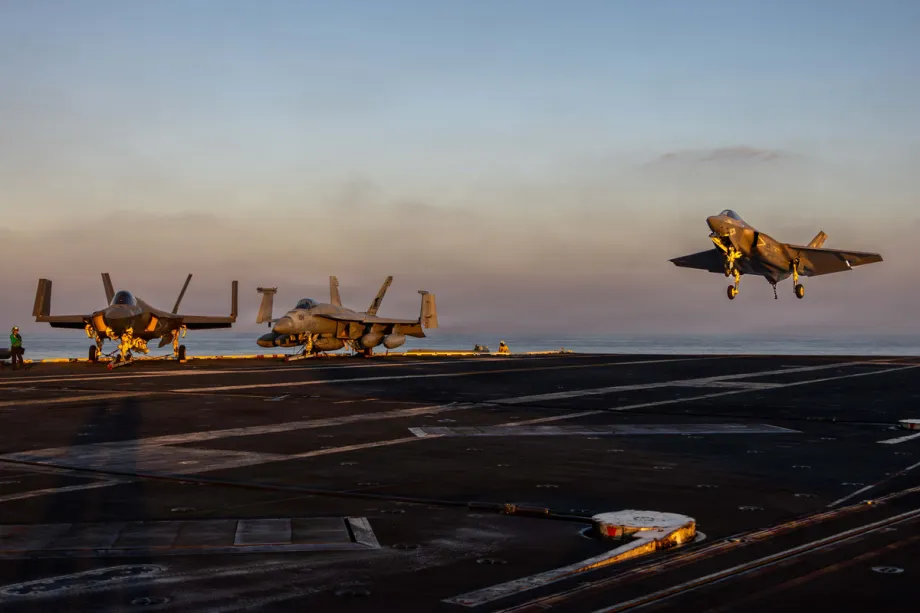
WASHINGTON — The US military has struck more than 12,300 targets inside Iran since the launch of Operation Epic Fury on February 28, according to a fact sheet released Wednesday by US Central Command (CENTCOM). The campaign, now in its second month, has employed a wide range of air, naval and ground systems including strategic bombers, fighter aircraft, drones and missile defense systems.
CENTCOM reported that more than 155 Iranian naval vessels have been damaged or destroyed during the operation, which was launched under the direct order of President Donald Trump. The command also confirmed that over 13,000 combat flights have been conducted since the campaign began .
The operation has targeted a comprehensive list of Iranian military infrastructure, including command and control centers, Islamic Revolutionary Guard Corps (IRGC) headquarters buildings, intelligence sites, integrated air defense systems, ballistic missile sites, and naval ships and submarines . Additionally, facilities linked to ballistic missile and drone manufacturing, weapons production and storage bunkers, and surface-to-air missile facilities have been struck .
‘Maximum Optionality’ for Commander-in-Chief
White House Press Secretary Karoline Leavitt said the deployment of additional US troops in the region provides President Trump with “maximum optionality” in the ongoing conflict, despite ongoing diplomatic efforts to end the war. “It’s the job of the Pentagon to create maximum optionality for the commander-in-chief,” Leavitt said .
The Pentagon has reportedly prepared plans for the possibility of extended ground operations in Iran lasting several weeks, though Leavitt declined to rule out or confirm potential ground operations . President Trump has indicated that American forces could target Iran’s Kharg Island, a critical hub handling nearly 90 percent of the country’s oil exports .
Coalition Partners Report High Interception Rates
Coalition partners, including Bahrain, Kuwait, Saudi Arabia and the United Arab Emirates, have reported high interception rates of Iranian airborne threats, aligning with the upper end of figures achieved by other air defense campaigns in recent conflicts, according to an analysis by the Centre for Strategic and International Studies (CSIS) .
The CSIS report showed that after initial intense activity, the US effort has settled into a pace of 300 to 500 targets struck per day as military leaders transition to cheaper, short-range munitions following early use of long-range weapons .
Regional Tensions Escalate
The conflict has spread across the Middle East, with Iran retaliating through drone and missile strikes targeting Israel and Gulf countries that host US military assets . Iranian-aligned groups in Iraq have also claimed responsibility for attacks on purported US targets in the region, including in Iraq and the Kurdistan Region .
US Central Command released a video earlier this week claiming to show American military strikes targeting Iranian naval vessels and aircraft. In a post on X, CENTCOM said, “US forces continue to eliminate the Iranian regime’s ability to project power in meaningful ways outside of Iran’s borders” .
Casualties and Impact
A total of 13 US service members have been killed, and about 303 others have been injured since the operation began, according to CENTCOM . According to the Human Rights Activists News Agency (HRANA), at least 1,574 people have been killed in Iran, including 236 children, 1,211 military personnel, and 707 individuals whose civilian or military status has not yet been confirmed .
The campaign has also seen significant deployment of US military assets, including B-1, B-2, and B-52 bombers, F-22 and F-35 fighter jets, and electronic warfare aircraft such as the EA-18G Growler. At sea, nuclear-powered aircraft carriers, submarines, and guided-missile destroyers have been deployed, while land-based systems including Patriot interceptor missiles, THAAD anti-ballistic missile systems, and HIMARS rocket artillery have supported operations .
President Trump has warned that the US would strike Iran’s power plants if a deal is not reached on or before April 6, 2026, though he has also stated that talks with Iran are on a positive trajectory .
The operation marks one of the largest concentrated uses of American military power in the Middle East in recent decades, with CENTCOM stating that major combat operations continue with no immediate end date announced .