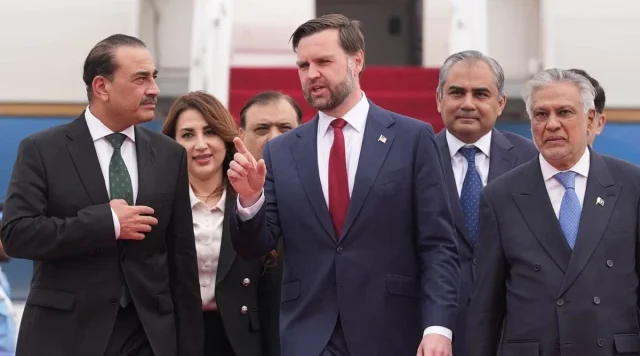
ISLAMABAD – United States Vice President JD Vance has landed in Islamabad as part of a US delegation to discuss the US-Iran ceasefire dubbed the ‘Islamabad Talks 2026’, the Foreign Office said on Saturday. The delegation included Vance, and President Donald Trump’s key Middle East envoys, Steve Witkoff and Jared Kushner.
The US delegation was received by Deputy Prime Minister and Foreign Minister Ishaq Dar, Chief of Defence Forces and Chief of Army Staff Field Marshal Syed Asim Munir, and Interior Minister Mohsin Naqvi upon arrival, according to the Ministry of Foreign Affairs. US Chargé d’Affaires Natalie Baker was also present to receive the vice president.
Welcoming Vance, Dar commended the US commitment to achieving lasting regional and global peace and stability. He “expressed hope that parties would engage constructively, and reiterated Pakistan’s desire to continue facilitating the parties towards reaching a lasting and durable solution to the conflict,” the statement read.
Vance’s Remarks Before Departure
Vance departed for Pakistan a day earlier to attend the ‘Islamabad Talks’ and said that America was looking forward to the negotiation with Iran and expressed hope that it would be positive. “We’re looking forward to the negotiation. I think it’s going to be positive. If the Iranians are willing to negotiate in good faith and extend an open hand, that’s one thing. If they’re going to try to play us, they’re going to find that the negotiating team is not that receptive. The president has given us some pretty clear guidelines, and we’ll see how it goes,” said JD Vance.
Iranian Delegation Arrives
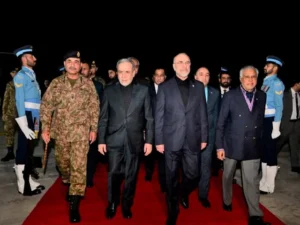
The Iranian delegation, consisting of Iranian Foreign Minister Abbas Araghchi and Parliament Speaker Mohammad-Bagher Ghalibaf, also arrived in Pakistan late Friday night to attend the high-stakes negotiation talks with the US. The FO said the “high-powered delegation” was led by Ghalibaf and was received by Dar, National Assembly Speaker Sardar Ayaz Sadiq, Naqvi, and CDF Munir. It added that Dar expressed the hope that the parties would “engage constructively” and reiterated Pakistan’s desire to continue facilitating them towards reaching a lasting and durable solution to the conflict.
High-Stakes Negotiations
Pakistan is set to host what could prove to be one of the most consequential diplomatic engagements in recent history, as senior leaders from the US and Iran arrive in Islamabad for high-stakes negotiations following a devastating six-week war that has left thousands dead and pushed the global economy to the brink of recession.
Security Lockdown
Islamabad has effectively been placed under an unprecedented security lockdown ahead of the talks. Key routes have been sealed, security personnel heavily deployed, and surveillance heightened to ensure the safety of visiting dignitaries. Officials say the negotiations will take place at a secure, undisclosed location, away from the media spotlight.
Pakistan’s Mediation Role
Pakistan has emerged as a key mediator in the region. Last month, the US and Israel launched airstrikes on Iran, which prompted Tehran to retaliate with attacks on Israel and US military bases in the Gulf. This escalation of tensions in the Middle East led to efforts by political and military leadership in Pakistan to de-escalate the situation.
To ease tensions, Pakistan had also hosted a quadrilateral foreign ministers’ meeting in Islamabad, with representatives from Turkiye, Saudi Arabia, and Egypt. The meeting grabbed the world’s attention and was widely appreciated for Pakistan’s efforts. Pakistan and China also jointly proposed a five-point initiative aimed at restoring peace and stability in the Gulf and the broader Middle East.
The Ceasefire Framework
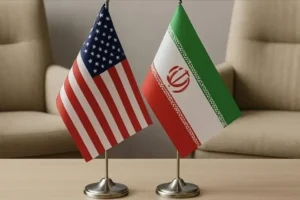
A fragile, conditional ceasefire is in place between the US and Iran, agreed after weeks of intense conflict. The deal revolves around a two-week pause in fighting, largely aimed at halting major military strikes and reopening strategic routes like the Strait of Hormuz — although core disagreements remain unresolved. Both Washington and Tehran have declared the ceasefire a kind of victory, even as they stick to competing demands for a long-term settlement.
At the centre of the truce is a 10-point proposal from Iran, which the US has described as a “workable basis” for negotiation. The plan reportedly covers issues like non-aggression, control and operation of the Strait of Hormuz, lifting sanctions, and cessation of hostilities on multiple fronts — including calls for an end to wars in related theatres. This framework is now set to guide peace talks, with Pakistan expected to host negotiations aimed at turning the temporary ceasefire into a more durable peace.
Analysis: A Defining Moment for Pakistani Diplomacy
The arrival of Vice President JD Vance — the highest-ranking US official to visit Pakistan in years — and Iran’s parliamentary speaker marks a defining moment for Pakistani diplomacy. Having brokered a two-week ceasefire between the United States and Iran, Pakistan is now attempting to convert that pause into a permanent peace agreement.
The presence of such high-level figures underscores both the urgency and the gravity of the situation. Washington and Tehran are due to begin negotiations seeking to end the six-week-old Iran war that has killed thousands of people across the Middle East, disrupted energy supplies, fed inflation, and slowed the global economy.
As the delegations gather in Islamabad, the world will be watching. Pakistan has brought the parties to the table. Now comes the harder part: keeping them there and securing a deal.