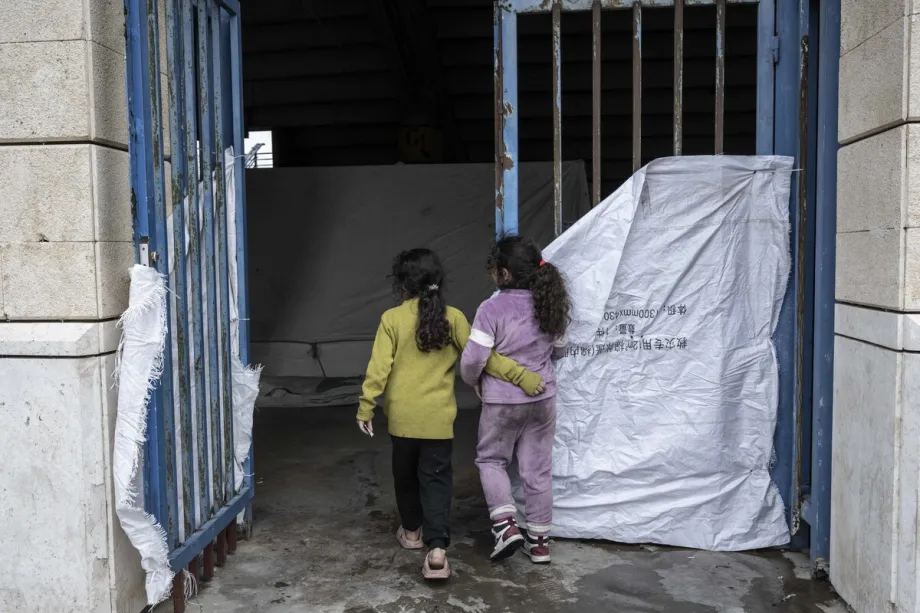
An average of 19,000 children have been displaced every day in Lebanon over the past three weeks as Israeli strikes continue to devastate the country, UNICEF officials said Friday, painting a grim picture of a humanitarian catastrophe unfolding at staggering speed. More than 370,000 children have been forced from their homes in just three weeks—the equivalent of “hundreds of school buses filled with children fleeing for their lives every 24 hours,” according to the UN agency’s representative in Lebanon.
GENEVA – The human cost of the expanding Middle East conflict is being measured in the lives of children, as Lebanon becomes the latest frontline in a war that has already claimed thousands of lives across the region. Marcoluigi Corsi, UNICEF representative in Lebanon, delivered a harrowing assessment of the crisis during a UN briefing in Geneva, revealing that more than 370,000 children have been displaced in just three weeks—an average of at least 19,000 girls and boys forced from their homes every single day.
“The speed and scale are staggering,” Corsi said, describing a “sudden, chaotic mass displacement” that is “tearing families apart and hollowing out entire communities.” He explained that the crisis has displaced roughly 20 percent of Lebanon’s population in less than a month, with more than one million people uprooted from their homes.
To grasp the magnitude of the displacement, Corsi offered a stark comparison: “hundreds of school buses filled with children fleeing for their lives every 24 hours.” The image captures the relentless pace of the crisis, which shows no signs of abating as Israeli strikes continue to pound targets across Lebanon.
The Psychological Toll on Children
Corsi warned of severe psychological consequences for children caught in repeated cycles of violence, saying the mental and emotional exhaustion weighing on them is “devastating.” The relentless bombardment and displacement are not merely physical hardships but are embedding deep-seated fear that will have lasting effects.
“This relentless cycle of bombardment and displacement is severely compounding their psychological scars, embedding deep-seated fear and threatening profound, long-term emotional harm,” Corsi said. The trauma of displacement, the loss of homes, and the constant threat of violence will shape the lives of these children for years to come.
The physical toll is equally shocking. Corsi reported that at least 121 children have been killed and 395 injured in the escalation. These numbers, he emphasized, represent not statistics but individual lives cut short or forever altered by the conflict.
A Humanitarian System Under Siege
Deteriorating living conditions are adding to the toll, with more than 135,000 displaced people sheltering in over 660 sites across Lebanon, many of which are overcrowded and unsafe. Basic services are collapsing under the weight of the crisis. Water systems have been damaged, and more than 435 schools have been repurposed as shelters—disrupting education for more than 115,000 students.
“Children are paying the highest price for this conflict,” Corsi said, calling for “an immediate ceasefire” and urgent humanitarian access. “They need to stop running and start living as children should.”
The UN official’s appeal underscored the desperate need for a pause in the fighting to allow humanitarian aid to reach those who have been displaced. Without such access, the risk of a humanitarian catastrophe will only grow.
‘Access to Safety Is Becoming Increasingly Difficult’
The UN refugee agency (UNHCR) echoed UNICEF’s urgent warnings, with its representative in Lebanon, Karolina Lindholm Billing, telling the briefing that people in Lebanon no longer feel safe—even in displacement. Families live in constant fear, she said, and the psychological toll, particularly on children, will last “far beyond the current conflict.”
“Access to safety is also becoming increasingly difficult,” Billing warned, noting that the destruction of key bridges in the south has cut off entire districts, isolating more than 150,000 people and “severely limiting humanitarian access.” The infrastructure damage is not merely a byproduct of the conflict but a deliberate obstruction that prevents aid from reaching those who need it most.
Billing stressed that beyond immediate shelter needs, there is a “clear, urgent requirement” for increased protection and community support. “The risk of a humanitarian catastrophe is real,” she said, as needs are “rising faster than resources.”
“Without expanded shelter, overcrowding will worsen. Without strengthened protection, risks for children, women and vulnerable groups will increase,” Billing added. “If aid does not reach people quickly, distress will turn into tension.”
Red Cross Volunteers Under Fire
The International Federation of Red Cross and Red Crescent Societies (IFRC) also sounded the alarm, calling on the international community and donors to act as needs grow in Lebanon. Tommaso Della Longa, IFRC spokesperson, told reporters that “needs are growing, and we cannot leave affected communities in Lebanon to face this crisis alone.”
Della Longa highlighted the extreme risks facing humanitarian workers, particularly those operating during nighttime missions. “One of the major challenges faced is the high level of risk facing volunteers, particularly during nighttime missions,” he said.
“Staff and volunteers are working under extreme pressure while ensuring both their personal safety and the safe evacuation of injured individuals,” he continued. “Sadly, we already lost one volunteer and several others were injured during ambulance missions.”
The loss of a volunteer—and the injury of several others—underscores the dangers facing those trying to provide aid in the midst of active hostilities. The IFRC’s priority, Della Longa said, is to sustain the response, addressing both immediate needs and the longer-term sustainability of operations.
The spokesperson noted that IFRC’s support is “critical” to maintaining ambulance services, health services including Mobile Medical Units, blood supplies for hospitals, and relief assistance for displaced families.
Lebanon Caught in Regional Conflagration
Lebanon’s crisis is inseparable from the broader regional conflict that has engulfed the Middle East since US-Israeli strikes on Iran began on February 28. The country has been subjected to sustained Israeli bombardment targeting Hezbollah positions, but the strikes have caused widespread civilian casualties and infrastructure damage.
The displacement of more than one million people—roughly 20 percent of Lebanon’s population—in less than a month represents one of the most rapid population movements in recent history. The country, already grappling with a severe economic crisis and political instability, is now facing a humanitarian disaster that threatens to overwhelm its already fragile systems.
International Response and Diplomatic Efforts
As the humanitarian crisis deepens, diplomatic efforts to end the broader conflict continue. Pakistan has positioned itself as a key mediator, offering to host US-Iran talks in Islamabad. The White House has said that talks remain “productive” even as it warned that President Trump is prepared to “unleash hell” on Iran if Tehran fails to accept the “reality of the current moment.”
Iran, meanwhile, has hardened its position, with its military declaring control over the Strait of Hormuz and its parliament speaker accusing the US and Israel of planning to occupy one of Iran’s islands. The gap between the two sides appears wide, even as backchannel communications continue.
For Lebanon, the stakes could not be higher. The country’s children are paying the highest price for a conflict they did not create. Whether diplomatic efforts can produce a ceasefire before the humanitarian catastrophe worsens remains an open question.
Analysis: Children as Casualties of a Regional War
The displacement of 19,000 children daily in Lebanon is not merely a statistic—it is a measure of the human cost of a conflict that has spiraled far beyond its original parameters.
What began as US-Israeli strikes on Iranian nuclear facilities has expanded into a regional war that now encompasses Lebanon, Iraq, and the Gulf states. In each theater, the pattern is the same: civilians bear the brunt, children suffer most, and the infrastructure of daily life is systematically destroyed.
The numbers from Lebanon are staggering but also, in a grim sense, predictable. When bridges are destroyed, water systems damaged, and schools converted to shelters, the result is always the same: displacement, disease, and the disruption of childhood.
For the international community, the question is whether these numbers will finally catalyze action. The UN agencies have made their case clearly: the needs are growing, the risks are mounting, and the window for effective intervention is closing.
For now, the children of Lebanon continue to flee—19,000 every day, filling the equivalent of hundreds of school buses, searching for safety that seems increasingly elusive. Whether they will find it depends not on their own efforts but on the decisions of adults far from the front lines, in capitals where the calculus of war and peace is being made.