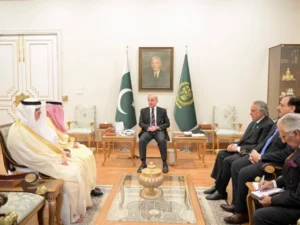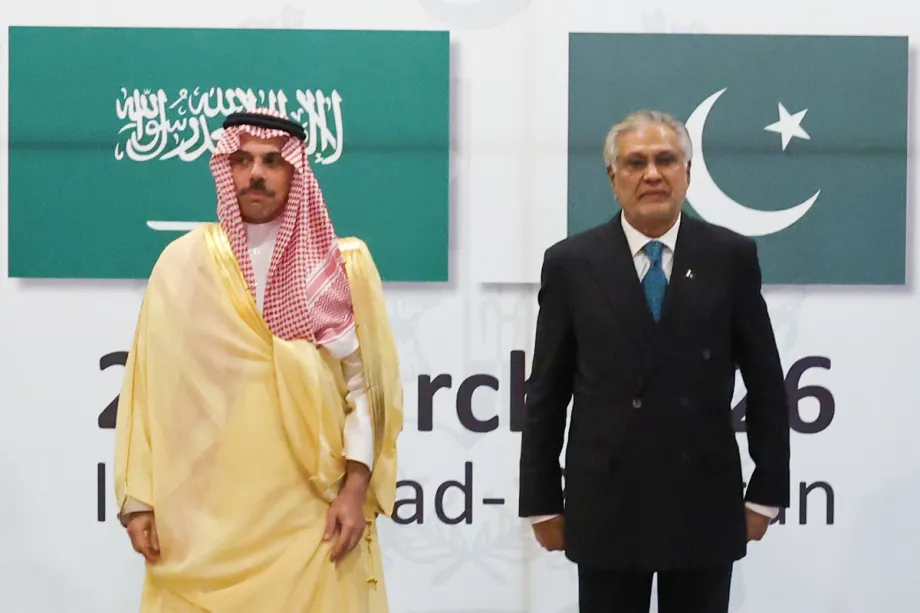
Pakistani Foreign Minister Ishaq Dar and his Saudi counterpart Prince Faisal bin Farhan Al Saud held high-level talks in Islamabad on Sunday, discussing “evolving regional and international developments” as the Middle East conflict enters its second month. The meeting is part of a broader diplomatic push by Pakistan to coordinate mediation efforts with key regional powers to end the US-Israeli war on Iran.
ISLAMABAD – As the conflict that has engulfed the Middle East enters its second month, Pakistan and Saudi Arabia have reaffirmed their commitment to working together to promote peace and stability in the region. Foreign Minister Ishaq Dar hosted Saudi Foreign Minister Prince Faisal bin Farhan Al Saud for talks that focused on the escalating crisis and the urgent need for diplomatic solutions.
The two top diplomats stressed “the importance of dialogue, diplomacy, and collective efforts to promote peace, security and stability in the region,” according to a statement from Islamabad’s Foreign Ministry. They reaffirmed their commitment to closer engagement and agreed to continue working together at both the bilateral and multilateral levels to “further strengthen cooperation and contribute to regional peace and prosperity.”
The Saudi Foreign Ministry confirmed the discussions on social media platform X, noting that the two sides “reviewed bilateral relations and discussed joint efforts regarding regional developments.”
A Coordinated Regional Response
Prince Faisal’s visit to Islamabad is part of a broader diplomatic initiative that has brought the foreign ministers of Saudi Arabia, Turkey, and Egypt to Pakistan for consultations. The quadrilateral meeting reflects a coordinated regional effort to de-escalate the conflict, which has drawn in multiple actors and threatened to destabilize the entire region.
The Saudi foreign minister was later hosted by Prime Minister Shehbaz Sharif, who gave assurances “that Pakistan would always stand shoulder to shoulder with Saudi Arabia” and reaffirmed “Pakistan’s full and unwavering solidarity and support” for the kingdom.
Pakistan’s Mediation Role
Pakistan has emerged as a key mediator in the US-Iran conflict, leveraging its unique relationships with both Washington and Tehran. Prime Minister Shehbaz Sharif has formally offered to host peace talks in Islamabad—an offer that President Donald Trump reposted on his Truth Social platform, signaling Washington’s openness to the initiative.
Deputy Prime Minister and Foreign Minister Ishaq Dar has confirmed that indirect communication between the US and Iran is underway through messages being relayed by Pakistan, with Turkey and Egypt also assisting diplomatic efforts.
The current meetings represent an attempt to coordinate positions among the mediating nations and develop a unified approach to pressing both Washington and Tehran toward a ceasefire.
The Conflict So Far
The US-Israeli war on Iran began on February 28 with airstrikes targeting Iranian nuclear facilities and senior leadership, including the killing of Supreme Leader Ayatollah Ali Khamenei. According to Iranian figures, more than 1,300 people have been killed in the strikes, with thousands more injured and hundreds of schools, hospitals, and other civilian infrastructure damaged or destroyed.
Iran has retaliated with waves of drone and missile strikes targeting Israel, as well as Jordan, Iraq, and Gulf countries hosting US military assets. The attacks have caused casualties and damaged infrastructure while disrupting global markets and aviation.
The closure of the Strait of Hormuz has driven global oil prices above $100 a barrel, and the threat of further escalation has kept the region on high alert.
Saudi Arabia’s Position
Saudi Arabia, a key US ally and the world’s largest oil exporter, has been caught in the middle of the conflict. The kingdom has faced Iranian missile and drone attacks targeting its territory, and its energy infrastructure remains vulnerable to further strikes.
At the same time, Riyadh has maintained channels of communication with Tehran and has supported diplomatic efforts to end the war. The Saudi foreign minister’s visit to Islamabad underscores the kingdom’s interest in finding a negotiated solution that prevents further escalation and protects Gulf stability.
What’s Next
The quadrilateral meetings in Islamabad are expected to produce a coordinated regional strategy for engaging with both Washington and Tehran. The foreign ministers of Turkey and Egypt are also scheduled to meet with Pakistani leadership as part of the initiative.
For Pakistan, the success of its mediation efforts would cement its status as a key regional power and strengthen its relationships with both the United States and Iran. But significant obstacles remain, with Iran demanding substantial concessions—including recognition of its control over the Strait of Hormuz and guarantees against future attacks—and the US insisting on the dismantling of Iran’s nuclear and missile programs.
A Critical Diplomatic Window
The gathering of top diplomats from Pakistan, Saudi Arabia, Turkey, and Egypt in Islamabad represents a significant effort to coordinate regional mediation. With the conflict now in its second month and showing no signs of abating, the window for diplomacy may be narrowing.
Pakistan’s role as mediator reflects its unique position—maintaining close ties with the US while also having deep connections with Iran. The Pakistani military leadership, including Army Chief Field Marshal Asim Munir, has reportedly been in direct communication with both Washington and Tehran, using these relationships to facilitate backchannel communications.
For Saudi Arabia, the conflict presents a strategic dilemma. The kingdom has long relied on US security guarantees, but it has also sought to de-escalate tensions with Iran. Supporting Pakistan’s mediation efforts allows Riyadh to contribute to regional stability without directly confronting either side.
As the diplomats continue their consultations, the question is whether this coordinated regional effort can bridge the gap between the US and Iran. The stakes are high: continued escalation could draw in additional actors and further destabilize the region, while a diplomatic breakthrough would represent a significant achievement for Pakistan and its partners.