Despite official claims of reform, access to policing for women in Pakistan remains uneven, shaped by structural gaps, cultural barriers, and limited representation. From Punjab to Sindh and Khyber-Pakhtunkhwa, women continue to face challenges both as citizens seeking justice and as officers serving within the system, according to interviews and data collected across the country.
KARACHI/LAHORE/PESHAWAR – Across Pakistan’s provinces, the story is similar: women are dramatically underrepresented in law enforcement, and those who do serve face systemic barriers that their male counterparts do not. While provincial governments have announced reforms and quotas, the gap between policy and practice remains wide, leaving female citizens without adequate access to justice and female officers without the support they need to serve effectively.
Punjab: Awareness Gaps and Institutional Shortcomings
In Lahore, access to police services for women remains fraught with difficulties. A limited number of women police stations, low public awareness, and institutional shortcomings continue to hinder women seeking justice. Although the Punjab government has introduced reforms such as the Virtual Women Police Station, awareness of these initiatives remains minimal.
A recent case illustrates the problem. Rehan Bibi and Saadia Kausar, two sisters from South Punjab, traveled to Lahore to pursue a property dispute with their brothers but struggled to navigate the police system. With little education and no awareness of procedures, they were attended to by male officers in the absence of female staff and were not guided to seek help from women officers.
“We had no idea how the system works. No one ever informed us,” they told The Express Tribune, describing the experience as confusing and distressing.
Despite directives from Punjab Chief Minister Maryam Nawaz Sharif to improve police behavior, the ground reality often falls short. Lahore, despite being a major metropolitan center, has only a handful of women police stations. Women help desks in general police stations exist but are widely considered insufficient.
A key issue is the shortage of female personnel. Women are frequently required to interact with male officers, leading to discomfort and a lack of trust. Delays in FIR registration, insufficient attention to domestic violence cases, and lack of privacy further discourage women from seeking justice.
While the Virtual Women Police Station—launched by the Punjab Safe Cities Authority—offers an alternative through helplines, mobile applications, and online communication, its potential remains underutilized due to lack of awareness.
DIG Lahore Faisal Kamran maintains that progress is being made. “Lahore’s police operations wing comprises 21,100 personnel, including 1,252 women officers. Of the city’s 84 police stations, the Race Course Police Station has been designated as a Women Police Station. Women are also included in field teams and specialized units, including those handling sexual harassment cases,” claimed Kamran.
Yet experts argue that meaningful reform requires more than policy announcements; it demands implementation, accessibility, and trust-building.
Sindh: Women Serve but Representation Lags
In Sindh, similar patterns emerge. While policing remains a demanding profession, many women continue to serve with resilience, often balancing professional duties with family responsibilities. Some are even seen managing childcare during duty hours, reflecting both dedication and systemic gaps in support.
Despite their contributions, women remain underrepresented. Out of approximately 150,000 Sindh Police personnel, only 5,815 are women—just 3.8 percent of the force. Although the quota for women was set at 10 percent, with plans to raise it to 15 percent, progress has been slow.
Representation at senior levels is also limited. Only seven women serve as Superintendents of Police, three as Assistant Superintendents, 24 as Deputy Superintendents, 100 as Inspectors, and 47 as Sub-Inspectors.
In Karachi, all 108 general police stations are headed by male Station House Officers. Female SHOs are restricted to women police stations, of which there are only three in the city.
Senior officer Shahla Qureshi, who has served extensively in Sindh Police and now works as SP Operations in Quetta, stresses that increasing quotas alone is insufficient. “Women must be given real opportunities,” she said, noting that female SHOs such as Ghazala Syed have demonstrated exemplary performance when entrusted with leadership roles.
Another prominent figure, Suhai Aziz Talpur, led the response to the 2018 attack on the Chinese Consulate in Karachi, successfully foiling the assault while serving as SSP South. Her leadership remains a powerful example of women’s capabilities in high-pressure roles.
However, challenges persist at lower ranks. A female officer stationed outside the Karachi Press Club, speaking anonymously, described policing as male-dominated. Despite being a graduate, she has remained a constable for years, highlighting the lack of career progression. “Women prove themselves whenever given responsibility,” she said, calling for promotions based on merit.
Khizar Hayat, Vice Chairman of the Human Rights Commission of Pakistan (Sindh chapter), believes that increasing women’s representation in leadership roles would not only improve policing standards but also strengthen public trust—particularly for female victims seeking justice.
Khyber-Pakhtunkhwa: Cultural Barriers and Logistical Challenges
In Khyber-Pakhtunkhwa, the challenges are even more pronounced. For many women, joining the police force is not just a career choice but a struggle against entrenched social norms and logistical barriers.
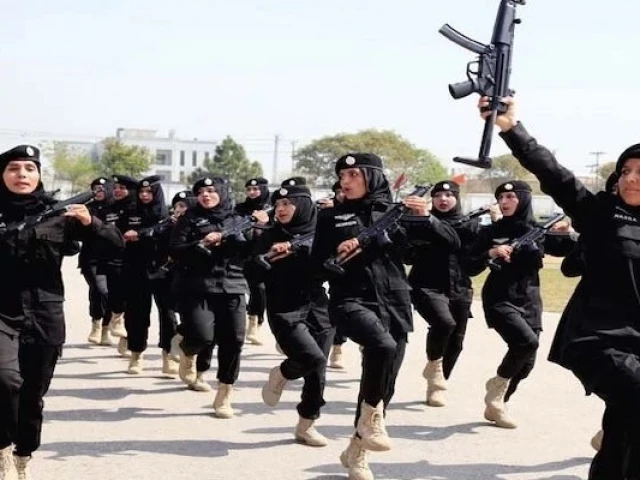
In Peshawar, where the police force exceeds 10,000 personnel, only around 165 women officers serve across 34 police stations. On average, just two to three female officers are available per shift, reflecting a severe shortage.
Women officers are tasked with diverse responsibilities—from participating in raids and managing women’s desks to escorting prisoners and providing security during religious events and elections. Yet structural issues persist. Many come from remote districts and lack access to accommodation, while transport—particularly for night duties—remains a major concern.
A female constable told The Express Tribune that married officers often bring their children to work due to a lack of support. Although a daycare facility exists, security concerns make it unreliable. “Balancing duty and family under such conditions is extremely difficult,” she said.
While a 10 percent quota exists, women make up less than 1 percent of the province’s 100,000-strong force, with only around 1,800 officers. Cultural barriers and security challenges further restrict participation, particularly in tribal districts.
Stories of Resilience
Despite these obstacles, stories of resilience continue to emerge. In Budh Bher, a sensitive area once affected by militancy, Saima Sharif has been appointed as Additional SHO—the first woman to hold the position there. For her, the role is deeply personal; her brother, Moeen, was martyred in 2012 while fighting militants in the same area.
“I belong to a family of a martyr. The honor of the uniform comes before everything,” she said, emphasizing her commitment to addressing cases involving women, particularly honor-related crimes.
The K-P Police has introduced reforms, including appointing a female District Police Officer in Chitral and inducting women into investigation units. Female Additional SHOs have also been posted in Swat and Khyber tribal districts for the first time.
The Gap Between Policy and Practice
Across Pakistan, the presence of women in policing is slowly expanding, but progress remains uneven. While policy measures and individual success stories signal change, systemic barriers continue to limit both participation and impact.
The 10 percent recruitment quotas announced by various provincial governments remain largely unmet. In Sindh, women make up less than 4 percent of the force; in Punjab, despite the highest numbers, representation remains low; in K-P, the figure is less than 1 percent.
For women seeking justice, the shortage of female officers means they often must navigate a system where male officers handle sensitive cases involving domestic violence, sexual assault, and honor crimes—a dynamic that discourages many from coming forward.
What’s Needed
Experts and activists point to several necessary reforms:
- Increased recruitment to meet and exceed existing quotas
- Career progression pathways that promote qualified women to leadership positions
- Infrastructure improvements, including separate accommodations, reliable transport, and secure daycare facilities
- Awareness campaigns to inform women about available services, including virtual police stations and women’s help desks
- Cultural change within police institutions to create environments where women feel supported and valued
As Khizar Hayat of the Human Rights Commission noted, increasing women’s representation in leadership roles would not only improve policing standards but also strengthen public trust—particularly for female victims seeking justice.
Bridging the gap between policy and practice will require not only increased recruitment but also structural reforms, awareness, and a shift in institutional culture—ensuring that justice is accessible, inclusive, and equitable for all.
Analysis: A Long Road to Equal Representation
The underrepresentation of women in Pakistan’s police forces reflects broader societal challenges, but it also has concrete consequences for women seeking justice. When female victims of domestic violence, sexual assault, or honor crimes encounter a system dominated by male officers, the barriers to reporting and seeking help are significant.
The few women who do join the police often serve with distinction, as the examples of Suhai Aziz Talpur, Ghazala Syed, and Saima Sharif demonstrate. But their success comes despite the system, not because of it. The lack of infrastructure—housing, transport, daycare—makes it difficult for women to serve, particularly those from remote districts. The absence of career progression pathways means many remain at lower ranks for years, regardless of their qualifications.
For the millions of Pakistani women who need to interact with the police, the shortage of female officers is not a statistical abstraction. It means reporting a crime is intimidating. It means sensitive cases are handled without female presence. It means justice remains out of reach.
The quotas announced by provincial governments are a start, but they are not being met. And quotas alone are not enough. Without structural reforms—including promotions for qualified women, infrastructure to support them, and cultural change within institutions—the numbers will remain low, and the barriers will persist.
As one female constable in Karachi put it, “Women prove themselves whenever given responsibility.” The challenge for Pakistan’s police forces is to give them that responsibility—and the support to fulfill it.