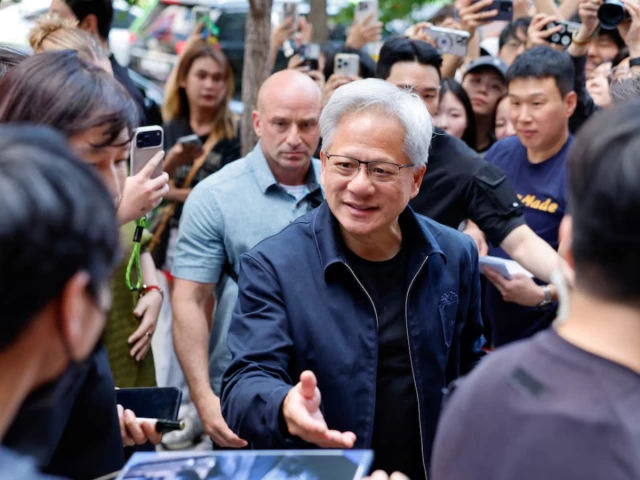
SEOUL: Nvidia Chief Executive Officer Jensen Huang has predicted that robotics will become South Korea’s next major growth industry, highlighting the country’s strengths in manufacturing, artificial intelligence, and advanced engineering during his latest visit to Seoul.
Huang made the remarks on Friday upon arriving at Gimpo International Airport, marking his second visit to South Korea in less than a year and underscoring Nvidia’s expanding partnerships with Korean technology companies in semiconductors, artificial intelligence, and robotics.
Robotics and AI to Drive Future Growth
Speaking to reporters, Huang said South Korea’s position as one of the world’s leading manufacturing hubs makes it ideally suited to benefit from the next wave of robotics and physical artificial intelligence technologies.
“Because Korea is a manufacturing centre of the world, we can apply the robotics technology and physical AI technology that we invent here for industry,” Huang said.
He noted that the future of manufacturing, particularly semiconductor production, will increasingly rely on robotics, automation, and AI-powered systems.
“The manufacturing of semiconductors will become increasingly robotics and increasingly AI-driven in the future,” he added.
Meetings with Major Korean Companies
During his visit, Huang is scheduled to meet executives from some of South Korea’s largest technology and industrial companies, including:
- Samsung Electronics
- SK Hynix
- Hyundai Motor Group
- LG Group
- Naver
The Nvidia chief hinted at major business opportunities for Korean firms, joking with reporters that he had brought “a lot of business for Korea” along with “some surprises.”
The meetings are expected to focus on AI infrastructure, advanced memory technology, autonomous systems, robotics, and future semiconductor collaboration.
South Korea’s Advantage in Robotics
Huang emphasized that South Korea possesses a unique combination of strengths that position it as a future global leader in robotics.
“Korea is extraordinary at manufacturing, mechatronics, and artificial intelligence,” he said.
“The fusion of all of that technology is perfect robotics.”
Industry analysts agree that South Korea’s leadership in electronics, automotive manufacturing, semiconductors, and industrial automation provides a strong foundation for large-scale adoption of robotics and AI-powered factories.
Growing Importance of AI Memory Chips
The Nvidia CEO also highlighted the importance of Korean memory chip manufacturers to the global AI ecosystem.
Samsung Electronics and SK Hynix collectively supply a significant portion of the high-bandwidth memory (HBM) chips and DRAM technologies used in Nvidia’s advanced AI processors.
As demand for AI accelerators continues to surge worldwide, South Korean companies remain critical partners in Nvidia’s supply chain.
Huang stressed the importance of ensuring that suppliers remain aligned with Nvidia’s future technology roadmap.
Nvidia Expanding Presence in Korea
Huang confirmed that Nvidia has already begun recruiting talent for a new research and development centre in South Korea.
“As soon as we have enough people here, then we’ll build a site,” he said.
The planned expansion reflects Nvidia’s growing commitment to the Korean market and its strategy of strengthening partnerships with leading technology firms across Asia.
Meeting Korean E-Sports Stars
Before his business meetings, Huang visited a gaming café in Seoul where he met professional e-sports players, including global gaming icon Lee Sang-hyeok, better known as “Faker.”
His daughter, Madison Huang, accompanied him during the visit and was seen wearing the jersey of T1, one of South Korea’s most successful e-sports organizations.
The visit highlighted Nvidia’s strong ties to the gaming industry, which remains a major driver of the company’s growth and brand recognition.
Looking Ahead
Huang’s visit comes at a time when global competition in artificial intelligence, robotics, and advanced semiconductor technologies is intensifying.
His remarks reinforce growing expectations that robotics, powered by AI and advanced manufacturing technologies, could become one of South Korea’s most important economic sectors over the coming decade.
With major investments planned across AI infrastructure, autonomous systems, and smart factories, South Korea appears poised to play a central role in the next generation of industrial innovation.