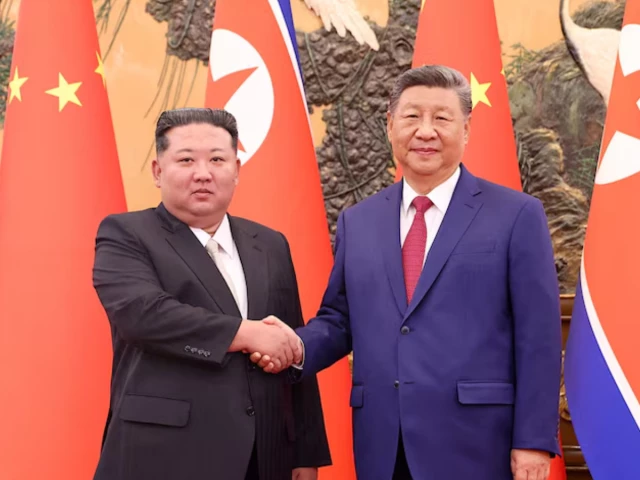
PYONGYANG: Chinese President Xi Jinping arrived in North Korea on Monday for a highly anticipated two-day state visit, marking his first trip to Pyongyang in seven years and signaling renewed engagement between the longtime allies amid shifting regional dynamics.
The visit comes at a time when North Korean leader Kim Jong Un appears increasingly confident, backed by closer ties with Russia, continued nuclear weapons development, and limited interest in renewed negotiations with the United States.
Analysts say the summit reflects both China’s efforts to strengthen its influence over North Korea and Kim’s growing confidence on the international stage.
Kim Welcomes Xi from a Position of Strength
Unlike Xi’s previous visit in 2019, which occurred shortly after the collapse of nuclear negotiations between Kim and then-US President Donald Trump, this visit takes place under very different circumstances.
Since then, North Korea has expanded its nuclear programme, strengthened military cooperation with Russia, and deepened trade and strategic ties with Moscow following its support for Russia’s military operations in Ukraine.
Just days before Xi’s arrival, Pyongyang announced plans to deploy a new 10,000-ton naval destroyer and reaffirmed its status as a nuclear-armed state.
Kim has also called for an “exponential” expansion of North Korea’s nuclear arsenal, underscoring his determination to strengthen the country’s military deterrence.
China Seeks to Reassert Influence
For Beijing, the visit represents an opportunity to reinforce its relationship with one of its most important regional partners.
China remains North Korea’s largest trading partner and economic lifeline despite periodic tensions over Pyongyang’s nuclear ambitions.
Xi’s visit is expected to focus heavily on economic cooperation, trade, tourism, infrastructure development, and regional stability.
Political observers note that China is eager to ensure North Korea remains within its strategic sphere of influence, especially as Pyongyang’s ties with Moscow continue to expand.
Economic Cooperation Expected to Dominate Talks
Diplomatic sources suggest that economic issues will likely dominate discussions between the two leaders.
North Korea is currently implementing a new five-year development plan aimed at expanding tourism, improving infrastructure, and boosting domestic economic growth.
The country has gradually reopened after years of strict pandemic-related border closures that severely limited foreign tourism and international trade.
Before the COVID-19 pandemic, Chinese visitors accounted for nearly 90 percent of foreign tourists entering North Korea, making tourism a valuable source of foreign currency.
Experts believe both countries may seek to increase cross-border investment and commercial activity following the summit.
Russia Relationship Gives Kim More Leverage
Analysts say North Korea’s growing relationship with Russia has strengthened Kim’s negotiating position.
Military cooperation and economic exchanges with Moscow have provided Pyongyang with additional strategic options and reduced its dependence on Beijing.
“North Korea is certainly gaining economically from what they’re able to provide militarily to Russia,” regional analysts have noted.
This development has allowed Kim greater flexibility in balancing relations between his two major allies while maintaining independence in decision-making.
Nuclear Programme Remains a Key Issue
Despite improving ties, differences remain between Beijing and Pyongyang regarding North Korea’s nuclear programme.
China has consistently called for denuclearization and regional stability, while North Korea continues to expand its nuclear capabilities in defiance of international sanctions.
Kim has repeatedly made clear that his country’s nuclear deterrent is non-negotiable and remains central to national security.
Observers believe Xi is unlikely to publicly challenge North Korea’s nuclear ambitions during the visit, focusing instead on maintaining stability and preventing regional tensions from escalating.
Regional Implications
The summit is being closely watched by regional powers including South Korea, Japan, and the United States.
South Korean President Lee Jae Myung has recently expressed hope that China could play a constructive role in improving inter-Korean relations and reducing tensions on the Korean Peninsula.
However, North Korea has shown little interest in renewed engagement with either Seoul or Washington, choosing instead to focus on strengthening military capabilities and strategic partnerships.
Looking Ahead
Xi’s visit highlights the enduring strategic relationship between China and North Korea despite changing geopolitical circumstances.
While economic cooperation is expected to be a major outcome of the summit, the meeting also sends a broader signal about shifting alliances and power dynamics in East Asia.
As North Korea continues to expand its military capabilities and deepen ties with Russia, China appears determined to maintain strong relations with its neighbour while preserving stability along one of Asia’s most sensitive borders.