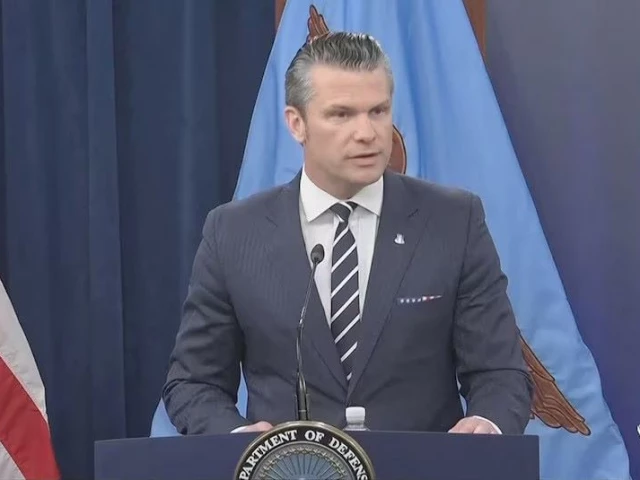
WASHINGTON – US Defence Secretary Pete Hegseth said on Tuesday that a US operation to protect commercial ships from Iran in the Strait of Hormuz was temporary, Washington was not looking for a fight, and the ceasefire with Iran was still in effect. “The ceasefire is not over,” Hegseth told reporters.
“We said we would defend and defend aggressively, and we absolutely have. Iran knows that, and ultimately, the president can make a decision whether anything were to escalate into a violation of a ceasefire,” he said.
A fragile truce in the Middle East was under strain on Tuesday after the US and Iran exchanged fire in the Gulf as they wrestled for control of the Strait of Hormuz.
Project Freedom Launched
US President Donald Trump launched a new operation, called Project Freedom, on Monday as he sought to wrest control of the critical waterway from Iran, which effectively closed the Strait of Hormuz after the US and Israel started the conflict on February 28.
Hegseth said that Iran does not control the strait. “Project Freedom is defensive in nature, focused in scope and temporary in duration, with one mission, protecting innocent commercial shipping from Iranian aggression. American forces won’t need to enter Iranian waters or airspace. It’s not necessary. We’re not looking for a fight,” Hegseth said.
Iran Blames US for Fujairah Fire
An unnamed Iranian military official says the fire at Fujairah port was not a planned Iranian attack and instead shifted the blame to US “military adventurism”, according to Al Jazeera.
“The Islamic Republic had no pre-planned programme to attack the mentioned oil facilities, and what happened was the result of US military adventurism aimed at creating a passage for the illegal transit of ships through the restricted waterways of the Strait of Hormuz,” the official told Iran’s IRIB news agency.
Ghalibaf’s Warning
Iran’s parliament speaker, Mohammad Bagher Ghalibaf, said in a social media post on Tuesday that the security of shipping and energy transit had been threatened by breaches of the four-week-old ceasefire by the US and its allies.
“The new equation of the Strait of Hormuz is in the process of being solidified. The security of shipping and energy transit has been jeopardised by the United States and its allies through the violation of the ceasefire and the imposition of a blockade,” the X post read.
“We know well that the continuation of the current situation is unbearable for the United States, while we have not even begun yet,” he said.
Limited Shipping Traffic
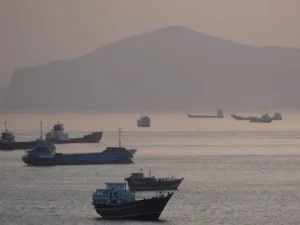
Several merchant ships in the Gulf reported explosions or fires on Monday, and an oil port in the United Arab Emirates, which hosts a large US military base, was set ablaze by Iranian missiles. Commercial shipping through the strait remained limited, with only four vessels moving in both directions in 24 hours.
New US Trade Route ‘Rocky, Shallow, and Risky’
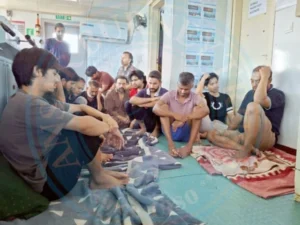
The US-led Joint Maritime Information Center is advising stranded ships to cross the Hormuz Strait in Oman’s waters, saying it set up an “enhanced security area”, according to Al Jazeera. However, the semi-official Fars news agency reported on Tuesday that two commercial vessels attempting to traverse the sea route are now stuck.
“The waters near the coast of Oman are rocky and the vessels are unable to leave or return from this part,” Fars quoted an unnamed Iranian “informed source” as saying. “The southern coast of the Strait of Hormuz – near the two islands of Musandam and al-Khail – does not have the geographical ability to become a maritime corridor, and the passage of vessels through the rocky and shallow southern areas is very risky.”
Conflicting Reports
Iran’s Islamic Revolutionary Guard Corps has effectively closed the narrow waterway under threat of mines, drones, missiles and gunboats. The US has responded with a blockade of Iranian ports.
Iranian Foreign Minister Abbas Araghchi said Monday’s events showed there was no military solution to the crisis. He said peace talks were progressing with Pakistan’s mediation, and warned the US and the UAE against being drawn into a “quagmire.”
The US military said two US merchant ships made it through the strait, without saying when, with the support of Navy guided-missile destroyers. While Iran denied any crossings had taken place, Maersk said the Alliance Fairfax, a US-flagged ship, exited the Gulf via the Strait of Hormuz, accompanied by the US military, on Monday.
Civilian Casualties
The commander of US forces in the region said his fleet had destroyed six small Iranian boats, which Iran also denied. Iranian media quoted a military commander as saying US forces targeted civilian boats, killing five civilians. Iran also said on Monday it had fired on a US warship approaching the strait, forcing it to turn around. Iranian officials later described the fire as warning shots.
South Korean Tanker Damaged
South Korea reported that one of its merchant ships, HMM Namu, in the strait suffered an explosion and fire in its engine room, though no one aboard was hurt. A South Korean government spokesperson said it was unclear if an attack caused the fire.
Also on Monday, the British maritime security agency UKMTO reported two ships had been hit off the coast of the UAE, and the Emirati oil company ADNOC said one of its empty oil tankers was hit by Iranian drones.
Israel-Lebanon Ceasefire Under Strain
The Israeli army acknowledged Tuesday it has struck about 500 areas in Lebanon since a ceasefire took effect on April 17, and that five Israeli soldiers were killed and 33 others injured by Hezbollah fire. “Five soldiers from the army and security forces were killed and 33 others injured since the ceasefire,” Army Radio said.
The broadcaster explained that three soldiers were killed by explosive-laden drones, two by improvised explosive devices, 31 were injured by explosive devices and two in clashes with Hezbollah fighters.
In recent weeks, Hezbollah’s drones have become a growing concern in Israel, with Prime Minister Benjamin Netanyahu describing them as a “major threat.”
Despite the ceasefire that was announced on April 17 and extended until May 17, the Israeli army continues daily strikes in Lebanon and widespread demolition of homes in dozens of villages. Lebanon’s Health Ministry said Monday that 17 people were killed in the past 24 hours, bringing the death toll from Israeli attacks since March 2 to 2,696, with 8,264 injured.
Analysis: A Ceasefire in Name Only
Defence Secretary Hegseth’s statement that “the ceasefire is not over” is technically true, but the reality on the ground tells a different story. The US and Iran exchanged fire in the Gulf. Project Freedom is a military operation to force the strait open. Iran has threatened to close it permanently.
The competing narratives — the US claiming it destroyed Iranian boats, Iran claiming US forces killed civilians — underscore the fog of war. The limited shipping traffic (only four vessels in 24 hours) reflects the extreme caution of the maritime industry.
In Lebanon, the ceasefire is equally fragile. Israel has struck 500 areas since April 17, and Hezbollah continues to attack Israeli forces.
Hegseth’s statement that the US is “not looking for a fight” is belied by the deployment of Navy destroyers, the escort of commercial vessels, and the launch of Project Freedom. The US is looking to reopen the strait — and is willing to use force to do so.
Iran’s parliament speaker warned that “we have not even begun yet.” The implication is clear: Tehran has more cards to play.
As the one-month deadline for Iran’s 14-point proposal ticks down, the situation in the Strait of Hormuz remains a powder keg. The ceasefire may not be over — but it is hanging by a thread.