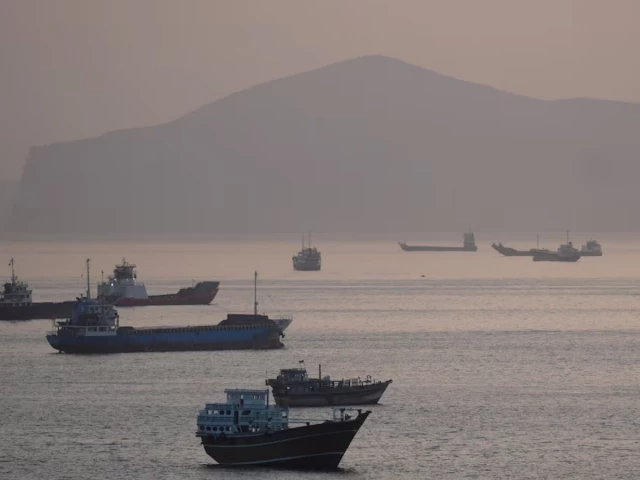
ANKARA – Commercial shipping through the Strait of Hormuz remained limited on Tuesday, with only four vessels moving in both directions through the key energy passage amid the latest escalation between Iran and the US around Hormuz, according to ship-tracking data compiled by Anadolu.
The latest data showed two vessels moving east to west and two west to east near the strait in the last 24 hours as of 0900GMT Tuesday. The east-to-west traffic included the vessels Muara and Aurora, which was listed in the data as Shimokita Maru.
Vessel Details
The Muara, a container ship, was shown as moored at Jebel Ali in the United Arab Emirates as its destination. The Aurora was listed as a limestone carrier en route to Umm Qasr, Iraq. The vessel was shown in transit.
In the opposite direction, west-to-east traffic included Nooh Gas, listed in the data as Luma, and Pasargad 11. The Nooh Gas was listed as an LPG tanker carrying liquefied petroleum gas and heading to Khor Fakkan in the United Arab Emirates. The vessel was shown laden and in transit. The Pasargad 11, a general cargo ship, was listed with Port Rashid in the United Arab Emirates as its destination.
Among the selected vessels, the Nooh Gas is a US Office of Foreign Assets Control (OFAC)-sanctioned LPG tanker, according to US Treasury records.
Continued Caution
The limited number of selected vessel movements underscored continued caution around the waterway, which remains one of the world’s most important transit routes for crude oil, refined products and liquefied natural gas.
US Escorts
The latest movements came as military activity around the Strait of Hormuz intensified under Washington’s “Project Freedom” initiative to guide stranded vessels through the contested passage. Danish shipping giant Maersk said one of its US-flagged commercial vessels, the Alliance Fairfax, exited the Persian Gulf through the Strait of Hormuz under US military protection on May 4, adding that the transit was completed “without incident” and all crew members were safe.
The passage came after two US Navy destroyers, the USS Truxtun and USS Mason, transited the strait and entered the Persian Gulf after fending off Iranian missiles, drones and small boats, according to CBS News, which cited US defense officials.
Conflicting Accounts
Iranian media also reported Tuesday that five civilians were killed when US forces targeted two small cargo boats in the Strait of Hormuz. The semi-official Tasnim news agency, citing a military source, said the boats were carrying people’s cargo from Khasab, Oman, toward Iran, disputing Washington’s account that it had targeted Iranian small boats threatening commercial shipping.
The competing accounts underscored the growing security risks facing commercial shipping in and around Hormuz.
Background of the Conflict
Regional tensions have escalated since the US and Israel launched strikes against Iran on February 28, triggering retaliation from Tehran against Israel and US allies in the Gulf, along with the closure of the Strait of Hormuz. A ceasefire took effect on April 8 through Pakistani mediation, but talks in Islamabad failed to produce a lasting agreement. The truce was later extended by US President Donald Trump indefinitely.
Since April 13, the United States has enforced a naval blockade targeting Iranian maritime traffic in the Strait of Hormuz.
Diplomatic Prospects
Despite the escalation, Tehran said it is reviewing Washington’s response to its latest 14-point proposal, leaving open the possibility of a diplomatic breakthrough. Iran has set a one-month deadline for negotiations on a deal to reopen the strait, end the US naval blockade, and permanently end the war in Iran and Lebanon.
Analysis: A Fragile Passage
The limited shipping traffic through the Strait of Hormuz — only four commercial vessels in 24 hours — reflects the extreme caution of the maritime industry. The strait normally handles about 20 percent of global oil supplies. The current trickle is a fraction of normal volume.
The US “Project Freedom” initiative is escorting vessels through the strait, but the risks remain high. Iranian forces have attacked or seized vessels, and the US has responded with force. The conflicting accounts of civilian deaths underscore the fog of war.
The diplomatic path remains open — Iran is reviewing Washington’s response to its 14-point proposal — but the one-month deadline is ticking. Until a deal is reached, shipping through the Strait of Hormuz will remain a high-risk endeavour.