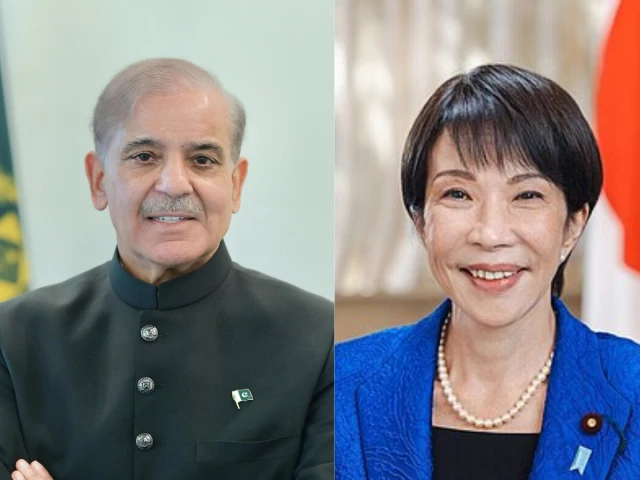
ISLAMABAD – Japanese Prime Minister Sanae Takaichi on Monday praised Pakistan’s diplomatic role in facilitating talks between the United States and Iran in a telephone conversation with Prime Minister Shehbaz Sharif. According to the Prime Minister’s Office, the two leaders discussed the recently held ‘Islamabad Talks’ between the US and Iran, hosted by Pakistan.
Takaichi appreciated Pakistan’s role in supporting the diplomatic process, saying it was important for regional stability and global energy security. She expressed Japan’s “full support for the peace process and its importance for regional stability and global energy security,” the statement read.
Pakistan’s Continued Commitment
PM Shehbaz thanked the Japanese leader for her goodwill, noting that he was grateful to both the US and Iranian delegations for their “extensive discussions in Islamabad.” He said Pakistan would continue its efforts to ensure that the ceasefire is maintained. The prime minister also expressed a desire to further strengthen Pakistan-Japan bilateral cooperation, a sentiment reciprocated by the Japanese prime minister. Both leaders agreed to maintain close coordination going forward.
Talks Inconclusive but Process Continues
The call comes a day after the US and Iran were unable to reach an agreement to end their war despite marathon negotiations lasting around 21 hours. The prolonged talks, aimed at halting hostilities that have killed thousands and driven global oil prices higher over the past six weeks, ended with both sides blaming each other for the impasse.
On Saturday, US and Iranian delegations arrived in Pakistan for conclusive talks following a two-week immediate ceasefire “everywhere, including Lebanon,” announced by PM Shehbaz, who later invited delegations from both countries to Islamabad. The Iranian delegation was led by Speaker Bagher Ghalibaf and assisted by Foreign Minister Abbas Araghchi, while the US delegation was led by VP JD Vance, along with Special Envoy Steve Witkoff and Jared Kushner.
Context of the Conflict
The US and Israel launched a joint offensive on Iran on February 28, killing thousands of people in Iran, including then-supreme leader Ayatollah Ali Khamenei, and leaving tens of thousands injured, with civilian areas, including residential buildings and religious sites, among those hit. The conflict also expanded geographically. Iran retaliated with drone and missile strikes targeting Israel as well as Jordan, Iraq, and Gulf countries hosting US military assets. It also restricted the movement of ships through the Strait of Hormuz.
Analysis: International Recognition
Japan’s appreciation of Pakistan’s diplomatic role adds to the growing international recognition of Islamabad’s efforts to mediate between the US and Iran. While the talks did not produce a final agreement, the fact that Pakistan brought the two adversaries to the table has been widely acknowledged.
Prime Minister Takaichi’s emphasis on “regional stability and global energy security” reflects Japan’s interests as a major energy importer. The disruption of shipping through the Strait of Hormuz has affected global energy supplies, and Japan, like Pakistan, has a stake in the resumption of normal traffic.
PM Shehbaz’s commitment to ensuring that the ceasefire is maintained suggests that Pakistan will continue to play a facilitative role, even as the parties work through their differences. The international community, as represented by Japan’s statement, appears to support this approach.
As the ceasefire enters its second week, the question is whether the parties can build on the momentum generated in Islamabad. Japan’s support for the peace process is a small but meaningful signal of international backing.