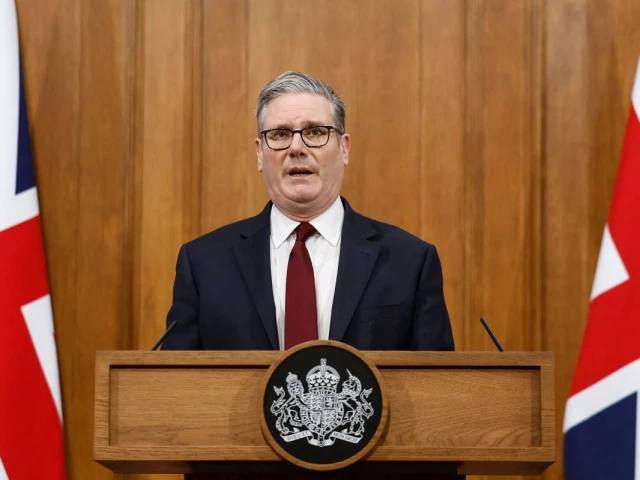
LONDON – British Prime Minister Keir Starmer said on Monday that, whatever the pressure, Britain would not be dragged into the Iran war nor be involved in a blockade of the Strait of Hormuz. “We’re not supporting the blockade,” he told BBC Radio 5 Live, adding that it was vital to get the strait reopened.
“It is, in my view, vital that we get the Strait open and fully open, and that’s where we’ve put all of our efforts in the last few weeks and we’ll continue to do so,” Starmer said. Britain had minesweepers in the region, he said, and while he could not discuss operational matters, the military capability was “focused from our point of view on getting the Strait fully open.”
Resisting Pressure to Join the War
Starmer said Britain was facing pressure to join the war, but he would not do so unless there was a “clear lawful basis” and a “clear thought-through plan.” “My decision has been very clearly that whatever the pressure, and there’s been some considerable pressure, we’re not getting dragged into the war,” he said.
UK-France Summit on Maritime Security
Starmer also posted on X about the UK and France co-hosting “a summit to advance work on a coordinated, independent, multinational plan to safeguard international shipping when the conflict ends.” About 40 countries at the beginning of April discussed joint action to reopen the Strait of Hormuz and stop Iran holding “the global economy hostage,” Britain said, after US President Donald Trump said securing the waterway was for others to resolve.
US Blockade Announced
The US military said it would begin a blockade of all maritime traffic entering and exiting Iranian ports and coastal areas on Monday, after weekend talks failed to reach a deal to end the war with Iran. US Central Command said that the US blockade, starting at 10am ET on Monday (7pm PKT), would be “enforced impartially against vessels of all nations entering or departing Iranian ports and coastal areas, including all Iranian ports on the Arabian Gulf and Gulf of Oman.”
Vessels transiting the Strait of Hormuz to and from non-Iranian ports will not be impeded, the US military said.
Trump’s Warning
President Donald Trump said on Sunday US forces would also intercept every vessel in international waters that had paid a toll to Iran. “No one who pays an illegal toll will have safe passage on the high seas,” Trump wrote on social media, adding: “Any Iranian who fires at us, or at peaceful vessels, will be BLOWN TO HELL!”
Iran’s Response
Meanwhile, the unified command of the Iranian armed forces said the ports in the Arabian Gulf and the Sea of Oman are “either for everyone or for no one,” state broadcaster IRIB reported. “The Armed Forces of the Islamic Republic of Iran consider defending the legal rights of our country a natural and legal duty, and accordingly, exercising the sovereignty of the Islamic Republic of Iran in the territorial waters of our country is the natural right of the Iranian nation,” IRIB cited Iran’s forces as stating.
“Enemy-affiliated vessels” will have the right to pass through the Strait of Hormuz, while other vessels will be allowed passage subject to regulations by Tehran. “The criminal US’s imposition of restrictions on the movement of vessels in international waters is an illegal act and amounts to piracy.” If the security of the ports is threatened, no port in the region “will be safe,” the forces added.
Analysis: A Transatlantic Divide
Prime Minister Starmer’s refusal to support a blockade of the Strait of Hormuz — or to be dragged into the Iran war — sets Britain apart from its closest ally, the United States. While the US has announced a blockade of Iranian ports and threatened to intercept vessels that pay tolls to Iran, Britain is focusing on minesweeping and getting the strait “fully open.”
Starmer’s insistence on a “clear lawful basis” and a “clear thought-through plan” before joining any war reflects a more cautious approach than that of the Trump administration. The prime minister’s reference to “considerable pressure” suggests that the US has been pushing for greater British involvement.
The UK-France summit on maritime security indicates that European powers are pursuing their own path, distinct from the US blockade strategy. The focus on a “coordinated, independent, multinational plan” suggests that European countries are seeking to avoid being drawn into a direct confrontation with Iran.
As the US begins its blockade, and Iran threatens that no port in the region will be safe if its ports are threatened, the risk of escalation remains high. Britain’s refusal to back the blockade may limit the effectiveness of the US effort, but it also reduces the risk of British entanglement in a wider war.