On February 28, 2026, the United States went to war. There was no congressional debate, no public deliberation, no formal declaration. Just a midnight operation, with top lawmakers notified only minutes before the bombs fell, announcing that American aircraft were already striking Tehran. This is not how a republic wages war. This is how a king does.
WASHINGTON, D.C. – The strikes on Iran—codenamed Operation Epic Fury—killed Iranian Supreme Leader Ali Khamenei and multiple senior officials, put American lives in harm’s way without a single vote of the people’s representatives, and shook global energy markets to their foundations. Article I of the Constitution gives Congress, not the president, the power to declare war. President Donald Trump did it anyway. And in doing so, he did not merely break a rule—he broke the foundational compact of American self-governance.
The White House’s legal rationale was collective self-defense under the UN Charter. But the United States was not under attack. Iran had not struck American soil. Administration officials released conflicting statements about the aims of the operation, ranging from ending Iran’s nuclear program to outright regime change—language that has no grounding in any congressional mandate or democratic debate.
As Senator Andy Kim told TIME, lawmakers and the American public were being asked to accept military escalation without understanding the endgame: “The President has really boxed us in and put us on the hook for things that we haven’t discussed as a country.” When senators demanded classified briefings, they largely received stonewalling. What followed was not strategic clarity but performative chaos: on the same day his administration surged forces to the region, Trump posted on social media about winding down. He threatened to bomb Iranian power plants if the Strait of Hormuz was not opened on his timetable.
And when asked about rising gas prices, he shrugged: “If they rise, they rise.” These are not the words of a commander-in-chief accountable to a republic. They are the words of a man who believes he answers to no one.
A Constitutional Crisis Ignored
Dissent has come from across the political spectrum, which is precisely what makes the administration’s contempt for Congress so damning. Senator Chris Van Hollen called it plainly: “Trump is lying to the American people as he launches an illegal, regime-change war against Iran. This is endangering American lives and has already resulted in mass civilian casualties.”
Kentucky Republican Thomas Massie declared: “This is not ‘America First.’ The Constitution conferred the power to declare or initiate war to Congress for a reason—to make war less likely.” Army veteran and Ohio Republican Warren Davidson said simply: “War requires Congressional authorization.”
These are conservatives honoring their oath, not partisans playing politics. And yet the war powers resolutions they championed failed to override a presidential veto, as most Republicans fell in line. Senator Tim Kaine’s warning now hangs over every future presidency: “Don’t hide under your desk and just let the president do it on his own. Because if you do, you’re opening the door for presidents of either party into the future just to wage war willy-nilly.”
The Human and Economic Toll
The human cost is already devastating. According to Iranian figures, more than 1,900 Iranians have been killed. Thirteen American soldiers have died. The economic cost is being borne by the entire world. Brent crude surpassed $126 per barrel at its peak, its highest level in years. The Strait of Hormuz—through which 20 percent of global oil supplies flow—was effectively closed, and QatarEnergy, responsible for 20 percent of the world’s LNG supply, declared force majeure on all exports.
Global stocks fell 5.5 percent in the war’s opening days. Inflation is forecast to rise across the eurozone, the United States, and Asia simultaneously, presenting central banks with the specter of stagflation—while the president who lit the fuse demands that the Federal Reserve cut interest rates.
Families in Chicago and Chennai, in Lagos and London, are absorbing the price of a decision made by one man without asking anyone’s permission.
The World Economic Forum put the deeper betrayal into words: the United States “has imposed enormous costs on many of the same economies it relies on as trading and strategic partners.” Allies were not consulted. The democratic world was not asked. And yet it is paying, country by country, household by household, for a war it did not vote for and cannot stop.
The International Order Crumbles
This matters far beyond economics. The United States built the post-war international order on the premise that even the most powerful nation would operate within rules and seek legitimacy before using force. When that premise collapses, the argument for democratic governance in an age of strongmen collapses with it. A world with kings—whether in Moscow, Beijing, or Washington—is a more dangerous world for everyone.
The phrase “No Kings” is not a slogan invented by the left. It is the founding premise of the American republic, inscribed in the separation of powers and in a Constitution written by men who had lived under a monarchy and refused to recreate one. This war is the most dramatic breach of that premise yet—but not the first. Trump launched strikes on Iranian nuclear facilities last year without a congressional vote. He ordered the capture of Venezuela’s president without one.
Each unchallenged act of unilateral power makes the next easier. This is how republics die—not in a single dramatic moment, but in the slow accumulation of precedents no one stopped in time.
The Week of Action
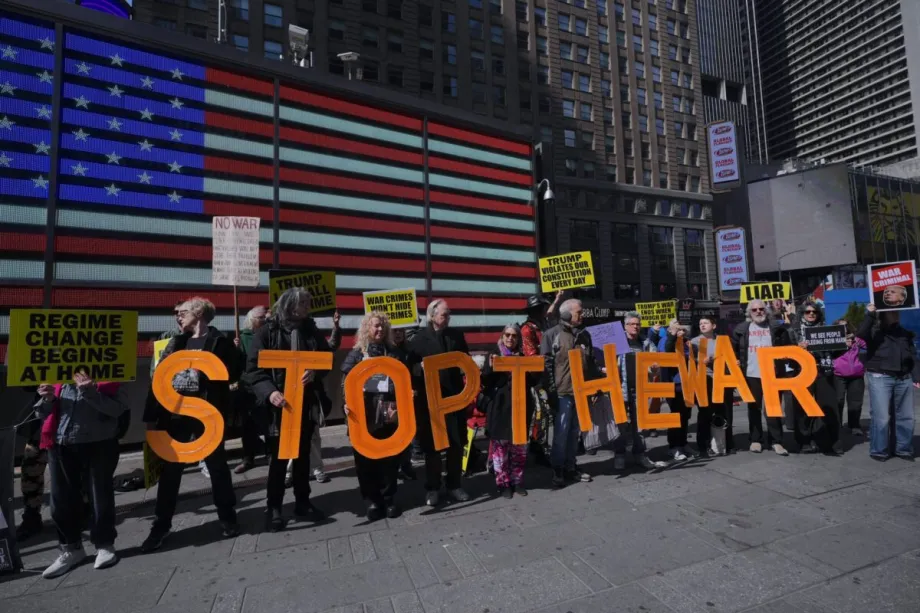
On March 28, over 3,000 “No Kings” protests are scheduled across every state in this country. Organizers describe it as a moment for Americans to declare that the Constitution still matters—that the power to declare war belongs to the people’s representatives, not to one man who believes himself above the law.
The protests are drawing support from across the political spectrum. Anti-war activists stand alongside constitutional conservatives. Veterans who served under both Republican and Democratic administrations have joined the call. The message is simple: no president, regardless of party, has the authority to launch a war of choice without congressional approval.
The Precedent and the Future
What makes the Iran war particularly dangerous is the precedent it sets. If a president can launch a major war against a nation of 85 million people without congressional authorization, then there is no limit to presidential war-making authority. Future presidents—of either party—will inherit this expanded power. The question is not whether they will use it, but when.
The administration’s defenders argue that the president, as commander-in-chief, has inherent authority to use military force to protect national security. But the Constitution’s framers deliberately placed the power to declare war in the legislative branch. They had lived under a king who could wage war at will. They did not intend to create another.
Analysis: A Republic on the Precipice
The Iran war is not merely a foreign policy crisis; it is a constitutional crisis that reveals how far the American system has drifted from its founding principles.
For the first 200 years of American history, presidents sought congressional authorization for major military action. The Korean War was conducted under a UN Security Council resolution, but Congress later ratified the commitment. The Vietnam War was conducted under the Gulf of Tonkin Resolution, which Congress passed. Even the wars in Afghanistan and Iraq, however controversial, received congressional authorization.
The Iran war has no such authorization. It rests on a theory of executive power that would have been unrecognizable to the Constitution’s framers—and alarming to anyone who believes that the power to send Americans to die in war should be exercised by the people’s representatives, not by one man.
The protests scheduled for March 28 represent a test of whether American democracy can still defend itself. The machinery of checks and balances has failed. Congress passed war powers resolutions; the president vetoed them. Lawmakers demanded briefings; the administration stonewalled. The courts have been reluctant to intervene in what they consider political questions.
That leaves the people. The Constitution begins with “We the People”—not “We the President.” The power to declare war was placed in Congress because the framers believed that the most momentous decision a nation can make—the decision to go to war—should be made by those accountable to the citizens who will fight and die.
When that power is seized by one man, the people have a duty to demand it back. The protests are a start. But restoring the constitutional order will require sustained pressure, across elections, across administrations, until the precedent of unchecked presidential war-making is overturned.
The phrase “No Kings” is not about Donald Trump. It is about the system that allowed any president to launch a war without congressional approval. If that system is not restored, the republic that the Constitution created will cease to exist—not in a dramatic collapse, but in the slow erosion of the principles that made it worth defending.
Analysis: The Death of American Democracy?
The Iran war may not mark the death of American democracy, but it reveals how close the republic has come to the brink. When one man can launch a war against a nation of 85 million people without a single vote in Congress, the constitutional order has already been fundamentally altered.
The protests on March 28 are a reminder that the people have not surrendered their voice. But whether that voice can restore the checks and balances that the framers designed remains to be seen. The republic was built on the premise that no one—not even the president—is above the law. The Iran war tests that premise as it has not been tested in generations.
What happens next will determine whether the United States remains a republic governed by laws or becomes something else: a nation where one man’s will is enough to send Americans to war, without debate, without authorization, without the consent of the governed.
The framers tried kings before. They knew how it ends. The question is whether their successors remember.