TEHRAN/WASHINGTON – The narrative of the conflict has shifted. What began as a US-Israeli offensive aimed at degrading Iran’s military capabilities and potentially triggering regime change has evolved into a grinding confrontation where neither side can claim decisive victory. For Iran, survival itself has become a form of triumph. For the United States and Israel, the costs of continued escalation are mounting—economically, politically, and strategically.
“We do not choose between empires—we choose dignity, sovereignty, and freedom,” the words of Indonesian independence leader Soekarno resonate with Iran’s posture. Tehran has framed the conflict not as a battle for territorial gain but as a struggle for national survival and regional autonomy. That framing has proven resilient, even as US and Israeli bombs have struck Iranian nuclear facilities, military installations, and industrial infrastructure.
Iran’s Five Conditions for Peace
As of March 25-26, 2026, Iran has formally rejected US proposals to end the conflict, instead outlining five key conditions for a ceasefire, as reported by Iranian state media and the Iranian Embassy in South Africa:
- A complete stop to US and Israeli actions against Iran and its allies —including an end to strikes, assassinations, and military operations across the region.
- The establishment of concrete mechanisms to prevent the re-imposition of war —binding guarantees that the conflict will not resume after a ceasefire.
- Guaranteed and clear payment for war damages and compensation —a demand reflecting the staggering human and material toll of the conflict, including more than 82,000 civilian structures damaged or destroyed.
- An end to fighting across all fronts involving Iran and its regional “resistance” allies —encompassing not only direct US-Iran hostilities but also the conflicts in Lebanon, Gaza, and elsewhere that have become entangled with the broader war.
- Recognition of Iranian sovereignty and control over the Strait of Hormuz —a demand that would permanently alter the strategic balance in the Gulf, giving Tehran formal authority over the waterway through which approximately 20 percent of the world’s oil passes.
These demands represent a comprehensive counterproposal to what Iran has labeled an “excessive” 15-point US plan. Iranian officials have stated they will not accept dictates from Washington and will continue resisting until their own conditions are met, citing that engagement in talks with the US would be tantamount to an admission of defeat.
The Narrative Divide: Who Is Negotiating with Whom?
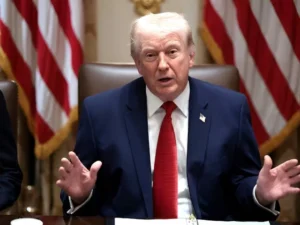
The divergence in public narratives could not be starker. President Donald Trump has claimed to have had “very good and productive conversations” with Iran, stating that the sides had “major points of agreement.” He claimed to have paused strikes on Iranian power plants to allow negotiations to proceed.
Iran has denied direct or indirect negotiations. A senior Iranian official mocked the US claim, questioning if Washington was “negotiating with themselves.” While Iran’s Foreign Ministry acknowledged receiving “messages” from friendly nations regarding US willingness to talk, it denied these exchanges amounted to formal negotiations. Tehran has accused the Trump administration of fabricating news about talks to control high energy prices in the US and to manage the economic impact of the war.
The situation shows a clear divergence in narratives: the US trying to project control and diplomacy, while Iran seeks to project strength and deny any retreat.
Military Resilience Despite Strikes
Despite US-Israeli airstrikes on February 28 targeting senior leaders—including Supreme Leader Ayatollah Ali Khamenei—and nuclear facilities, Iran’s regime has displayed remarkable resilience. Iran has launched hundreds of drones and ballistic missiles targeting US military bases in Gulf states and in Israel. It has also warned that any further moves by the US or its backers will result in “relentless, unceasing attacks” on regional infrastructure.
Analysts indicate Iran is shifting toward “strategic containment” and pragmatic endurance, retaining its ability to project power over critical energy chokepoints like the Strait of Hormuz. The closure of the strait—which Iran has effectively maintained since early March—has driven global oil prices above $126 per barrel at its peak and disrupted energy markets worldwide.
Iran continues to evade sanctions with economic support from China, which buys the vast majority of its oil. Beijing’s backing has provided Tehran with a critical economic lifeline, insulating it from the full impact of US sanctions and enabling it to sustain its military campaign.
America’s Off-Ramp: Declaring Victory and Getting Out
White House figures have suggested the US should “declare victory and get out” of the conflict, seeking an “off-ramp” or negotiated settlement. Critics allege US official statements claiming Iran’s navy and air force are finished are not supported by ground reality, drawing parallels to false optimistic reporting from previous wars.
Based on reports as of March 2026, the Trump administration is exploring an exit strategy by framing tactical successes as a “declared victory.” The administration faces pressure to end the war due to concerns over regional stability, global economic impacts, and the desire to avoid a prolonged, costly entanglement.
The White House is shifting goals away from regime change toward limited objectives, such as degrading Iran’s military capabilities and ensuring oil security in the Strait of Hormuz. President Trump has indicated the conflict was decided early on, citing the destruction of Iranian naval vessels and missile capacity, which advisers urge him to use as a “mission accomplished” moment to exit.
Reports highlight a divide in Washington, with some officials favoring an immediate exit, while others push for further escalation. Despite US strikes destroying significant portions of Iran’s military capabilities, the Iranian regime’s resilience has led to concerns that Iran could also claim victory by simply surviving the conflict.
Israel’s Equation: A Forever War
As of March 2026, Israel has experienced significant structural, economic, and security-related damage from prolonged regional conflicts, yet it continues to act as a central, albeit constrained, player in—and sometimes an obstacle to—peace negotiations.
Israel’s economy has suffered heavily, with losses exceeding $57 billion (roughly 177 billion shekels) between 2023 and early 2026, representing about 8.6% of its annual GDP. The ongoing conflict has caused debt to approach 70% of GDP, necessitating a revised 2026 state budget that added $13 billion to finance war efforts.
The Port of Eilat entered bankruptcy and closed due to disruptions in shipping, while the prolonged conflict has led to decreased exports to certain regions. Attacks on Israeli territory increased by 120% in 2025 compared to 2024, with continued attacks into 2026.
Despite fatigue, Israeli officials have stated the “war is not close to ending,” continuing strikes in Gaza and against Iranian targets. Israel finds itself in a “forever war” scenario, struggling with the costs of managing multiple fronts, including Gaza and Lebanon. Some observers note that the damage has created a new, challenging precedent for Israeli security, potentially weakening its traditional military deterrence, though it still holds significant offensive power.
The GCC Quandary: A New Regional Architecture
Post-war, the Gulf Cooperation Council (GCC) faces an urgent need for a new regional security architecture, shifting from reliance on US protection to an inclusive “cooperative security model.” This structure would likely incorporate Iran and Iraq to prevent future conflicts, moving beyond the current defensive, fragmented posture toward a collective, stable, and locally-driven equilibrium.
Instead of deepening rifts, the new arrangement would prioritize normalization between GCC states and Iran to ensure regional stability. The war has highlighted the risks of relying on US-Israel protection, prompting GCC states to reconsider their security dependence. With oil infrastructure and regional stability threatened by direct attacks, the focus is shifting to protecting Gulf investments and preventing further conflict.
While Riyadh stands to gain from a weakened Iran, the potential for Iranian state collapse or fragmentation poses a massive threat to regional stability.
A GCC without US and Israeli dominance would likely shift toward a security architecture rooted in regional integration, featuring normalized ties with Iran, reduced reliance on foreign military bases, and increased strategic autonomy. This shift would accelerate a pivot toward Eastern powers like China and Russia for trade and diplomatic partnerships.
Russia and China Upset the Regional Applecart
Russia and China are reshaping the Middle East by leveraging a perceived US pullback to build deep economic and security ties with GCC nations. China drives infrastructure and trade via the Belt and Road Initiative, while Russia focuses on energy coordination and security, offering GCC states a non-interfering alternative partnership.
China is a dominant trade partner, investing heavily in technology and infrastructure. Russia works closely with Saudi Arabia and the UAE to stabilize oil prices and expand trade. Russia maintains a key security presence, particularly in Syria, and provides arms to regional actors. While not replacing the US security umbrella, Russia and China offer weapons and military technology with fewer conditions than Western powers.
China has increased its diplomatic weight, notably mediating the Saudi Arabia-Iran rapprochement in 2023, signaling a shift toward regional conflict resolution. GCC nations use this engagement to hedge against dependency on the US, diversifying their strategic partners and negotiating better terms with Western counterparts.
The growing role of Russia and China contributes to a more multipolar Middle East, where GCC countries leverage relationships with multiple global powers to meet economic diversification goals, such as Saudi Vision 2030.
Analysis: The Limits of Power
In the final reckoning, this war has exposed the limits of power when confronted with resolve. Iran has demonstrated that endurance, geography, and strategic patience can outweigh brute force, forcing its adversaries into uneasy calculations of exit rather than victory.
The United States and Israel may still command formidable arsenals, but their political will is fraying under the weight of an unwinnable confrontation. The US is seeking an off-ramp, framing tactical successes as victory while exploring negotiations. Israel is bleeding economically, its deterrence questioned, its population weary of perpetual conflict.
Iran, by contrast, has achieved what it set out to achieve: survival. The regime remains intact. Its ability to project power over the Strait of Hormuz remains unchallenged. Its regional allies—Hezbollah, the Houthis, and Iraqi militias—continue to fight. And its narrative of resistance has resonated not only in Tehran but across the Global South, where the US-Israeli campaign is viewed through the lens of imperialism rather than self-defense.
What now emerges is not merely a military stalemate but a shifting world order where regional actors reclaim agency. The GCC is reconsidering its reliance on the US. China and Russia are filling the vacuum. The unipolar moment that followed the Cold War has definitively ended.
If there is a lesson here, it is stark: domination is no longer assured. Military superiority does not guarantee political victory. And dignity, once asserted, can redraw the map of power itself. Iran has held the keys to this war from the beginning. As the US seeks an exit, it may find that Tehran is the one who decides when—and on what terms—the door opens.