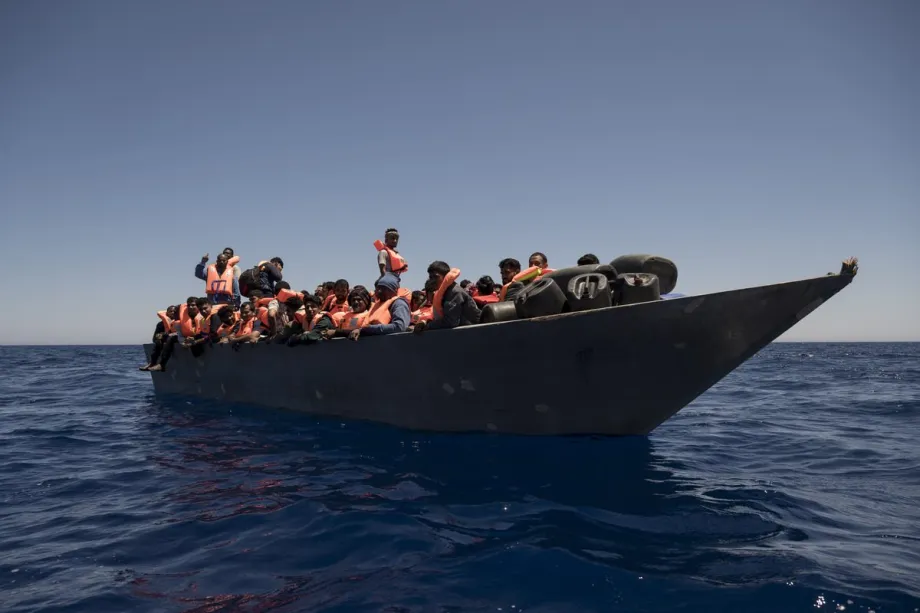
At least 70 people went missing on Saturday after a migrant boat capsized in the Mediterranean, an Italian NGO said Sunday. Mediterranea Saving Humans announced that 32 survivors and two bodies were recovered from the shipwreck, while over 70 people remain unaccounted for in the latest tragedy along the world’s deadliest migration route.
ROME – The wooden vessel, carrying approximately 105 women, men, and children, had set sail from Tajoura fleeing Libya before capsizing in the search and rescue (SAR) zone under Libyan control. The shipwreck occurred 14 nautical miles northeast of the ENI-NOC oil platforms in Bouri, according to the NGO.
Survivors disembarked and the recovered bodies arrived early Sunday on Italy’s southern island of Lampedusa. “Another 70 people are missing at sea. We stand close to the pain of the survivors, their families, and friends,” Mediterranea Saving Humans said in a post on X.
Survivors’ Accounts
On Lampedusa, survivors told the ANSA news agency that there were initially 110 people on board. They suggested that around 80 people ended up in the sea and drowned before the arrival of a coast guard patrol.
The discrepancy between the NGO’s count of 105 passengers and survivors’ account of 110 highlights the difficulty of accurately tracking the number of people on board unseaworthy vessels that depart Libya’s coast under cover of darkness.
Criticism of European Policies
Mediterranea Saving Humans used the tragedy to criticize European migration policies. “This latest shipwreck is not a tragic accident, but the result of European governments’ policies, which refuse to open safe and legal entry channels,” the NGO stated.
The organization has long argued that the lack of legal migration pathways forces asylum seekers and economic migrants to risk their lives on dangerous sea crossings.
The Central Mediterranean Route
The Central Mediterranean route, from Libya to Italy or Malta, is considered the deadliest migration route in the world. According to the International Organization for Migration (IOM), thousands of people have died attempting the crossing in recent years.
Migrants, many fleeing conflict, persecution, and poverty in sub-Saharan Africa and the Middle East, pay smugglers to board overcrowded, unseaworthy boats. These vessels frequently capsize or break apart during the multi-day journey.
Lampedusa’s Ongoing Role
The small Italian island of Lampedusa, located closer to Africa than to mainland Italy, has become a primary landing point for migrants rescued at sea. The island’s reception center, designed to hold a few hundred people, has repeatedly been overwhelmed by mass arrivals.
The arrival of survivors and bodies from Saturday’s shipwreck adds to the strain on the island’s resources, though local authorities and NGOs continue to provide assistance.
Regional Context
The tragedy occurs as the broader Middle East and North Africa region is engulfed in conflict. The US-Israel war on Iran, now in its sixth week, has displaced millions and disrupted economies across the region. The instability in Libya, which has been in a state of conflict since the fall of Muammar Gaddafi in 2011, continues to provide a launching point for human smugglers.
However, the survivors of this shipwreck were reportedly fleeing not only economic hardship but also the effects of regional instability. As conflicts spread and economic conditions deteriorate, the pressure to migrate across the Mediterranean is likely to increase.
A Preventable Tragedy
The capsizing of the migrant boat in the Mediterranean is a tragedy that was both predictable and preventable. The vessel, carrying over 100 people, was never seaworthy. The route, across one of the world’s busiest and most dangerous sea lanes, was always risky. And yet, people continue to board these boats because they see no alternative.
Mediterranea Saving Humans’ criticism of European governments is pointed. By refusing to open safe and legal entry channels, European countries have effectively outsourced migration control to Libya, a country with a weak central government and documented human rights abuses against migrants.
For the 70 people now missing at sea, it is too late. For their families, the anguish will be lifelong. For the survivors, who watched as others drowned, the trauma will never fully heal.
As the European Union debates migration policy, the bodies of those who drown in the Mediterranean serve as a grim reminder of the human cost of inaction. The question is not whether more people will attempt the crossing—they will. The question is how many more must die before European governments open safe and legal pathways.