Pakistan has urged all parties involved in the escalating Middle East crisis to pursue dialogue and diplomacy, warning that military confrontation threatens regional and global stability.
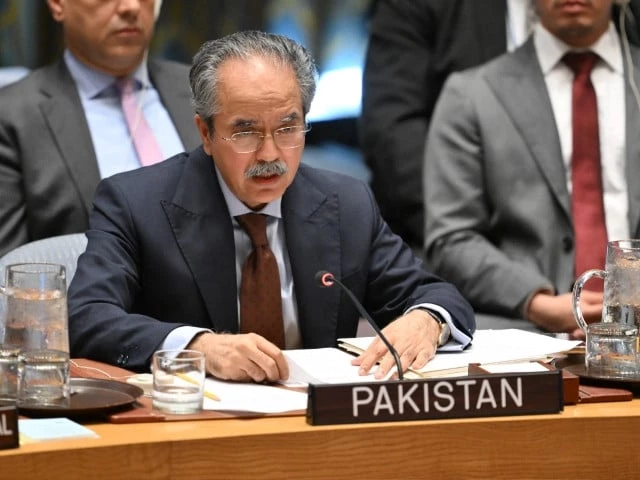
Speaking at the United Nations Security Council briefing on “The Situation in the Middle East,” Pakistan’s Permanent Representative to the UN, Asim Iftikhar Ahmad, said diplomacy consistent with the principles of the UN Charter remained the only realistic path toward de-escalation.
“Dialogue and diplomacy, consistent with the principles and purposes of the UN Charter, remain the only viable path toward de-escalation and lasting peace and stability in West Asia and the Middle East,” Ahmad told the Security Council.
Pakistan Condemns Drone Attacks on UAE and Saudi Arabia
During the session, Pakistan strongly condemned recent drone attacks targeting the Barakah Nuclear Power Plant in the United Arab Emirates and security incidents involving Saudi Arabia.
Ahmad described the attacks as unacceptable and reaffirmed Pakistan’s support for the sovereignty and territorial integrity of Gulf states.
“Pakistan stands in complete solidarity with the governments and the brotherly peoples of the UAE and KSA in the wake of these heinous attacks,” he said.
The statement came after reports that a drone struck an electrical generator near the Barakah nuclear facility, though UAE authorities confirmed there was no radiation leak or reported injuries.
Saudi Arabia later announced that it had intercepted three drones entering its territory from Iraqi airspace.
Pakistan Warns Against Attacks on Nuclear Facilities
Pakistan also expressed serious concern over attacks involving nuclear-related infrastructure, warning such incidents violated international law and global nuclear safety norms.
Ahmad told the Security Council that targeting nuclear facilities represented:
- A violation of international humanitarian law
- A breach of the UN Charter
- A threat to international nuclear safety standards
- A danger to civilian populations and regional stability
“We believe that any and all targeting of nuclear facilities constitutes a grave violation of international law,” he stated.
The remarks reflect growing international alarm over the risks associated with attacks near sensitive energy and nuclear infrastructure during the ongoing Middle East tensions.
Islamabad Expands Diplomatic Mediation Efforts
Pakistan’s envoy also highlighted Islamabad’s ongoing efforts to facilitate diplomatic engagement between regional actors amid fears that renewed conflict could spread across the Gulf and beyond.
“It is in this context that Pakistan has been making sincere efforts to facilitate diplomatic engagement between the concerned parties,” Ahmad said.
He thanked regional stakeholders, international partners, and António Guterres for supporting Pakistan’s mediation initiatives.
Pakistan has increasingly emerged as a diplomatic intermediary in recent weeks, maintaining communication with:
- Iran
- Gulf Arab states
- The United States
- International organizations
Diplomatic analysts say Islamabad’s balanced relations with multiple competing powers have positioned it as one of the few countries capable of engaging all sides simultaneously.
Regional Tensions Continue Rising
The latest UN remarks come amid continuing instability across the Middle East following:
- US-Iran tensions
- Drone attacks in Gulf states
- Naval confrontations near the Strait of Hormuz
- Nuclear-related security concerns
- Regional proxy conflicts
Security experts warn that attacks involving Gulf infrastructure could significantly threaten:
- Global oil supplies
- Maritime trade routes
- International energy markets
- Regional civilian safety
The Strait of Hormuz remains particularly sensitive because it handles a substantial share of global oil shipments.
Gulf Security Crisis Draws International Concern
The incident involving the Barakah nuclear facility has heightened concerns inside the international community due to the potential consequences of attacks near nuclear infrastructure.
Earlier this week, Rafael Grossi warned that strikes on operational nuclear facilities could result in severe radioactive consequences affecting large surrounding areas.
Pakistan’s comments at the UN align with broader international calls for restraint and urgent diplomatic engagement.
Saudi Arabia Signals Strong Security Response
Saudi Arabia’s defense ministry also warned that it would take operational measures against any attempts to violate the kingdom’s sovereignty or security.
The intercepted drones have further intensified fears that regional militias or proxy groups could expand the conflict into a broader Gulf confrontation.
Analysts say the combination of drone warfare, naval tensions, and nuclear security concerns has created one of the region’s most dangerous security environments in years.
Analysis: Pakistan Positions Itself as Regional Diplomatic Mediator
Pakistan’s latest statement at the UN reflects Islamabad’s increasingly active diplomatic role in Middle East crisis management.
Rather than aligning directly with any military bloc, Pakistan appears focused on positioning itself as a mediator advocating de-escalation, dialogue, and regional stability.
The strong condemnation of attacks on Gulf infrastructure — especially nuclear facilities — also demonstrates Pakistan’s concern about how rapidly the conflict could spiral beyond conventional military confrontation.
By emphasizing diplomacy through the UN framework, Islamabad is attempting to reinforce international legal norms while balancing relationships with both Gulf allies and Iran.
As tensions continue across the region, Pakistan’s mediation efforts may become increasingly important if major powers seek alternative channels for communication and conflict prevention.