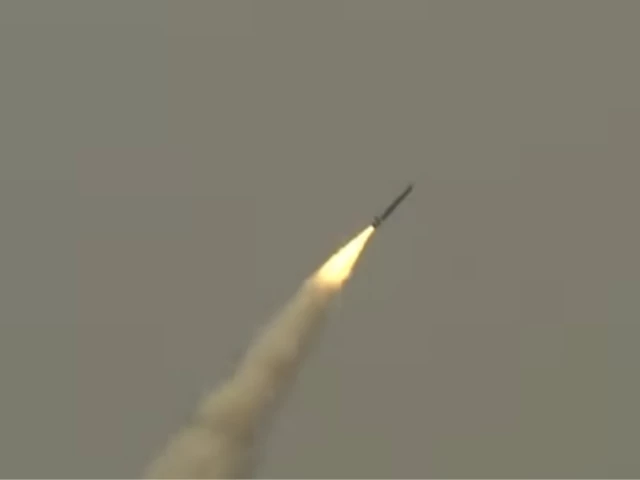
RAWALPINDI, May 14, 2026 — The Pakistan Army on Thursday successfully conducted a training fire of the indigenously developed Fatah-4 ground-launched cruise missile, the military’s media wing said in a statement .
According to the Inter-Services Public Relations (ISPR), the Army Rocket Force Command conducted the test as part of ongoing efforts to enhance operational readiness .
Advanced Capabilities
The cruise missile is “equipped with advanced avionics and state-of-the-art navigational aids” and is “capable of engaging long-range targets with high precision,” the ISPR statement said .
“The training fire was conducted to enhance the operational efficiency of troops and validate the technical parameters of various subsystems incorporated for improved accuracy and enhanced survivability,” the statement added .
Official Witnesses and Commendations
The training fire was witnessed by senior officers from the Pakistan Army Rocket Force Command, along with scientists and engineers from the developing agency .
President Asif Ali Zardari, Prime Minister Shehbaz Sharif, Chief of Defence Forces, Chief of Army Staff Field Marshal Asim Munir, Chief of Naval Staff Admiral Naveed Ashraf, and Air Chief Marshal Zaheer Ahmed Babar Sidhu commended the successful test .
The country’s leadership “appreciated the technical prowess, dedication, and commitment of all those who contributed to the success of the F-series missile training fire,” the ISPR added .
Recent Missile Tests by Pakistan
The Fatah-4 test is the latest in a series of successful missile tests by Pakistan’s armed forces in recent weeks :
April 21: Taimoor Air-Launched Cruise Missile
The Pakistan Navy conducted a successful test of the Taimoor air-launched cruise missile, an indigenously developed anti-ship weapon system described as “a powerful demonstration of precision strike capability and operational readiness” .
According to the ISPR, the missile executed its mission with “exceptional precision,” validating the Pakistan Navy’s combat capability to detect, target, and “decisively neutralise enemy sea-based threats at extended ranges” .
April 16: Ship-Launched Anti-Ship Missile
The Pakistan Navy also successfully conducted a live weapon firing of an indigenously developed ship-launched anti-ship missile, further demonstrating the navy’s operational readiness .
The Fatah Series: A Brief Overview
The Fatah series of missiles represents Pakistan’s push toward indigenously developed precision-strike capabilities. Previous tests in the series have included:
- Fatah-1 (August 2021): A multi-caliber guided rocket system with a range of 140 kilometers, capable of delivering conventional warheads with high precision
- Fatah-2 (December 2023): An extended-range variant with improved guidance systems
- Fatah-3 (October 2024): A further evolution with enhanced navigation and targeting capabilities
The Fatah-4 appears to be a cruise missile variant, distinct from the earlier ballistic/rocket systems in the series, reflecting a broadening of the program’s scope .
Strategic Context
The successful tests come amid heightened regional tensions . The ongoing war between the US-Israel alliance and Iran—now in its third month—has disrupted global energy supplies and created an unpredictable security environment across the Middle East and beyond .
While Pakistan has maintained a policy of strategic restraint, the successful testing of advanced indigenous weapons systems serves multiple purposes:
- Enhancing conventional deterrence capabilities
- Reducing reliance on foreign military imports
- Demonstrating technical self-sufficiency to regional rivals
- Validating operational readiness during a period of regional instability
Technical Specifications
While the ISPR did not disclose specific technical details about the Fatah-4’s range, speed, or warhead capacity, the statement emphasized:
| Feature | Description |
|---|---|
| Type | Ground-launched cruise missile |
| Guidance | Advanced avionics & state-of-the-art navigational aids |
| Targeting | Long-range, high precision |
| Origin | Indigenously developed |
| Purpose | Enhance operational efficiency, validate technical parameters |
The mention of “improved accuracy and enhanced survivability” suggests the missile incorporates features designed to evade enemy air defenses .
What’s Next
The successful test marks another milestone in Pakistan’s efforts to build a comprehensive, indigenous defense production capability. The Fatah-4 is expected to enter service with the Army Rocket Force Command following validation of all technical parameters .
Observers will be watching for:
- Any official disclosure of the missile’s range and payload capacity
- Potential induction timelines
- Responses from regional powers, particularly India
The test also reinforces Pakistan’s stated policy of maintaining “full spectrum deterrence,” balancing conventional and unconventional capabilities to address perceived threats from its eastern neighbor .
For more defense news, visit the Inter-Services Public Relations (ISPR) official website .