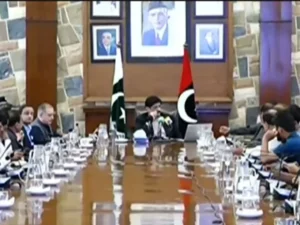
ISLAMABAD – Chief Justice of Pakistan Yahya Afridi on Monday highlighted the significance of judicial cooperation with Turkiye, stressing the role of artificial intelligence in strengthening Pakistan’s judiciary. His remarks came during a ceremony marking the signing of a judicial cooperation agreement between the Supreme Court of Pakistan and the Constitutional Court of the Republic of Turkiye in Islamabad.
The two sides signed a Memorandum of Understanding (MoU) aimed at establishing a structured framework for collaboration, focusing on judicial exchange, capacity building, and sharing best practices in adjudication.
Welcoming the Turkish delegation led by Kadir Özkaya, CJP Afridi described the MoU as a “significant step for constitutional governance and fundamental rights in both countries.”
CJP Afridi’s Remarks
Recalling his visit to Turkiye, CJP Afridi said, “I had the honour of attending the 63rd anniversary of the Constitutional Court of Turkiye. During the visit, I engaged with artificial intelligence experts and expressed my desire to bring such expertise to Pakistan. These experts also participated in our symposium.”
He further highlighted plans to familiarise Pakistani judicial officers with Turkiye’s advanced judicial system, saying, “Arrangements were made for a visit to Turkiye for our judicial officers.”
The Chief Justice emphasized that artificial intelligence could play a transformative role in Pakistan’s judicial system, potentially reducing case backlogs, improving case management, and enhancing access to justice.
Turkish Chief Justice’s Address
Chief Justice of the Constitutional Court of Turkey, Kadir Özkaya, addressed the ceremony, saying, “The justice system is a fundamental part of life. I am pleased to see that Pakistan’s judges are highly competent.”
He emphasized the shared values between the two countries, stating, “We believe in the sovereignty of Allah,” and praised the strong brotherhood between Pakistan and Turkiye.
Özkaya’s remarks highlighted the cultural and religious bonds that underpin the judicial cooperation between the two nations.
Key Attendees
The ceremony was attended by Chief Justice of the Federal Shariat Court, Justice Aminuddin Khan, Attorney General Mansoor Usman Awan, Law Minister Azam Nazir Tarar, and other senior officials.
The high-level Turkish delegation, visiting Islamabad from April 6 to 9, includes distinguished judges and senior officials.
Scope of the MoU
According to a statement issued by the Supreme Court, the MoU is expected to establish a structured and forward-looking framework for collaboration, focusing on:
- Judicial exchange: Exchange of judges and judicial officers between the two countries
- Capacity building: Training programs and professional development opportunities for judicial officers
- Best practices in adjudication: Sharing of successful approaches to case management, decision-making, and court administration
- Technology integration: Adoption of modern technologies, including artificial intelligence, to improve efficiency, transparency, and access to justice
The initiative reflects the shared commitment of Pakistan and Turkiye to strengthening constitutional governance, upholding the rule of law, and reinforcing judicial independence, as well as fostering closer institutional linkages between their superior courts.
Professional Development Focus
The MoU particularly emphasizes professional development of the judiciary at the district level, where case backlogs and resource constraints are most acute. Exposure to Turkiye’s advanced judicial system, which has successfully integrated technology into court processes, could provide valuable lessons for Pakistan’s ongoing judicial reforms.
Institutional Linkages
The agreement is expected to strengthen institutional links between Pakistan’s and Turkiye’s superior courts, creating channels for ongoing communication and collaboration beyond the initial exchange programs.
Analysis: A Forward-Looking Partnership
The judicial cooperation MoU between Pakistan and Turkiye represents a significant step in the longstanding brotherly relations between the two countries. While Pakistan and Turkiye have historically enjoyed strong political and military ties, judicial cooperation has been less developed.
CJP Afridi’s emphasis on artificial intelligence reflects a recognition that Pakistan’s judiciary must modernize to address the enormous case backlog that has plagued the system for decades. With millions of cases pending across the country, AI-powered case management systems, predictive analytics, and automated document processing could significantly reduce delays and improve access to justice.
The focus on capacity building, particularly at the district level, addresses a critical need. District judiciary officers handle the vast majority of cases but often lack access to the training and resources available to superior court judges. Exposure to Turkiye’s judicial system, which has undergone significant modernization in recent years, could provide valuable insights.
The MoU’s emphasis on sharing best practices in adjudication reflects a recognition that judicial systems face common challenges, regardless of country. By learning from each other’s successes and failures, Pakistan and Turkiye can improve their respective judicial systems more rapidly than by working in isolation.
For Pakistan, the agreement comes at a time when the judiciary faces significant challenges, including political pressure, resource constraints, and the need for technological modernization. The partnership with Turkiye offers a pathway to address some of these challenges through international cooperation.
For Turkiye, the agreement reinforces its role as a regional leader and its commitment to strengthening ties with brotherly nations. The emphasis on shared values, including belief in the sovereignty of Allah, underscores the cultural and religious bonds that unite the two countries.
As the implementation of the MoU begins, the focus will be on translating the framework into concrete outcomes. Exchange programs, training sessions, and technology transfer initiatives will need to be designed and executed effectively to realize the potential of this forward-looking partnership.