GILGIT – The Pakistan Peoples Party (PPP) has demanded that the election schedule for the Gilgit-Baltistan Assembly be issued immediately, as the election commission has yet to announce a timeline, four months after the legislature completed its tenure. General elections for the assembly were scheduled for January 24, 2026, while local government polls — announced after a gap of 20 years — were set for February 14, 2026. However, days after the announcements, both were postponed indefinitely due to harsh weather conditions in the region.
When contacted on Saturday, GB Chief Election Commissioner (CEC) Raja Shehbaz Khan said the electoral watchdog was preparing to conduct the elections but had not yet decided on a date. The CEC said the commission would inform the public of the dates when it had decided.
Multiparty Conference Stalled
The GB caretaker government had planned to convene a multiparty conference on March 24 to consult political parties about the polls, and a new schedule was expected to be issued toward the end of March. However, no development has taken place in this regard so far.
On Friday, the GB chapter of the PPP demanded that the regional CEC formally announce the general election schedule immediately. In a statement, it said that the CEC should announce the election schedule so that the political system could “function as per the constitutional requirements.”
The statement said that due to the efforts of the PPP leadership and other stakeholders, the peace and security situation in GB was “very encouraging,” adding that the weather conditions have also improved. “All political parties, including the PPP, demand that the election schedule be announced and the constitutional requirement be met by holding transparent and impartial elections on time,” it said.
Caretaker Government’s Position
When contacted by Dawn, GB’s caretaker Information Minister Ghulam Abbas said that the announcement of the election schedule was the GB election commission’s mandate. However, he added, the caretaker government would facilitate and support the GB election commission to conduct “transparent, free and fair” elections. Abbas said the election schedule would be announced by the CEC, but that he was not sure when the elections would be conducted.
Fears of Further Delay
Fourteen political parties had stood opposed to holding elections in the months of January or February due to harsh weather conditions, as many areas remained cut off from other areas amid heavy snowfall. Currently, political parties in GB are uncertain about conducting the polls before June, but fear they could be delayed until October.
It has been agreed that conducting elections during Muharram, which begins on June 15 or 16 this year, or during other religious days such as Chehlum, is not possible. Political leaders fear, therefore, that delaying elections until June may in effect cause them to be delayed till September or October.
Sources said that the local chapter of the ruling PML-N was not in favour of conducting elections during the current situation, as the party fears that fuel price hikes and other issues were not favourable for its election campaign.
Political Uncertainty
Uncertainty prevails among political parties and leaders about the assembly elections in the absence of a schedule. They said in the absence of an elected assembly, people have been facing multiple issues, and many projects and decisions were awaiting approval.
However, sources said that the election schedule announcement could be further delayed due to the recent oil price hike and March’s violent protests in Skardu and Gilgit protesting the assassination of Iran’s Supreme Leader Ayatollah Ali Khamenei in US-Israeli strikes.
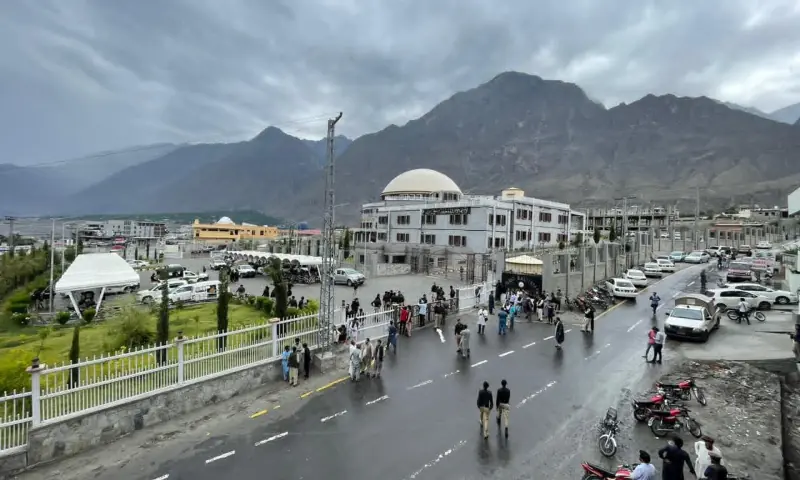
At least 20 people, including two security personnel, had died in those demonstrations, and a curfew had been imposed in both cities for several days following the incident. A judicial commission comprising three judges had initiated an inquiry into the riots. Currently, the situation is normal in the region.
However, the GB caretaker government fears the eruption of protests and a law and order situation if actions were taken against those involved in the incidents once the judicial commission completes its probe. Sources said that before the completion of the inquiry, GB elections can be delayed further to avoid a possible escalation.
Constitutional Requirements and Legal Framework
According to the 2018 Gilgit-Baltistan Order (GBO), elections must be held within 60 days following the completion of the assembly’s tenure. The assembly completed its five-year tenure on November 24, 2025, meaning that elections were constitutionally required to be held by late January 2026.
On December 12, 2025, President Asif Ali Zardari had announced January 24 as the polling day for the GB general elections. CEC Shahbaz had issued the election schedule for both GB Assembly elections, as well as the long-delayed LG polls, following the presidential order.
On December 18, after multiparty meetings and with a majority opinion among party heads, the CEC postponed the elections due to harsh weather. The CEC had said that the new polling dates for both elections would be announced later. The CEC had told the media that the schedule for both elections would be issued for the “last week of May or early June,” when the weather had normalized.
Five-Year Background
The last GB Assembly elections were held on November 15, 2020, across 24 constituencies. The PTI formed the government, and Khalid Khurshid was elected chief minister. However, in July 2023, the GB Chief Court disqualified Khurshid. Subsequently, a coalition government was formed by members of the PTI disgruntled group, the PPP, and the PML-N, which elected Haji Gulbar Khan as the new CM.
The assembly completed its five-year tenure on November 24, 2025. Subsequently, Prime Minister Shehbaz Sharif, being the GB council chairman, had appointed retired Justice Yar Muhammad as the caretaker chief minister of GB on the same day, under the “terms of Article 48-A(2) of the Government of Gilgit-Baltistan Order, 2018.”
Analysis: A Democratic Deficit
The months-long delay in holding elections in Gilgit-Baltistan represents a growing democratic deficit in the region. The constitutional requirement that elections be held within 60 days of the assembly’s tenure has been violated, and the indefinite postponement has left the region without an elected government for four months.
The PPP’s demand for an immediate election schedule reflects the frustration of political parties that have been waiting for months to campaign. The caretaker government’s inability to provide clarity on when elections might be held only adds to the uncertainty.
The concerns about weather, law and order, and the timing of religious observances are legitimate. But the repeated delays—first due to weather, then due to the March protests, and now potentially due to the ongoing judicial inquiry—suggest that the elections may be pushed back indefinitely.
For the people of Gilgit-Baltistan, the absence of an elected assembly has real consequences. Development projects are stalled. Government decisions are pending. And the democratic rights of citizens are being undermined.
As the PPP and other political parties push for an immediate election schedule, the GB Election Commission faces the challenge of balancing practical constraints with constitutional requirements. The longer the delay continues, the more the legitimacy of the caretaker government will be questioned—and the more the people of Gilgit-Baltistan will be deprived of their right to elect their own representatives.