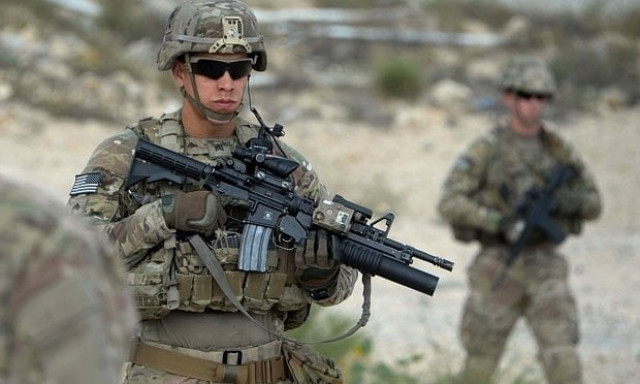
Thousands of soldiers from the United States Army’s elite 82nd Airborne Division have started arriving in the Middle East, two US officials told Reuters on Monday, as President Donald Trump weighs his next steps in the war against Iran. The deployment adds to thousands of additional sailors, Marines, and Special Operations forces already sent to the region, expanding options that could include the deployment of forces inside Iranian territory.
WASHINGTON, D.C. – The US military buildup in the Middle East is accelerating. The paratroopers, based out of Fort Bragg, North Carolina, join approximately 2,500 Marines who arrived over the weekend aboard an amphibious assault ship—the first of two contingents. The additional army soldiers include elements of the 82nd Airborne Division headquarters, logistics and support personnel, and one brigade combat team.
The officials, speaking on condition of anonymity, did not specify where the soldiers were deploying, but the move was expected. No decision has been made to send troops into Iran, but they will build up capacity for potential future operations in the region, one source said.
Kharg Island: A Strategic Target
The soldiers could be used for several purposes in the Iran war, including an attempt to seize Kharg Island—the hub for 90% of Iran’s oil exports. In an interview with the Financial Times published Sunday, Trump said he wants to “take the oil in Iran” and could seize the export hub.
When asked about the state of Iranian defense on the island, Trump said, “I don’t think they have any defense. We could take it very easily.”
Such a move would be highly risky, since Iran can reach the island with missiles and drones. However, seizing it would give the United States the ability to severely disrupt Iran’s energy trade, placing enormous pressure on Tehran’s economy.
The internal Trump administration discussions have also included potentially putting US troops inside Iran to secure safe passage for oil tankers through the Strait of Hormuz, as well as extracting highly enriched uranium from deep underground facilities.
Trump’s Dual Track: Diplomacy and Threats
As US forces pour into the region, Trump struck a dual tone. He said the US was in talks with a “more reasonable regime” to end the war, calling Iran’s new leaders “very reasonable” and expressing optimism about a deal.
“I think we’ll make a deal with them, I’m pretty sure, but it’s possible we won’t,” Trump told reporters Sunday evening.
But he also repeated his warning to Tehran to open the Strait of Hormuz or risk US attacks on its oil wells and power plants. In a social media post Monday, Trump wrote: “Great progress has been made but, if for any reason a deal is not shortly reached, which it probably will be, and if the Hormuz Strait is not immediately ‘Open for Business,’ we will conclude our lovely ‘stay’ in Iran by blowing up and completely obliterating all of their Electric Generating Plants, Oil Wells and Kharg Island.”
Rubio: US Close to Achieving Objectives
Secretary of State Marco Rubio said Washington was close to achieving its objectives in Iran “in a matter of weeks,” adding that Trump had “a number of options available” to prevent Iran from controlling the Strait of Hormuz.
During an interview with ABC News, Rubio said the US was focused on the “destruction” of Iran’s air force, navy, and weapons factories, as well as the substantial reduction in the number of missiles Iran possesses.
“All of those objectives are being met, on or ahead of schedule and should be able to achieve in a matter of weeks,” he said.
Rubio also confirmed that “there are direct messages and talks taking place between parties inside Iran and the United States, primarily through intermediaries,” while emphasizing that Trump “always prefers diplomacy and always prefers to reach a result.”
Iran Denies Direct Talks, Warns Against Humiliation
Iran’s Foreign Ministry spokesperson Esmaeil Baghaei said Monday that Tehran has “not had any direct negotiations with the US so far,” dismissing US proposals as “excessive and unreasonable requests.”
“I wonder how many people in America take the claims of American diplomacy seriously,” Baghaei said, according to the semiofficial Tasnim news agency.
“Our position is clear. We are under military aggression. Therefore, all our efforts and strength are focused on defending ourselves.”
Parliament Speaker Mohammad Baqer Qalibaf accused the US of sending messages about possible negotiations while simultaneously planning a ground invasion. “As long as the Americans seek Iran’s surrender, our response is that we will never accept humiliation,” he said.
Baghaei also said Iran’s parliament was reviewing a possible exit from the Nuclear Non-Proliferation Treaty, which recognizes the right to develop nuclear energy as long as nuclear weapons are not pursued. Trump has cited preventing Iran from obtaining nuclear weapons as a key reason for the attacks.
Israel Continues Strikes
An Israeli official said there was no intention to scale back attacks against Iran ahead of any possible talks. The Israeli military said it launched over 140 air strikes on central and western Iran over the 24 hours to Sunday evening, hitting ballistic missile launch sites and storage facilities.
Early Monday, Israeli air defenses responded to missiles launched from Iran. A chemical plant in southern Israel near Beersheba was hit by a missile or missile debris, prompting official warnings about “hazardous materials.”
Spain Closes Airspace to US Warplanes
In a significant diplomatic blow, Spain has closed its airspace to US planes involved in attacks on Iran, a step beyond its previous denial of use of jointly-operated military bases, Spanish newspaper El País reported Monday.
“This decision is part of the decision already made by the Spanish government not to participate in or contribute to a war which was initiated unilaterally and against international law,” Economy Minister Carlos Cuerpo said.
President Trump has threatened to cut trade with Madrid for denying the US use of Spain’s bases in the war.
UN Peacekeeper Killed in Lebanon
UN Secretary-General Antonio Guterres strongly condemned the killing of an Indonesian peacekeeper serving with the UN Interim Force in Lebanon (UNIFIL) amid hostilities between Israel and Hezbollah.
“This is just one of a number of recent incidents that have jeopardised the safety & security of peacekeepers,” Guterres said, calling on all parties to uphold international law and ensure the safety of UN personnel.
Economic Fallout
Iran’s effective blockade of the Strait of Hormuz has spiked oil prices and spread economic pain worldwide. Brent crude futures jumped to $115.66 a barrel, heading for a record monthly rise.
Stocks slumped in Asia, with Japan’s Nikkei index down 4.7%, as investors braced for a protracted Gulf conflict that threatens to bring a spike in inflation and the risk of recession.
Analysis: A Critical Moment
The arrival of thousands of 82nd Airborne paratroopers represents a significant escalation of US military commitment to the Middle East. While the Pentagon insists no decision has been made on ground operations, the forces being assembled give Trump the option to launch a ground offensive—whether against Kharg Island or elsewhere—with unprecedented speed.
Yet the political risks are enormous. American public support for the Iran campaign is low, and Trump’s approval ratings are already at their lowest since his return to the White House. Any use of ground troops, even for a limited mission, could further erode his standing ahead of November’s midterm elections.
The diplomatic track remains open, with Pakistan preparing to host potential talks. But the gap between the two sides appears wide. Iran’s leadership has publicly rejected humiliation and direct negotiations, while Trump threatens to “obliterate” Iran’s energy infrastructure if a deal is not reached.
As the war enters its second month, the convergence of thousands of paratroopers with a new diplomatic push creates a moment of maximum uncertainty—and maximum danger. The decisions made in the coming days will determine whether the conflict escalates into a ground war or finds a path to ceasefire.