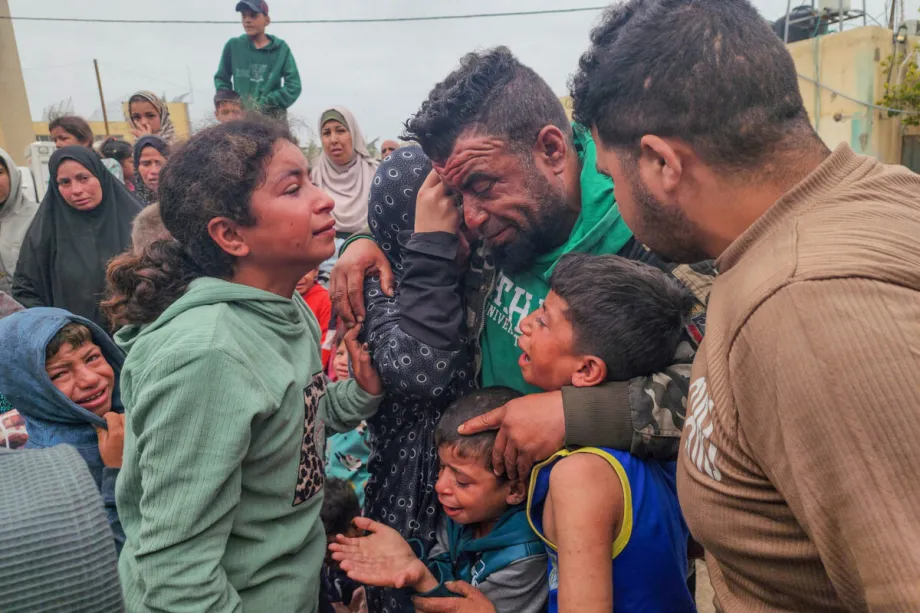
Two Palestinians were killed and a third injured early on Monday in an Israeli airstrike on the Zeitoun neighborhood, south of Gaza City, as Israeli forces continued operations across the strip, including controlled demolitions in areas east of the so-called “Yellow Line,” Anadolu Agency reported. The strikes bring the number of Palestinians killed by Israeli army fire since early Sunday to 11.
GAZA CITY – The latest violence in Gaza has claimed additional lives, with medical sources reporting that Israeli forces conducted airstrikes, artillery shelling, and controlled demolitions across multiple areas of the strip since Sunday.
Witnesses told Anadolu Agency that the Israeli army carried out controlled demolitions of buildings and facilities in areas under its control east of the so-called “Yellow Line,” east of the Tuffah neighborhood in Gaza City. Israeli artillery also shelled areas east of Deir al-Balah and Khan Younis in central and southern Gaza.
Casualties Mount
The airstrike on the Zeitoun neighborhood targeted civilians near the Asqoula junction, killing two Palestinians and injuring a third. Earlier on Sunday, medical sources reported that two Israeli airstrikes killed eight Palestinians in the Bir 19 area in the Mawasi district of Khan Younis, targeting two groups of people.
A Palestinian was also shot dead by Israeli forces near the Bani Suheila roundabout, east of Khan Younis.
Since early Sunday, a total of 11 Palestinians have been killed by Israeli army fire across different parts of the Gaza Strip.
Hundreds of Violations Since Ceasefire
The latest killings come amid a continued pattern of Israeli military activity in Gaza despite a ceasefire agreement that came into effect in October. According to Anadolu, since that agreement, Israel has carried out hundreds of violations through shelling and gunfire.
These violations have resulted in the deaths of 694 Palestinians and injuries to 1,896 others since the ceasefire was established.
Context of Ongoing Conflict
The violence in Gaza occurs against the backdrop of a broader regional war that has engulfed the Middle East since the US and Israel launched a joint offensive on Iran on February 28. While the primary focus of the conflict has shifted to Iran, Lebanon, and the Gulf states, Israeli military operations in Gaza and the West Bank have continued.
Israel has maintained that its operations in Gaza are necessary to prevent attacks and dismantle militant infrastructure. Palestinian officials and human rights organizations have condemned the continued strikes and demolitions as violations of the ceasefire agreement.
The ‘Yellow Line’ Area
The controlled demolitions east of the so-called “Yellow Line” in Gaza City represent an ongoing Israeli policy of establishing buffer zones within the strip. The “Yellow Line” refers to areas where the Israeli military has restricted Palestinian access, citing security concerns.
Witnesses reported that Israeli forces carried out demolitions of buildings and facilities in areas under their control east of the Tuffah neighborhood, expanding the zone of destruction in Gaza City.
Humanitarian Concerns
The continued military operations in Gaza have exacerbated an already severe humanitarian crisis. With infrastructure damaged and medical supplies limited, each new round of strikes adds to the burden on Gaza’s healthcare system.
The death toll since the ceasefire agreement—694 Palestinians killed—represents a significant number of casualties during what was supposed to be a period of reduced hostilities. Human rights organizations have called for international investigations into the violations.
Regional Context
The violence in Gaza cannot be separated from the wider regional conflict. Iran-backed Palestinian factions have maintained their support for Gaza-based groups, and Israeli operations in the strip are often coordinated with broader military strategies against Iranian-aligned forces across the region.
As the US-Israel war on Iran enters its second month, with thousands of US troops deploying to the Middle East and diplomatic efforts intensifying in Pakistan, the conflict in Gaza continues to claim lives on a near-daily basis.
Analysis: A Ceasefire in Name Only
The latest Israeli strikes in Gaza underscore a troubling reality: the ceasefire agreement that took effect in October has failed to halt Israeli military operations in the strip. With 694 Palestinians killed and nearly 1,900 injured since the agreement, the ceasefire exists more in name than in practice.
For Palestinians in Gaza, the daily reality remains one of airstrikes, artillery shelling, and the constant threat of demolitions. The “Yellow Line” areas represent an ongoing Israeli effort to establish permanent buffer zones, reducing the already limited territory available to Gaza’s 2 million residents.
For Israel, the operations are framed as necessary security measures to prevent attacks. But the toll on civilians—and the cumulative impact of hundreds of violations—raises questions about the viability of the ceasefire framework.
As the broader regional war continues, the conflict in Gaza is at risk of being overshadowed. But for the families of the 11 killed since Sunday, and the nearly 700 killed since the ceasefire, the war has never ended.