KARACHI – The economic fallout from the regional war is now manifesting in Pakistan’s inflation data, with the Sensitive Price Indicator (SPI)—which tracks essential commodity prices across urban centers—showing a significant pickup in price pressures. According to data released by the Pakistan Bureau of Statistics (PBS), prices of 23 out of 51 essential items increased during the week, signaling a broad-based rise that is hitting consumers across income groups.
The 8.24% year-on-year increase represents a sharp acceleration from earlier months when inflation had shown some signs of moderation. The data confirms that the combination of domestic energy adjustments and external shocks from the Middle East conflict is now feeding directly into household expenses.
Food Prices Drive Weekly Inflation
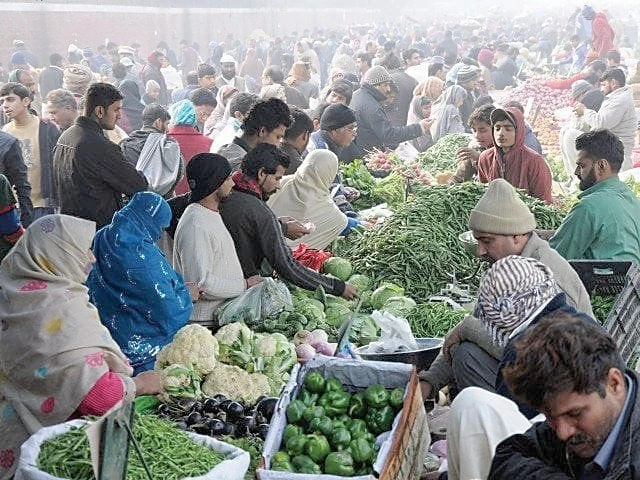
Food items remained the primary driver of weekly inflation, with staple commodities seeing dramatic price hikes. Onion prices surged by more than 18% in a single week, while tomatoes increased by over 11%. Potatoes rose by 8%, and chicken prices climbed approximately 8.7%. Eggs, garlic, mutton, and beef also recorded increases, adding to the burden on family budgets.
The timing of these increases is particularly significant. Coming just after the conclusion of Ramazan, when demand typically remains elevated, the price surge suggests that underlying supply chain pressures—exacerbated by the regional conflict—are now becoming entrenched.
On a year-on-year basis, the inflation trend is even more pronounced. Wheat flour prices rose by approximately 25.76%, while onions increased by more than 25%. Red chilli prices jumped by over 15%. Meat prices remained persistently high, with beef up 13% and mutton increasing by 12.41% compared to the previous year.
Energy Costs Compound the Crisis
Energy prices recorded even sharper annual increases, reflecting the impact of surging global oil prices driven by the closure of the Strait of Hormuz. Liquefied Petroleum Gas (LPG) surged by nearly 35% year-on-year, while diesel prices rose by approximately 30%. Gas charges increased by close to 30%, and petrol prices climbed by 25.75%.
On a weekly basis, LPG prices rose by more than 10%, while electricity charges increased by over 6%. These energy price adjustments, necessitated by the government’s efforts to manage the fiscal impact of higher import costs, are now feeding directly into household expenses and contributing to the broader inflationary pressure.
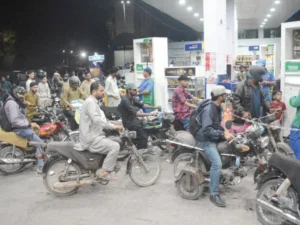
For the government, the energy price increases represent a difficult balancing act. Pakistan has already provided Rs69 billion in petrol and diesel subsidies over the past two weeks, and a new mobile app-based targeted subsidy system is being rolled out to support two- and three-wheeler owners. However, the scale of the price increases—LPG up 35% annually, petrol up 26%—threatens to overwhelm the capacity of targeted subsidy programs.
Regional Spillover Effects
The inflation data reflects the growing spillover effects of the Middle East conflict that began with US-Israeli strikes on Iran on February 28. The closure of the Strait of Hormuz has driven global oil prices above $100 a barrel, and the disruption to shipping routes has affected the prices of imported food commodities as well.
Iraq’s oil production has been slashed from 3.3 million barrels per day to just 900,000 barrels, further tightening global supply. The US has reported billions of dollars in military equipment losses in the conflict, and in Lebanon, Israeli strikes have displaced more than one million people, disrupting regional stability and supply chains.
For Pakistan, which imports the vast majority of its oil needs and relies on regional trade routes for essential commodities, the conflict’s spillover effects are now impossible to ignore. The SPI data confirms that the economic impact of the war is being felt not only in global energy markets but directly in the prices Pakistani households pay for food and fuel.
Disproportionate Impact on Lower-Income Households
A breakdown by income groups reveals that inflation continues to affect lower-income households disproportionately. The lowest income group—earning up to Rs17,732 per month—recorded a 7.02% annual increase in the cost of essential items. The second income group saw the highest rise at 8.76%, while other income brackets experienced inflation ranging between 7.15% and 7.64%.
The data confirms that while inflation is universal, its burden is not evenly distributed. Lower-income households spend a larger share of their budgets on food and energy—precisely the categories that have seen the sharpest price increases. For families already struggling to make ends meet, the combination of higher food costs and surging energy prices threatens to push basic necessities beyond reach.
Government Response
The government has been racing to implement measures to mitigate the impact of rising prices. The mobile app-based fuel subsidy system, finalized in recent days, will deliver targeted petrol subsidies to two- and three-wheeler owners through digital vouchers and QR code verification. The system is being fast-tracked to maintain uniform implementation and prevent discrepancies across retail outlets.
The federal government is also finalizing a proposal for a nationwide one-day weekly lockdown to conserve fuel, while Sindh has already implemented austerity measures including a 60% reduction in official vehicle fuel consumption and is considering smart lockdowns. Educational institutions in Sindh have been closed through March 31, and government offices are observing work-from-home on Fridays.
However, these measures—while necessary—are designed to manage demand rather than address the underlying supply shocks driving inflation. As long as the Strait of Hormuz remains disrupted and global oil prices stay elevated, Pakistan’s inflation outlook will remain heavily influenced by events beyond its borders.
Diplomatic Efforts
Pakistan’s diplomatic machinery is engaged in parallel efforts to address the broader energy challenges. Prime Minister Shehbaz Sharif has formally offered to host US-Iran talks in Islamabad—an offer that President Donald Trump reposted on his Truth Social platform, signaling Washington’s openness to the initiative. France and the G7 have expressed support for Pakistan’s mediation role.
The ministries of finance and foreign affairs are also engaged in parallel diplomatic efforts involving Iran and Saudi Arabia to manage broader energy supply challenges. Any resolution to the regional conflict that reopens the Strait of Hormuz and stabilizes oil prices would provide immediate relief to Pakistan’s inflation outlook.
Analysis: The Cost of War
Pakistan’s SPI data for the week ending March 26 provides a stark illustration of how regional conflicts impose economic costs far beyond the battlefields where they are fought.
For the 8.24% year-on-year increase recorded in the index, the proximate causes are clear: global oil prices driven up by the closure of the Strait of Hormuz; supply chain disruptions affecting imported food commodities; and domestic energy adjustments that reflect the higher cost of imports. But the underlying cause is a regional war that Pakistan did not choose and cannot control.
The burden of that war is now being distributed across Pakistani households—in the price of onion and tomatoes, in the cost of LPG and petrol, in the electricity bills that arrive at the end of the month. For the lowest-income households, those earning less than Rs18,000 per month, the 7.02% increase in essential item costs represents a significant reduction in real purchasing power.
The government’s targeted subsidy programs offer some relief, but they are a stopgap measure rather than a solution. The mobile app-based system for two- and three-wheelers, while innovative, can only reach a fraction of those affected. The proposed weekly lockdowns and fuel conservation measures may reduce demand, but they also impose their own costs on economic activity and household well-being.
As the SPI continues to climb, the political and economic pressures on the government will intensify. The public’s tolerance for rising prices, already strained by years of inflation, will be further tested. And the diplomatic efforts to resolve the regional conflict will take on new urgency—not only for the lives at stake in the Middle East but for the economic stability of countries like Pakistan that are caught in the war’s widening circle.
For now, the data tells a simple story: prices are rising, households are suffering, and the end is not yet in sight. The war’s spillover effects, once a distant concern, are now a daily reality for millions of Pakistanis.