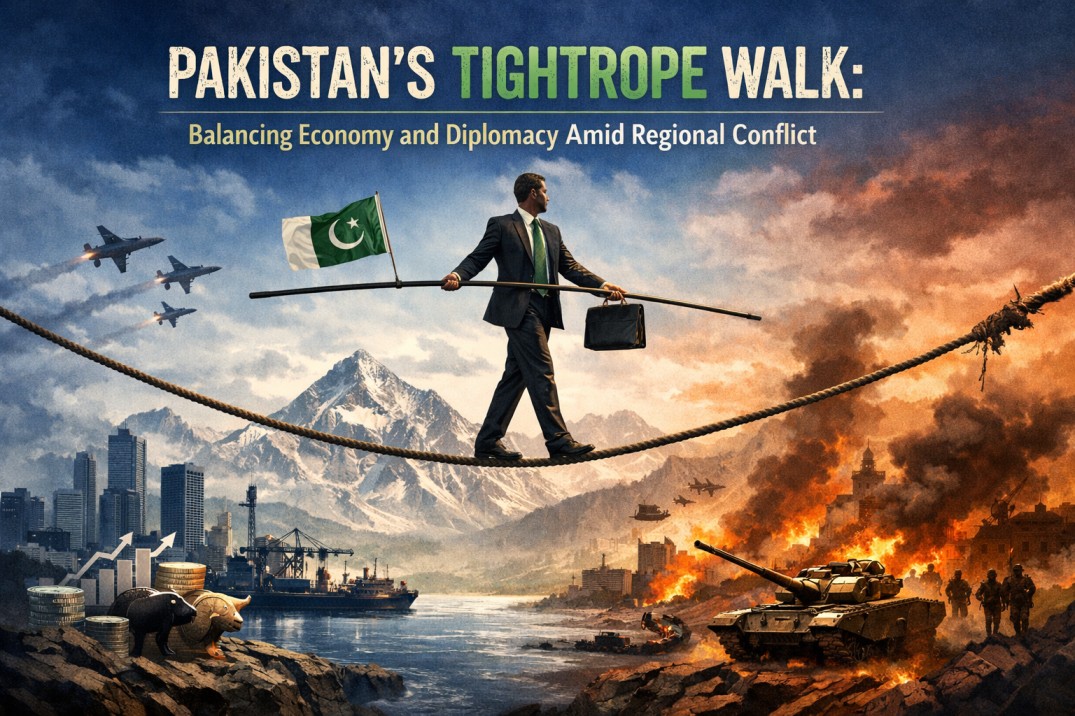
As conflict intensifies in the Middle East, Pakistan finds itself at the center of diplomatic conversations and geopolitical maneuvering.
While Islamabad has received praise for its engagement in regional discussions, it is also facing increasing pressure — both domestically and internationally. The country is effectively walking a tightrope, trying to balance economic instability with complex foreign policy demands.
This balancing act is becoming increasingly difficult as global uncertainty rises, particularly around oil prices and regional security.
Economic Fragility at the Core
Pakistan’s biggest challenge remains its fragile economy.
With limited financial buffers and reliance on external support, the government faces constant pressure to manage inflation, stabilize the currency, and maintain public confidence. Much of this pressure is linked to ongoing negotiations with the International Monetary Fund.
Economic experts warn that Pakistan has little room to absorb shocks, especially if global oil prices continue to rise or if external funding becomes uncertain.
At the same time, the government is grappling with declining public trust, making economic decision-making even more sensitive.
Petrol Price Crisis and Policy Confusion
One of the clearest examples of this struggle has been the government’s handling of petrol prices.
Initially, authorities moved quickly to raise fuel prices by Rs55 in response to rising international costs. The decision was defended as necessary, given global market conditions.
However, the strategy soon shifted.
Prime Minister Shehbaz Sharif later announced that the government would temporarily absorb the price increase, effectively offering a subsidy to consumers.
This created confusion in the market and among the public.
In the following weeks:
- The government attempted to share the financial burden with provincial administrations
- Officials admitted the subsidy could not continue indefinitely
- Multiple meetings were held to explore alternative solutions
Then came a sudden reversal. In a late-night announcement, ministers declared another sharp increase in fuel prices — even higher than the initial hike.
Within 24 hours, the prime minister returned to television to announce a reduction in prices, citing cuts in fuel taxes.
Public Reaction and Governance Concerns
The rapid policy shifts triggered widespread criticism.
Many observers accused the government of indecisiveness and poor planning, arguing that such reversals undermine economic stability and public trust.
Officials defended their actions by claiming that tax reductions required approval from the International Monetary Fund. However, this explanation has not fully convinced critics.
The episode also exposed deeper structural issues, including:
- A narrow tax base
- Heavy reliance on indirect taxes
- Limited fiscal space for subsidies
Even within government circles, questions are being raised about accountability and decision-making processes.
Risk of Economic Shock and Social Unrest
As inflation continues to rise, there are growing fears that further economic shocks could trigger public unrest.
Fuel prices, in particular, have a direct impact on daily life — affecting transportation, food costs, and overall living expenses.
Analysts warn that:
- Rising inflation could weaken purchasing power
- Export performance may decline
- Balance-of-payments pressures could increase
In such a scenario, even a small economic shock could have significant social and political consequences.
Authorities appear to be aware of this risk, as evidenced by their strong responses to even minor protest movements.
Diplomatic Balancing Act Intensifies
Pakistan’s challenges are not limited to domestic issues.
On the international stage, Islamabad is trying to maintain relationships with multiple global and regional players — each with its own expectations.
These include:
- The United States and international financial institutions
- Gulf countries such as the United Arab Emirates and Saudi Arabia
- Neighboring Iran
Balancing these relationships is becoming increasingly complex, particularly as regional tensions escalate.
UAE Loan Controversy and Gulf Relations
A recent development highlighting these challenges is the issue of a longstanding loan from the United Arab Emirates.
Reports suggest that Pakistan may return a loan dating back to the 1990s, as the UAE is no longer interested in extending it.
This move is being interpreted by some analysts as a reflection of changing dynamics in Pakistan-Gulf relations.
There are concerns that:
- Gulf countries may be unhappy with Pakistan’s neutral stance in regional conflicts
- Economic support from these countries could become less reliable
- Diplomatic tensions could have financial consequences
Given Pakistan’s reliance on Gulf partnerships for remittances, investment, and financial assistance, any strain in these relationships could have serious implications.
The Iran Factor and Regional Sensitivities
Pakistan’s relationship with Iran adds another layer of complexity.
Maintaining balanced ties with Iran is important not only for regional stability but also for domestic considerations, including sectarian harmony.
However, this balancing act comes with risks:
- Aligning too closely with Iran may upset Gulf allies
- Distancing from Iran could create internal tensions
Additionally, uncertainty surrounding the political future in Tehran adds further unpredictability.
Global Pressures and Strategic Uncertainty
As the Middle East conflict evolves, global powers — including the United States — may reassess their strategic positions.
Any shift in international expectations could place additional pressure on Pakistan’s foreign policy.
For Islamabad, the challenge is clear:
- Maintain neutrality where possible
- Protect economic interests
- Avoid alienating key allies
This requires careful diplomacy at a time when global tensions are already high.
Pakistan’s current situation reflects a delicate balancing act — one that spans both economic management and foreign policy.
With rising inflation, inconsistent policy decisions, and complex diplomatic pressures, the government faces a difficult path forward.
The ongoing regional conflict has only intensified these challenges, making stability harder to achieve.
For Pakistan, the stakes are high. The longer the conflict continues, the more difficult it will be to maintain balance — both at home and abroad.
In such uncertain times, one thing is clear: navigating this tightrope will require not just strategy, but consistency, clarity, and resilience.
FAQ
Why is Pakistan facing an economic crisis?
Pakistan is dealing with high inflation, a weak currency, and reliance on external financial support, especially from the IMF.
What caused the petrol price crisis in Pakistan?
Fluctuating global oil prices and inconsistent government policies led to multiple changes in fuel pricing.
How does the Middle East conflict affect Pakistan?
The conflict impacts oil prices, trade, and Pakistan’s diplomatic relations with key regional partners.
Why are Pakistan’s relations with Gulf countries important?
Gulf countries provide financial support, investment, and employment opportunities for Pakistani workers.