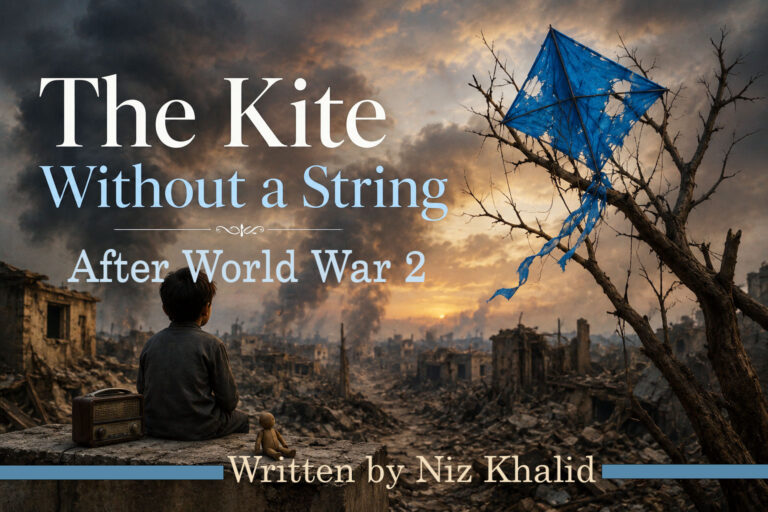
Based on true story of Rukhsana bibi
_
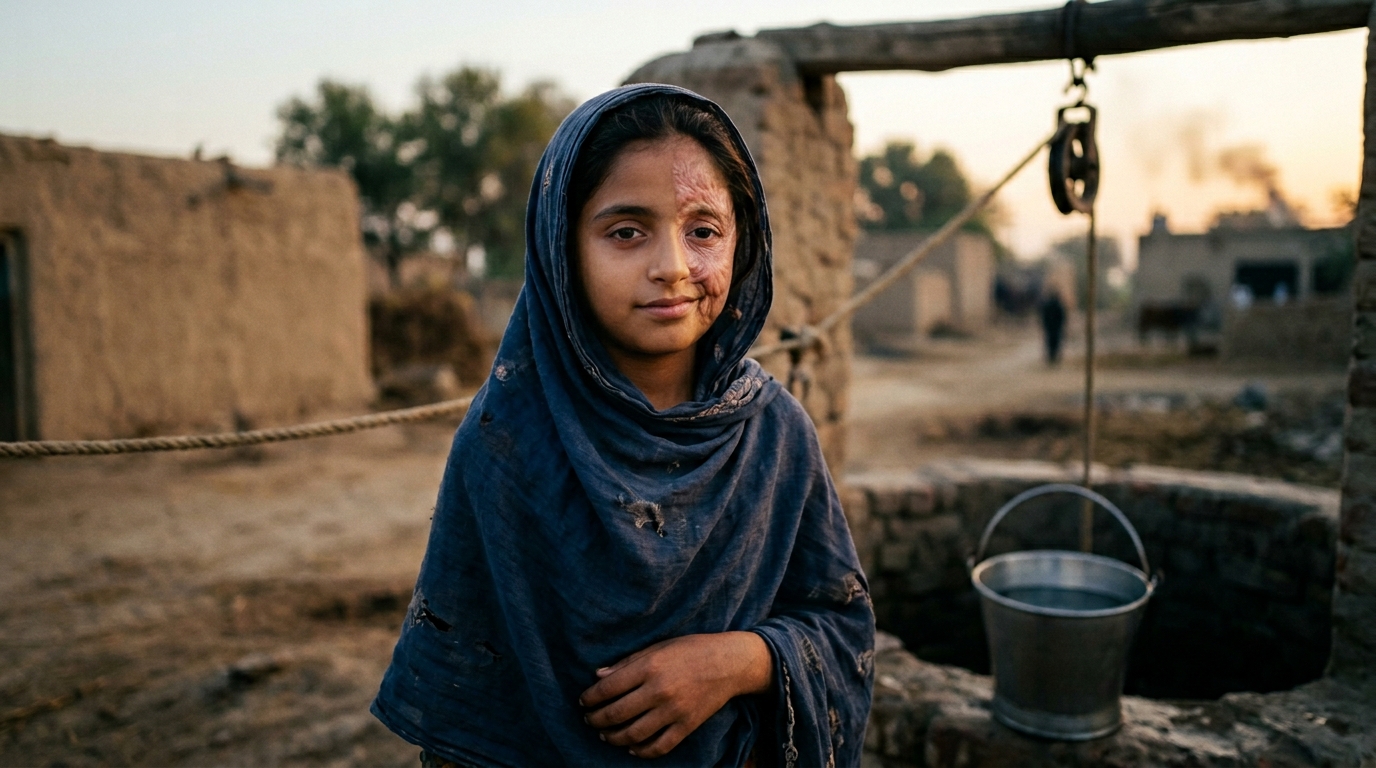
In the village of Noorpur, everyone knew Rukhsana by two things: the burn scar that pulled her left cheek tight, and the fact that her family owned nothing but a leaking roof and three goats.
She was four when the kerosene stove tipped. The fire caught her left side first and left her with a map nobody wanted to read.
The scar started at her temple and dragged her left eye down at the corner, so she always looked half-asleep on that side. It ran across her cheekbone in thick, ridged skin that never tanned, only turned pink in the sun. It tugged at her mouth, so her smile was crooked — higher on the right, barely there on the left. Her left ear was mostly a nub of cartilage. The burn traveled down her neck, over her collarbone, and stopped just above her left breast. The skin there was tight, shiny, like melted plastic. In summer it itched. In winter it cracked. Her left arm couldn’t straighten all the way. The elbow had fused slightly as it healed, so her hand always sat a little bent, like she was holding something invisible.
Kids are honest. That’s the problem. At six, a boy at the well pointed and said, “Don’t let the Bhutto touch the water, she’ll curse it.” Ghost. The name stuck.
They called her ghost for three reasons, and none were fair. Her scar caught shadows wrong, and in a village that believed in fire spirits, her half-closed eye looked dead. She moved quiet, turned her whole body to hear, and came to the well at 4 AM when only shadows were out. “She moves like a bhutto,” the women said. But mostly, the name was permission. If you call someone a ghost, you don’t have to give them water first. You don’t have to imagine they get hungry. Ghosts don’t count.
So she stopped going when others were there. School lasted three months. The teacher sat her in the back. One day she came home with ink thrown on her scarf — right over the scar. Her father didn’t say anything. He just took her to the river the next day and taught her knots.
“Fingers don’t need to be pretty,” he said, showing her how to weave a broken net. “They need to be clever.”
And hers were. While other girls learned to braid hair, she learned to braid rope, to split kindling with one good arm, to carry two water pots balanced on her hip because her left shoulder couldn’t take the weight. She grew up thin, but not weak. Rope-muscled. Her ribs showed because food was scarce, not because she was frail. Her feet were wide and hard from going barefoot — shoes were for weddings, and nobody thought she’d have one.
At twelve she stood in the pond and looked. A ghost, they said. She saw a girl with one bright eye and one sleepy eye. A girl with a jaw that didn’t line up. A girl whose own skin had decided to pull itself into a frown.
That night she went to the roof. The power was out, as usual. She lay back and found Orion. Then the Dipper. Then a star she didn’t know the name for, so she named it herself: Ammi. She counted 217 stars before she fell asleep.
No one could take that from her. Not the fire. Not the whispers. Not the well.
When she was sixteen, the river Betwa flooded. It happened fast. Three villages upstream were gone before the warning sirens even sounded in Noorpur. The bridge collapsed. Phones were dead. The only way to warn the town of Jhangar, 12 miles downstream, was to cross the old railway trestle. It was half broken, with gaps wide enough to swallow a man.
The headman looked at the men. They looked at the water. No one stepped forward.
Rukhsana did. She wasn’t brave. She just knew how to count. She’d spent years watching trains from that trestle, memorizing which sleepers were rotten, which gaps a goat could jump. She knew the pattern like she knew the stars.
“Give me your torch,” she told the headman. “And tell Jhangar I’m coming.”
The rain that night wasn’t falling. It was attacking. A solid roar on the tin roofs, like someone pouring gravel from the sky. On the river, it hit so hard it bounced back up as mist, so the Betwa looked like it was boiling. Thunder didn’t roll — it cracked right overhead and left her ears ringing.
The water didn’t fall straight. Wind shredded it sideways. It came under doorframes, down her collar. In ten minutes, dirt paths turned to ankle-deep sludge that sucked your sandals off. After an hour, that sludge became fast streams strong enough to knock over goats. The air got so thick with water she breathed it in. Her lungs felt wet.
The cold was the worst. This wasn’t summer rain. Soaked for hours, with wind cutting across the river, her body temp dropped fast. Fingers went numb and clumsy. Lips turned blue. Teeth chattered so hard she bit her tongue. She couldn’t feel the splinters in her palms because the cold took the skin first.
There was no light. Clouds sat so low they scraped the hills. At 2 AM there was no moon, no stars, no village lights — the power died first in floods. Only lightning. For one second it turned everything white: she’d see each raindrop frozen midair, the river climbing the banks, the skeleton of the broken trestle ahead. Then black again, darker than before.
The smell was wet earth, torn leaves, and something metallic from the swollen river. Sewage from flooded latrines. Ozone after lightning. And kerosene from overturned lamps in houses that were already gone.
The first twenty sleepers were easy. She knew them. Then she hit the gap. Three sleepers missing. A space wide enough to drop a buffalo. The wind came up through it and tried to peel her off the track. She pressed her forehead to the wet iron rail. Not to pray. To listen. The rail hummed. A vibration from deep water hitting the pillars. If the pillar went, she went.
She backed up two steps. The torch beam caught the edge of her burn scar — it had split open again on a nail. Blood and water ran into her mouth. She tasted metal.
“Count,” she told herself. Same as the stars. “One. Two. Three.”
She ran. Her bare foot landed half on, half off the next sleeper. Pain shot up her ankle. She dropped the torch. It wedged between two rails, still on, pointing straight down into the black water like a finger.
For ten seconds she couldn’t breathe. Then she crawled, grabbed the torch, and kept going.
At the halfway point came the teeth — where the ties were rotten, splintered up like a broken jaw. She had to test each one with her hand before putting weight on it. Left hand, right foot. Right hand, left foot. Like mending nets. Slow, clever fingers.
That’s when she heard it — not thunder. A train whistle, far off. Someone upstream had sent an engine to try the bridge. Fools. She screamed “No!” but the river ate the sound.
So she stood up on the teeth, waving the torch in wide circles. The beam was weak, but she was the only light for miles. Back and forth. Until the distant headlight stopped. Then reversed.
Her legs gave out after that. She crawled the last two hundred meters.
When solid ground finally hit her knees, she didn’t cry. She looked at her hands. Torn, bleeding, shaking. The same hands the women at the well wouldn’t touch.
She stood up. She still had three miles to run. Barefoot, because the river had taken her sandals.
She reached Jhangar at 3:17 AM. Because of her, 2,400 people evacuated before the water hit. Jhangar still stands.
The news cameras came later. They wanted to call her “the ugly girl who saved a town.” She stopped them.
“My name is Rukhsana,” she said, looking straight at the lens with her scarred face. “And I can count.”
The government gave her the Sitara-e-Shujaat. She used the prize money to build a school in Noorpur. Not for pretty children or rich children. For the ones who get called ghosts.
Today, there’s a statue of her in Jhangar. Not of a beauty queen. Of a thin girl with a scar, holding a torch, mid-step over a broken bridge. The plaque doesn’t mention her face. It says: Rukhsana Bibi – She counted, so we could live.
And in Noorpur, no one calls her Bhutto anymore. If a child tries, an elder will answer: “That’s Rukhsana Bibi. Say her name right.”
Written By : Niz Khalid