



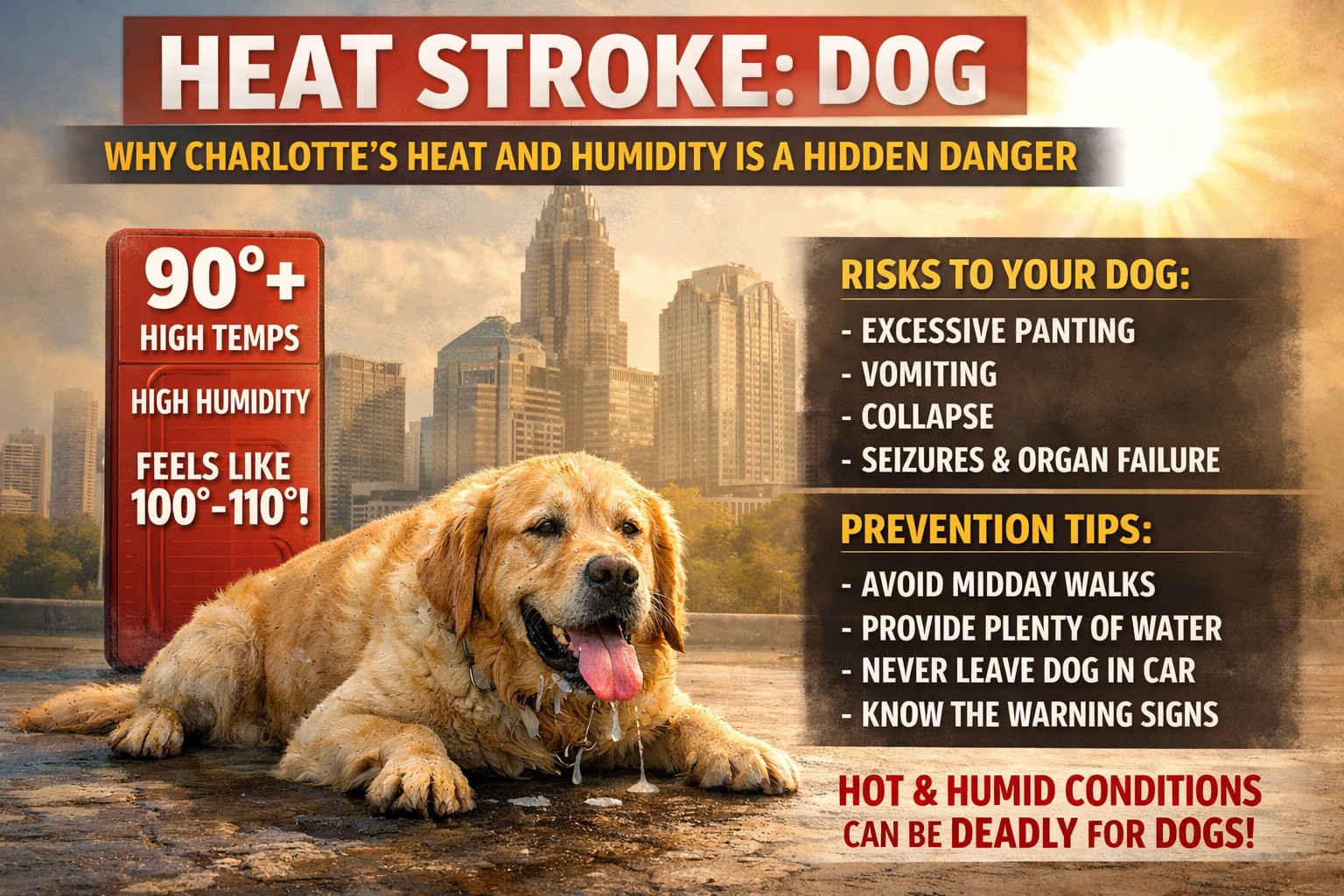
Living in the South means we share our lives with two constants: our beloved pets and the notoriously hot and humid Charlotte weather. While we often focus on external threats like fleas and ticks, we cannot overlook the environmental dangers right outside our door. The combination of high temperatures and thick humidity creates a perfect storm that can turn a simple walk into a life-threatening emergency.
While no dog should be outside for extended periods of time during this type of weather, it is critical to understand that specific breeds are especially prone to the heat and humidity. Heat stroke in dogs is not just about getting too hot; it is a condition of rapid, severe hyperthermia where the body’s temperature rises above 104°F (40°C), leading to systemic organ failure and death if not treated immediately.
Why Charlotte Weather is a Unique Challenge
Unlike dry heat, where dogs can cool themselves efficiently through panting and evaporation, humidity cripples their primary cooling mechanism. When the air is already saturated with moisture, the evaporation of water from a dog’s tongue and respiratory tract slows down significantly. This means that even on a day that doesn’t feel “scorching” to you, your dog could be overheating internally without any relief.
The asphalt and pavement in Charlotte amplify this danger. On an 85°F day, the pavement temperature can soar to 140°F. Not only does this burn your dog’s paw pads, but the radiant heat rising from the ground increases their core body temperature much faster than the ambient air temperature would suggest.
Brachycephalic Breeds: The “Especially Prone”
When discussing pets and heat sensitivity, the conversation must start with brachycephalic breeds—those lovable flat-faced dogs with shortened snouts. This includes popular breeds like:
- Bulldogs (English and French)
- Pugs
- Boxers
- Boston Terriers
- Shih Tzus
- Pekingese
These dogs are especially prone to heat stroke because they suffer from Brachycephalic Obstructive Airway Syndrome (BOAS). Their shortened airways, elongated soft palates, and narrowed nostrils make it physically difficult for them to move enough air to cool themselves down. They simply cannot pant efficiently.
For a Bulldog or a Pug, a mild walk on a humid Charlotte afternoon is the equivalent of a human trying to exercise while breathing through a thin straw. They overheat quickly, and because they cannot facilitate the air exchange needed for cooling, their temperature rises dangerously fast.
It is not just the flat-faced breeds, however. Other dogs that struggle include:
- Thick-coated breeds: Huskies, Malamutes, and German Shepherds have double coats designed for cold weather, not Carolina summers.
- Overweight or obese dogs: Excess fat acts as insulation, trapping heat inside the body.
- Senior dogs and puppies: Their bodies are less efficient at regulating temperature.
- Giant breeds: Newfoundlands and Great Danes generate immense body heat just by moving.
Recognizing the Signs of Heat Stroke
Heat stroke comes on fast, but it rarely happens without warning. You must watch for the early signs, which include:
- Excessive Panting: This goes beyond normal “doggy breathing.” It is loud, frantic, and distressed.
- Thick, Sticky Saliva: As dehydration sets in, the saliva becomes ropy and excessive.
- Bright Red Gums and Tongue: The body diverts blood flow to the surface in an attempt to cool down.
- Lethargy and Weakness: Your dog may stagger, seem disoriented, or refuse to stand.
- Vomiting or Diarrhea: Often a sign of internal distress.
- Collapse or Seizures: This indicates the heat stroke has reached a critical, life-threatening stage.
Immediate First Aid and Prevention
If you suspect your dog is suffering from heat stroke, you must act immediately.
Do not use ice-cold water. While it seems logical, extreme cold causes blood vessels to constrict, which can actually trap heat inside the body and can send the dog into shock. Instead, use cool (not cold) water. Place your dog in front of a fan, run cool water over their paws, belly, and head, and offer them small amounts of cool water to drink. Then, get to the nearest veterinarian immediately.
Prevention is always better than treatment.
- Walk Early or Late: Avoid the peak heat hours of 10 a.m. to 4 p.m.
- Test the Pavement: Place the back of your hand on the asphalt for 5 seconds. If it is too hot for you, it is too hot for your dog.
- Provide Water Constantly: Never leave home without a collapsible bowl and a bottle of fresh water.
- Know Your Breed: If you own a Bulldog or Pug, treat summer walks like a medical condition. Limit them to 5-10 minutes for bathroom breaks only, and save the exercise for air-conditioned indoor spaces.
Understanding the risks of the Charlotte climate is just as vital as understanding the risks of parasites. By staying vigilant and adjusting your routine to respect the heat, you can ensure your dog enjoys a long, safe, and happy life by your side.






I love pets. dog should be outside for extended periods of time during this type of weather, it is critical to understand that specific breeds are especially prone to the heat and humidity. Heat stroke in dogs is not just about getting too hot; it is a condition of rapid, severe hyperthermia where the body’s temperature rises above