



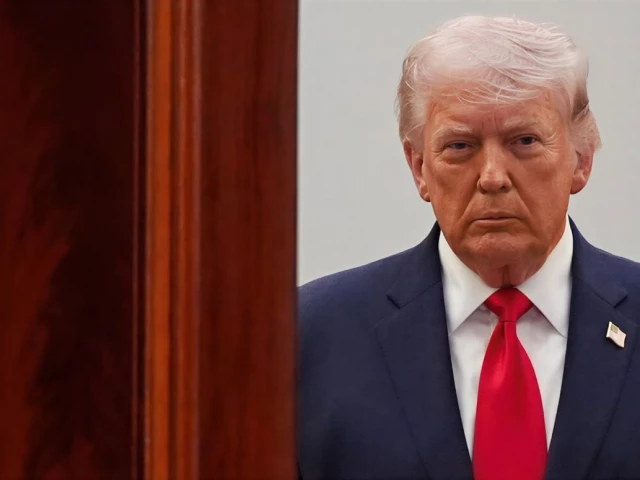
WASHINGTON – US President Donald Trump said on Wednesday that US military ships and aircraft will remain around Iran and threatened that the US will start “shooting” again unless Tehran fully complies with the deal reached with Washington. “All US Ships, Aircraft, and Military Personnel, with additional Ammunition, Weaponry … will remain in place in, and around, Iran, until such time as the REAL AGREEMENT reached is fully complied with,” Trump said on his Truth Social platform.
“If for any reason it is not, which is highly unlikely, then the ‘Shootin’ Starts,’ bigger, and better, and stronger than anyone has ever seen before,” the president added.
Iran’s Position on Talks
Iran had said earlier on Wednesday that it would be “unreasonable” to proceed with talks to forge a permanent peace deal with the United States after Israel pounded Lebanon with its heaviest strikes yet, killing hundreds of people. The two sides appeared to be far apart on Iran’s nuclear program, with Trump saying Iran had agreed to stop enriching uranium, and Iran’s parliament speaker, Mohammad Bagher Qalibaf, saying it was allowed to continue enriching uranium under the terms of the ceasefire.
“It was agreed, a long time ago, and despite all of the fake rhetoric to the contrary – NO NUCLEAR WEAPONS and, the Strait of Hormuz WILL BE OPEN & SAFE,” Trump added in his late Wednesday Truth Social post.
The Two-Week Truce
Iran and the US announced a two-week truce on Tuesday aimed at paving the way for a final agreement to end the war launched by the United States and Israel against Iran on February 28, which has left many dead and wounded. The announcement came less than two hours before the expiration of a deadline that Trump had repeatedly extended for Iran to reopen the Strait of Hormuz and accept an agreement or face “the destruction of an entire civilisation.”
Lebanon Fractures the Deal
The deal’s fractures emerged quickly as Israel carried out the heaviest strikes on its neighbour — including in densely packed central Beirut — since the Iran-backed militant group Hezbollah joined the war in early March. At least 182 people were killed and nearly 900 wounded on Wednesday, the Lebanese Health Ministry said.
Amnesty International’s regional director for the Middle East and North Africa, Heba Morayef, said that the “nightmare for civilians has become more terrifying” in Lebanon, “just hours after the world cautiously welcomed news of a US-Israeli ceasefire with Iran.”
“Civilians in Lebanon are already paying an unbearable price with children, health workers and journalists amongst those killed – the latest attacks will only escalate this devastating human toll,” Morayef said.
Israel’s Position
Israel said its battle against Hezbollah was not part of the US-Iran truce agreed late Tuesday, an argument echoed by US Vice President JD Vance, days before he is due to lead talks with Tehran in Pakistan. “If Iran wants to let this negotiation fall apart… over Lebanon, which has nothing to do with them, and which the United States never once said was part of the ceasefire, that’s ultimately their choice,” he said.
But Iran’s parliament speaker Mohammad Bagher Ghalibaf appeared to threaten the ceasefire, posting on X that the “workable basis on which to negotiate” had already been violated, making further talks “unreasonable.”
Disagreement on Terms
Adding to the fragility of the truce, agreed hours before a deadline set by Trump, a senior US official said Iran’s 10-point plan was not the same set of conditions the White House had agreed to in order to pause the war.
Humanitarian Crisis in Lebanon
In Lebanon, where UN rights chief Volker Turk called the scale of killing “horrific,” strikes across the capital Beirut without warning triggered scenes of horror and panic. More than 1,700 people have been killed in Lebanon since Israel launched airstrikes and a ground invasion last month, local officials said.
Analysis: A Fragile Truce
The US-Iran ceasefire, brokered by Pakistan, was always fragile. But its near-immediate fracturing over Lebanon demonstrates the difficulty of separating conflicts that have become intertwined. Iran views Hezbollah as a strategic ally and an attack on Lebanon as an attack on its interests. Israel views Hezbollah as an existential threat and has made clear that its operations in Lebanon are not subject to the US-Iran agreement.
Trump’s threat to resume “shooting” if Iran fails to comply with the deal puts Tehran in a difficult position. Iran can either accept Israeli strikes on Hezbollah — a key ally — or risk the collapse of the ceasefire and the resumption of full-scale war with the United States.
The disagreement over Iran’s nuclear program is equally problematic. Trump says Iran agreed to stop enriching uranium; Iran’s parliament speaker says enrichment is permitted under the terms of the ceasefire. This fundamental contradiction suggests that the two sides may have agreed to different things — or that the terms were deliberately left ambiguous to secure the truce.
For Lebanon, the timing is devastating. Just as the world welcomed news of a ceasefire, Israeli strikes killed hundreds. For the families of the victims, the “peace” was a cruel illusion.
As US and Iranian officials prepare to meet in Islamabad, the odds of reaching a permanent deal appear slim. The ceasefire may hold for two weeks, but the underlying issues — Iran’s nuclear program, the Strait of Hormuz, and the role of proxies like Hezbollah — remain unresolved. And Trump’s threat to resume shooting is a reminder that the alternative to diplomacy is war.




One thought on “Trump Says ‘Shooting’ Will Resume if Iran Fails to Uphold Ceasefire”